As the golden chariot rolls smoothly along a sun-dappled forest path, Kaikeyi is thinking about what Dasaratha said earlier.
Kaikeyi: Maharaj, while your Forest Intelligence Network is brilliant, something you said earlier is bothering me. You spoke of humans using metal eyes on poles (CCTV cameras) and metal birds (drones) in the 21st century. Metal has no life or brain. How can a machine “watch” or “understand” a human or an animal?
Dasaratha: They don’t have brains like ours, Kaikeyi, but possess an ‘artificial brain’ powered by Artificial Intelligence. Instead of storing information on paper using words and letters, they use a far more advanced method: binary code. Let me show you.
He halts the chariot and sketches a specific pattern in the air with his hands.
Dasaratha: Hold my hand. I will share the vision I saw.
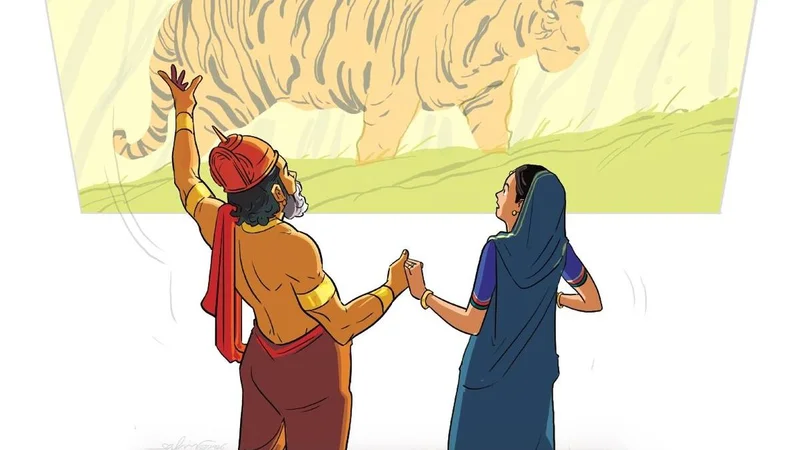
Kaikeyi takes his hand and the forest fades and dissolves into a swirling mist of light. When it clears, they are standing in a bright room with a glowing, rectangular panel floating before them
Dasaratha: Let me introduce you to a concept from the future: Machine Learning.
He waves his hand at the screen and it splits into three sections.
Dasaratha: In the future, humans will use a Teachable Machine. They feed it with thousands of examples. First, let us teach it to see.
Dasaratha points to the first section on the screen. It says: “CLASS 1: TIGER”. Hundreds of images of tigers flash onto the screen in rapid succession.
Dasaratha: The machine looks at the tiny dots of colour. It doesn’t see a tiger; it sees mathematical patterns. It notices the orange and black stripes. Now, we do the same for a deer.
Hundreds of pictures of deer flash onto the screen.
Kaikeyi: So, it learns the patterns of the deer’s antlers, spots and long legs?
Dasaratha: Exactly! When we click “train”, the machine builds rules based on those patterns.
He creates an image of a tiger hiding behind a bush that the machine has never seen before and feeds it into the test section. Instantly, a bar lights up to 99%, with the word “TIGER” flashing.
Kaikeyi (astonished): It recognised the stripes even though the tiger was hidden! Can it learn other things?
Dasaratha: It can learn from any data we give it.
The images are replaced by jagged, glowing lines mimicking sound waves.
Dasaratha: This is Voice and Audio Recognition. If we feed it thousands of sound clips — the gentle rustling of wind versus the harsh snap of a breaking branch under a poacher’s boot — it learns the invisible geometry of sound. It can even learn to recognise the specific voice of a person in distress, something I failed to do by the lake years ago...
Kaikeyi touches his arm gently. Dasaratha takes a breath and swipes the screen one last time.
Dasaratha: Finally, it can learn intention through Posture Recognition.
He takes the stance of an archer drawing a bow. On the screen, a digital skeleton made of glowing dots and connecting lines maps perfectly over his joints.
Dasaratha: It maps the shoulders, elbows, and knees. If we show it the angles of a person drawing a weapon versus a person simply planting a seed, it learns the shape of human movement. It doesn’t just see a person; it understands what they are doing.
Kaikeyi: It doesn’t need to be alive to learn; it just needs data!
Dasaratha: Precisely. The cameras capture the image, the microphones capture the sound, and the “brain” — the Machine Learning model — analyses the patterns instantly to know if the forest is safe.
Slowly the place dissolves into the mist and the king and queen are back in the forest of Ayodhya.
Kaikeyi: To think that humanity will one day build metal that can recognise faces, hear danger, and understand movement...
Dasaratha: It is a powerful tool. But remember, a machine only knows what it is taught. Just like our kingdom, the future will depend not just on the tools we build, but on the wisdom of the data we feed them.
Kaikeyi nods in agreement. The chariot rolls forward.
Build Your Own AI Forest Guard!
Note: This experiment should be done under adult supervision only
What You Need: A computer or laptop with a webcam; An internet connection; A paper with a drawing of a tiger; A paper with a drawing of a deer
Step 1: On the browser, go to teachablemachine.withgoogle.com and click the big blue “Get Started” button. Next, click on “Image Project. Select “Standard image model”.
Step 2: Click on the pencil icon next to the “Class 1” button and rename it as “Tiger”. Turn on your camera and hold up the drawing of the tiger. Now, click and hold the “Hold to Record” button. Move the tiger around a little bit until you have collected about 100 image samples.
Step 3: Below the Tiger box, you will see “Class 2”. Rename it as “Deer”. Repeat the process to collect 100 image samples.
Step 4: Now click the big “Train Model” button in the middle column. Do not switch tabs while it is training! Give it a minute to “think”.
Step 5: Once the training is complete, the “Preview” box on the right side of the screen will turn on. Hide both of your drawings so the camera just sees you. Now, hold up the tiger drawing suddenly. The bar at the bottom should jump to 100% Tiger! Quickly switch it to the drawing of the deer, and watch the AI recognise the change instantly.
What you did: You just programmed a computer without writing a single line of code! By showing the computer examples (data), the AI looked at the pixels, found the patterns, and created its own rules to tell them apart.
Published - July 24, 2026 09:25 am IST