Charli XCX is in a quandary. Or at least, that’s how it seems on her seventh album, Music Fashion Film. It’s been a strange, disjointed rollout for the pop star’s latest full-length release – her third in just over two years, if we’re including her Wuthering Heights soundtrack – not least because of the mixed messages about what the project is. The sound and themes, too, are confusing and often contradictory.
This makes sense if you know how Music Fashion Film came about. The artist born Charlotte Aitchinson felt creatively drained from the era-defining sensation that was 2024’s Brat – a work that sparked endless memes, merch, TikTok dances and smoking habits. After that, she was “not inspired to write anything new”. Then her longtime collaborator AG Cook suggested they record while in Paris for fashion week; the idea of working in such a contained, hectic environment appealed. Music Fashion Film evolved into a celebration of her three favourite mediums, hence the cover art featuring a trio of heavyweights: Martin Scorsese, Marc Jacobs, John Cale. “This album is, in a way, all about how lucky I feel to be able to do what I do,” she told fans in New York City earlier this month.
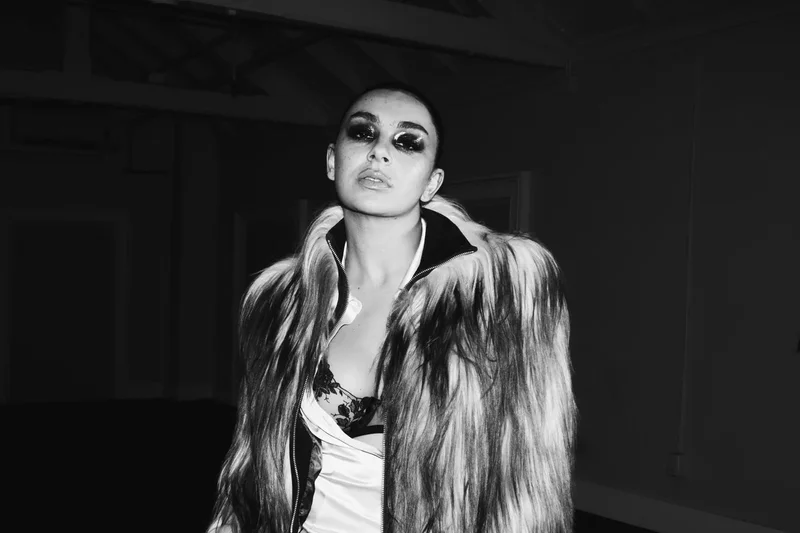
The first interview Charli did for this record was a Vogue cover, moodily shot in black and white. The strapline: “Charli XCX… on her rock reinvention.” The accompanying article stated that “she really is making rock music”, with Charli remarking: “What’s interesting for me is to bend the possibilities of what my perspective on that could be.” Fans were understandably confused, then, when she unveiled the first single, “Rock Music”, very much not a rock song, instead a pop track buoyed by a bouncy distorted guitar riff and the tongue-in-cheek refrain: “I think the dancefloor is dead/ So now we’re making rooooooock music.”
Amid the heated conversation over the song, Charli posted a video of herself stating she “never said I was making a rock album”. So, things get even more perplexing while listening to the album in full (all 30 minutes of it; most songs clock in at the two-minute mark) because actually, quite a lot of it does seem rock-inspired. “Card Declined” is stomping, dark and sulky, Seattle grunge style, with Charli intoning a shopping list in a manner that seems to knowingly poke fun at her own capitalist inclinations. “I’m Afraid” is even bleaker, like Kurt Cobain’s “Something in the Way”, insomnia in song form, as she wrestles with different identities and the notion that pain leads to better art. The production throughout is excellent – it envelops you, full of interesting textures and instrumentation, while Charli’s voice flits from her vocodered drawl to a sweet, pitched-up trill.
The music video for “Camera”, starring French actor Vincent Cassel, was influenced in part by a shot of an exhausted James Dean having his makeup touched up on the set of his final film, Giant – he died weeks after wrapping his scenes. The image connected with Charli, who thought about her own relationship with making art: “Even though it can feel hard and sometimes humiliating, there’s a burning passion to get to this place where you feel something powerful and indescribable,” Charli posted to Instagram. The thing is, when you see the finished film, Dean is in character. On Music Fashion Film, there are more than a few instances where you feel like you’re witnessing the creative process in action – you’re inside it, rather than enjoying the final, polished version.
In a Rolling Stone interview, Charli spoke of her belief that earnest and funny can exist in the same space. And truly, few do this better than her – just listen to “Girl, So Confusing” and then “Von Dutch” on Brat – but I wonder if the lines have blurred beyond her control. It’s frustrating to have a good song like “Camera”, which reminds me of the Yeah Yeah Yeahs’ circa Fever to Tell (2003) and addresses her indecision over pursuing a film career in her early thirties, followed by something like “2007”, a reheated take of her nostalgia fest with Troye Sivan, “1999”. “I can take you to heaven like it’s 2007,” she purrs coyly. We’re back to serious matters on closing track “No One Lasts Forever”, inspired by David Cronenberg’s account of a near-death experience and featuring a looping, spoken-word segment from the director himself.
Quite a lot of the songwriting feels like a hangover from Brat, often riffing along the lines of, “You doing this makes me feel like that, am I insecure, I hate this, I wanna do something, what does it all mean anyway?” It belies the confident album title and its lofty cover stars. Similarly, “SS26” is the prettiest song on the record but flails around with questions of futility in our messed-up world, and how the world of fashion seems vapid within that context; a strange message, on an album promising to celebrate the form. “Wink Wink” addresses her famous self-awareness but undermines it, too: “You don’t get me… I don’t know why you don’t believe me.”
So often, Music Fashion Film comes off like Charli is trying to work out where her place is in all of it. Is she trying to align herself with these auteurs, or confessing her insecurity that she might not belong there? Is she mocking the self-seriousness of herself and her peers or paying tribute to art’s transformative powers? She’d probably want you to believe all of the above. But the overarching sense on this album is of the kind of gin-infused, late-night philosophical ramblings sent drifting out of a Paris apartment window, along with grey wisps of cigarette smoke. At the time you feel like you’re really on to something. But in the cold light of day, most of the ideas are rather half-baked.