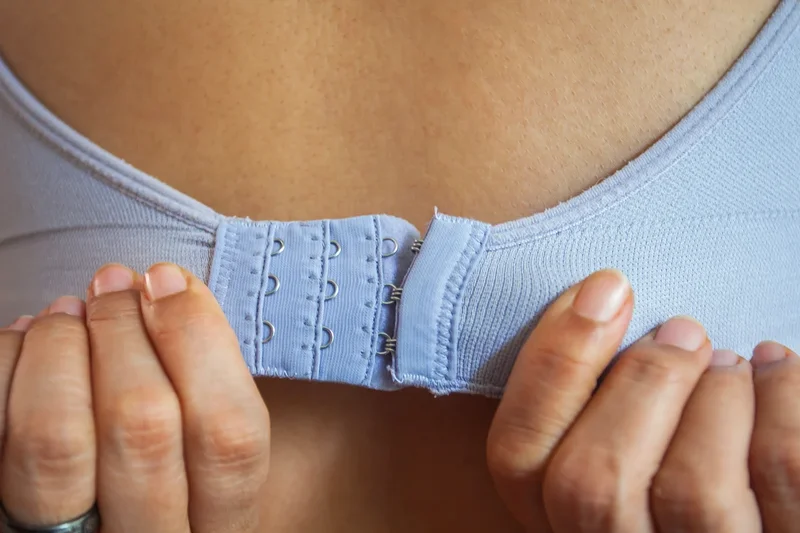
It’s almost impossible not to groan in pleasure at the relief of unclipping and wriggling free from a constricting bra after eight hours at the office confined in the skin-indenting cage made of straps and cups. The release is so freeing, so profound, that many women refuse to go back out after they’ve escaped. My bra is off, the day is done; thank you and goodnight.
But while we’ve basically become accustomed to understanding uncomfortable underwear as part of the way of life, bras that hurt are more than a hindrance; they’re a health issue that we’ve come to believe – after decades of reinforcement – is completely normal.
At the risk of sounding like Trinny and Susannah, who loved hoisting women’s straps up to their ears in the Noughties, 80 per cent of women wear the incorrect bra size, according to a long-referenced chiropractic and osteopathic study. Of these women, 70 per cent were wearing bras that were too small, while the other 10 per cent wore sizes that were too large. In a more recent report, in 10 months of bra fittings, it was found that only 6 per cent wore the correct bra size. This can lead to neck, back, shoulder and breast pain, bad posture, rubbing, chafing and all-around discomfort.
“This is actually something we see quite a lot,” says Dr Asiya Maula, private GP at The Health Suite. “Many women have been wearing the same bra size for years without realising their body has changed, so it’s not uncommon for them to be wearing something that’s simply no longer the right fit,” she adds. “If you’re adjusting your bra all day, taking it off the minute you get home because it’s uncomfortable or it’s leaving painful marks, those are all clues that something probably isn’t right,” Maula warns women who’re suffering.
Lack of measurement isn’t exactly women’s fault. Unlike optician appointments or even shoe fittings, women aren’t encouraged beyond puberty to have their bra size checked when buying. Plus, there are barriers to entry: “You can’t just walk in off the high street, you have to book in advance,” says former Topshop fashion director Gillian Ridley Whittle, who founded bra fitting experience and lingerie brand Peachaus in 2022.
Ridley Whittle makes it her business to go to festivals, offices and co-working spaces with her team in a bid to get more women fitted, healthy, and comfortable. “It’s really sad because the women who self-fit their bras, most of them don’t know what baseline comfort is,” she says, expressing dismay at the amount of money poorly fitting bras are costing the NHS and women who pay private health companies. “Their backs hurt, their necks hurt,” Ridley Whittle says. “One woman I met told me she had a cancer scare – and it turns out the lump was from her underwire.”
I think there’s a huge revolution that needs to happen in the underwear industry. We need ... to pull together and put women’s health, not aesthetic production, first
Bras are ancient. In fact, there’s evidence of their existence in Roman mosaics in Sicily, dating back to the fourth century AD. But bras as we know them today, with their cup sizes, bands, eye hooks and synthetic fabrics, date back to the 1930s, when Warner’s introduced its Alphabet Bra, with cup sizes from A to D, which continues to be the system in use. “As the fit system was introduced over 100 years ago, women’s bodies have changed since then,” says Ridley Whittle. “How we eat, socialise, everything’s shifted, so there’s a huge amount of old-fashioned ways of doing things in the underwear industry to this day.”
The entrepreneur asserts that if she had it her way, bras would now be treated as a piece of women’s health equipment, rather than a piece of clothing. “I think there’s a huge revolution that needs to happen in the underwear industry,” she says. “We need some standardisation, which requires us to pull together and put women’s health, not aesthetic production, first.”
While Ridley Whittle offers her pop-up shop services to employers for as little as £39 per session in a bid to make annual bra-fitting as common as a dentist’s check-up, she offers tips for women whose employers may not have yet gotten the memo: First, check if you can easily get two fingers up around the rib cage and the cradle (band), if not, it’s too tight. Second, the wire needs to cover the breast tissue. Third, if you get double boobs, they’re too small and too tight. And lastly, don’t hoist the straps up too tight – they shouldn’t press into your shoulders.
While straps often get blamed for lack of bolstering, Dr Maula asserts that they’re rarely the real problem: “Most of the support should actually come from the band around your chest. If the straps are digging in or leaving deep marks, it’s often a sign the bra isn’t fitting properly,” she says.
It’s not just the fit of a bra we should be worried about, experts warn – it’s the fabric, too. “Heat, sweat and friction are a perfect recipe for irritated skin,” explains Dr Maula. “We often see chafing underneath the breasts, pressure marks and sometimes fungal infections in the skin folds. Wearing breathable fabrics, making sure your bra fits properly and changing out of sweaty sports bras promptly can all help.” Additionally, microplastics (found in breast milk for the first time in 2022) are commonly omitted from low-quality fibres.
Katie Lopes, co-founder of comfort-led underwear brand Stripe and Stare spent two years developing a bra made of the right stuff. Like Ridley Whittle, she’d worked in retail and was put off by the fact that women’s underwear choice was between male-gaze-driven Victoria’s Secret-type designs, or huge boring granny pants at the other end of the spectrum.
“I looked at everything from organic cotton to bamboo,” Lopes explains of the long process of finding the right material. “I landed on Tensile, which is sort of like the Rolls-Royce of modals,” she says. “It’s made of cellulose, so it’s wood fibre.” Research has found that Tensile is more breathable than other materials because its fibres are very long, thin and smooth, making them good at “moisture wicking” (drawing dampness away from the skin). “They’re also scientifically proven to be two to three times softer than cotton,” Lopes adds.
The brand focuses on softness rather than the rigidity of underwriting or corseting, so that the bras can move with women during different hormonal cycles, during which time our bodies have been shown to fluctuate. “We wanted something that moved with the body and could expand a bit and retract a bit as our shape changes over the course of each month,” Lopes says. “The flip side of this is that we do say these aren’t bras to run a marathon in.”
Touching the Stripe and Stare products, they are softer than any underwear I’ve ever felt. It feels like luxury – but should, really, be standard procedure. “Our policy is that you should be able to wear underwear that you can just forget about,” explains Lopes. “We get messages from customers every single day saying they didn’t realise they were wearing uncomfortable underwear until they put ours on. Last week, one woman told me ‘I’ve been uncomfortable for 60 years. I can’t believe I just took that as normal.’”
Dr Maula reiterates that, as is often the case in many realms of women’s health, pain and discomfort isn’t something that we should simply have to live with. There are better-fitting bras and softer fabrics that won't rub and chafe, or cinch and scratch. While small businesses are working hard to make this fact known to those still suffering, both agree that underwear regulation is needed to make these products promised rather than a premium.