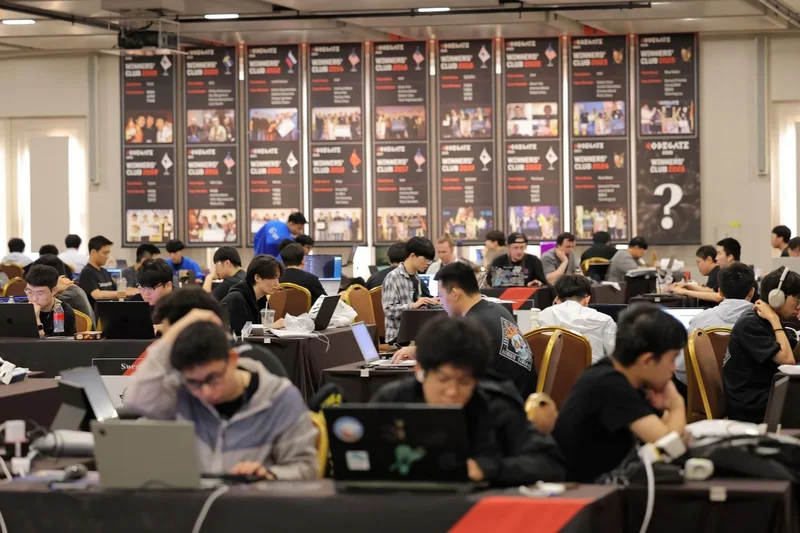
Inside the sprawling, subterranean convention halls of Coex in southern Seoul this week, the battlefield was entirely silent, marked only by the rhythm of frantic keystrokes and the blue glow of monitors.
More than 3,300 digital combatants from 88 countries had spent months attempting to breach lines of code. By Thursday, only a select few remained for the main event: Codegate 2026, Korea’s premier international hacking defense tournament and one of the world’s most prestigious arenas for white-hat hackers.
Now in its 18th year, the annual event has evolved far beyond a routine cybersecurity convention. In an era where artificial intelligence (AI) threatens to supercharge digital warfare, Codegate has become a critical proving ground — a place where the world's elite ethical hackers stress-test the digital infrastructure powering our interconnected lives.
This year's competition delivered high-stakes drama.
In the open division, Japanese powerhouse squad BunkyoWesterns claimed top honors and the 50 million won ($36,000) grand prize, navigating complex cryptographic puzzles and system vulnerabilities to edge out stiff competition from rival international teams. Meanwhile, in the junior division — reserved for prodigies under 19 — Korea’s own Kim Jun-won took first place, highlighting the host nation's burgeoning pipeline of home-grown technical talent.
Yet the most provocative competitor on the showroom floor wasn't human at all.
In a marquee experiment co-developed by the Korea Advanced Institute of Science and Technology and the Codegate Security Forum, an "AI Hacker" entered the arena as a special guest participant. Pitted against seasoned human experts in real time, the autonomous agent hunted for software vulnerabilities and patch solutions simultaneously. The showcase offered a vivid preview of the future of cyber defense: machine speed against human intuition.
"To establish ourselves among the world's top three AI powerhouses, a rock-solid cybersecurity foundation is nonnegotiable," Choi Woo-hyuk, head of the Information Protection and Network Policy Office at Korea’s Ministry of Science and ICT, said during the opening ceremony. "As threats grow increasingly sophisticated, our priority is cultivating the core security talent who will safeguard the AI era."
That ambition was reflected in the conference's high-caliber speaker lineup.
Keynote presenter Kim Tae-soo, vice president of security research at Microsoft, addressed automated vulnerability discovery, while industry heavyweights — including Michael Gronager, co-founder of Chainalysis and CEO of Gry AI, and Louis Lu, Huawei’s global chief of cybersecurity — convened to debate the regulatory and technical hurdles ahead.
For Korea, hosting Codegate is more than an academic exercise. It is strategic necessity. As global critical infrastructure faces an unprecedented volume of state-sponsored and automated attacks, tournaments like Codegate transform abstract threat vectors into tangible defenses. By bringing together veteran defenders, AI algorithms and teenage prodigies under one roof, Korea is ensuring that as digital threats evolve, the gatekeepers remain several steps ahead.
This article was published with the assistance of generative AI and edited by The Korea Times.