Korea’s renewed inclusion on the U.S. Treasury Department’s currency monitoring list is unlikely to have a significant impact on the local foreign exchange market, analysts in Seoul said Friday, dismissing the semiannual report as a largely routine event with limited immediate policy implications.
“The report drew much more attention early in President Donald Trump’s term last year. But it doesn’t result in any concrete measures, so it has become something of an old issue," said Lee Jung-hoon, an analyst at Daishin Securities. "I don’t expect it to have much impact on the market."
Kwon A-min, an analyst at NH Investment & Securities, also said the Treasury's foreign exchange report has become increasingly formulaic in recent years, shedding much of the political undertone it once carried.
"I expect little impact on the market from the report," Kwon said.
The Treasury, in its Report to Congress on Macroeconomic and Foreign Exchange Policies of Major Trading Partners of the United States, kept Korea on its currency monitoring list alongside China, Japan, Taiwan, Thailand, Singapore, Vietnam, Germany, Ireland and Switzerland on Thursday (local time). The list was unchanged from the previous report released in January.
Under the Treasury’s framework, economies are assessed against three benchmarks — a goods and services trade surplus with the United States of at least $15 billion, a current account surplus above 3 percent of gross domestic product (GDP) and persistent net foreign exchange purchases exceeding 2 percent of GDP over at least eight months in a year.
Economies meeting two of the three criteria are placed on the monitoring list, while those meeting all three are subject to enhanced analysis. Korea remained on the monitoring list after meeting the trade surplus and current account surplus thresholds.
The Treasury said Korea’s current-account surplus widened to 6.6 percent of GDP in 2025 from 5.3 percent a year earlier, driven largely by stronger exports of semiconductors and other technology products. But the won remained under depreciation pressure as increased capital outflows from overseas investments offset some of the foreign currency inflows generated by exports.
The department pointed to a surge in overseas stock purchases by public institutions, including the National Pension Service, as well as households and nonbank financial firms, as a key factor weighing on the won.
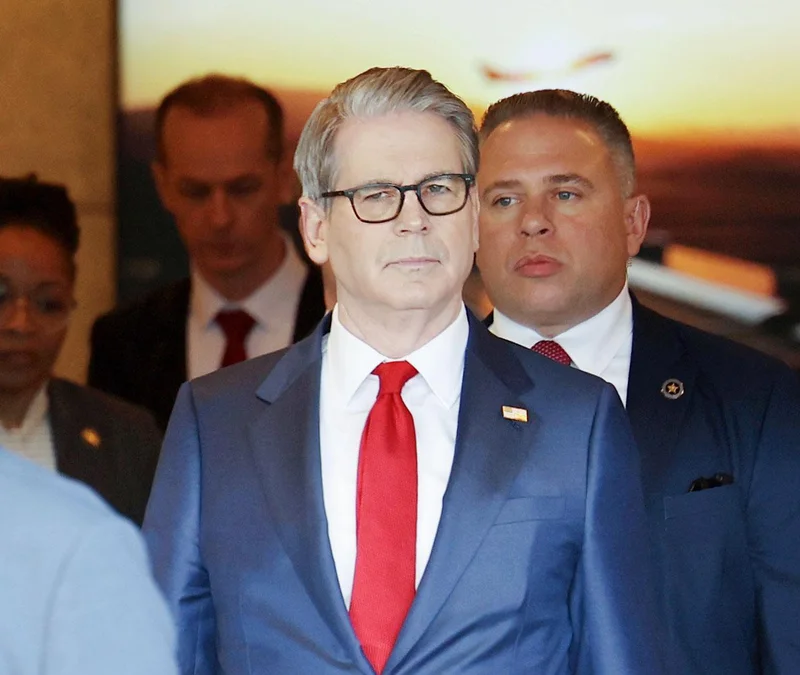
Treasury Secretary Scott Bessent signaled concern over the won’s decline during a Jan. 14 meeting with Korea’s Finance Minister Koo Yun-cheol, according to the department.
At the time, Bessent said that depreciation pressures were inconsistent with Seoul’s strong economic fundamentals and that excessive volatility in the foreign exchange market was undesirable.
“Korean authorities’ foreign exchange intervention during the report period appeared to focus on smoothing excessive volatility amid depreciation pressure on the won,” the Treasury said.
Regarding institutional reforms, the department positively assessed Seoul’s progress in easing restrictions on foreign investors’ access to the onshore foreign exchange market, saying the move would improve liquidity and price discovery over the medium to long term.
Under the Trade Facilitation and Trade Enforcement Act of 2015, the Treasury monitors the macroeconomic and currency policies of the 20 largest trading partners of the United States.
Korea was removed from the currency monitoring list in November 2023, marking its first removal from the list in more than seven years since April 2016, before being added back in November 2024 ahead of Trump's inauguration.
In response to the latest report, Korea’s Ministry of Finance and Economy said the government plans to continue close communication with the U.S. Treasury.
“We will expand mutual understanding and trust regarding the foreign exchange market and continue cooperation to stabilize the market,” a ministry official said.