Brazil · Companies
Simpar port sale to a unit of Philippines-based International Container Terminal Services, Inc. (ICTSI) values the Brazilian group’s Bahia terminals at R$1.8 billion (~US$353 million), a transaction that sent Simpar shares higher on July 23 as BTG Pactual analysts flagged an acceleration in the holding company’s debt-reduction plan.
Inside the Simpar Port Sale
Simpar, the São Paulo-listed holding company that controls some of Brazil’s largest transport and mobility brands, signed a binding agreement on July 23, 2026, to sell 100% of its Bahia port subsidiary HSIM to ICTSI Americas.
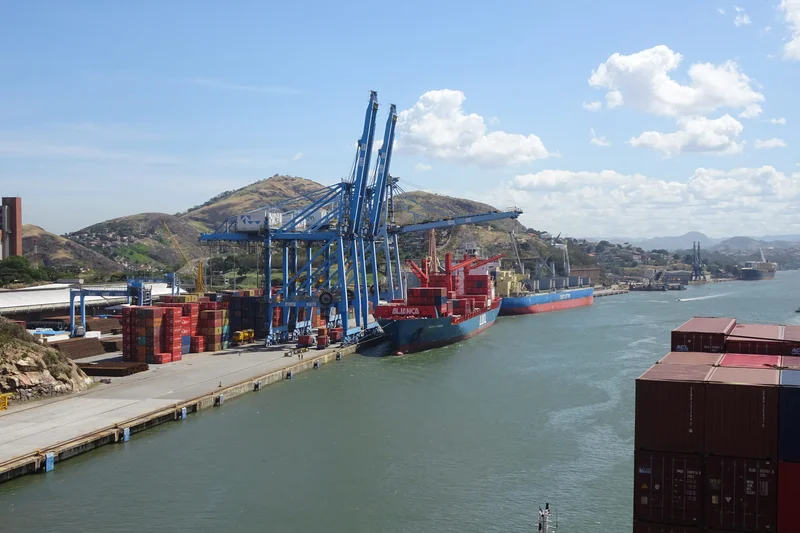
HSIM wholly owns the operators ATU12 and ATU18, which are jointly marketed as CS Porto Aratu and located at the Port of Aratu in Candeias, Bahia.
The enterprise value of R$1.8 billion (~US$353 million) breaks down into R$750 million (~US$147 million) in equity value and approximately R$1.0 billion (~US$196 million) in net debt sitting on the asset’s balance sheet as of the first quarter of 2026.
The equity portion will be paid as R$650 million (~US$127 million) at closing, with an additional R$100 million (~US$20 million) structured as an earn-out within 18 months after the deal is completed.
The terminals have received roughly R$900 million (~US$176 million) in prior investment and hold an installed capacity of 9.5 million tons per year, making them a relevant logistics gateway in Brazil’s Northeast.
Closing remains subject to approval from Brazil’s antitrust watchdog Cade and authorization from the competent port granting authority.
Who Is Simpar? A Primer for Foreign Investors
For international readers unfamiliar with the name, Simpar is a Brazilian holding company that acts as the controlling shareholder of four distinct operating businesses across the logistics and mobility chain.
Its portfolio includes JSL, one of Brazil’s largest road logistics operators; Movida, a car rental and fleet management company; Vamos, a truck, machinery, and equipment rental and dealership group; and Automob, a vehicle dealership platform.
Together these subsidiaries make Simpar one of the most diversified transport conglomerates in Latin America, with exposure to light vehicles, heavy trucks, port infrastructure, and integrated logistics services.
The CS Porto Aratu asset was a non-core piece inside this sprawling structure, a port operation that sat outside the group’s main rental, dealership, and road-logistics engines.
Live Company IntelligencePorto Seguro S.A — the full investor dossier
Valuation & profitability
Price & risk
$42.8752-wk high
$55.55
Revenue trend · 6y
R$42.75B
Ownership
Dividend
What Porto Seguro does.Porto Seguro S.A., together with its subsidiaries, provides a range of insurance products and services in Brazil and Uruguay. It offers auto, residential, travel, cell phone, life, motorcycle, notebook and tablet, photo and video, smart and games, bike, real estate, green card, bail, and moving insurance products, as well as reinsurance, combined…
The Buyer: ICTSI’s Growing Americas Footprint
The acquirer, ICTSI Americas, is a regional unit of International Container Terminal Services, Inc., a Philippines-headquartered global port operator with a presence across six continents.
ICTSI manages a network of container terminals and port concessions worldwide, and the Aratu acquisition marks a further expansion of its Americas platform, adding dry-bulk handling capacity in one of Brazil’s key industrial port complexes.
The Port of Aratu serves the Camaçari petrochemical hub and other industrial clusters in Bahia state, giving ICTSI a foothold in a region with steady demand for bulk cargo movement.
Deleveraging Catalyst: Why the Market Cheered
BTG Pactual analysts pointed to the deal’s immediate balance-sheet benefit: by selling HSIM, Simpar removes roughly R$1.0 billion (~US$196 million) in net debt from its consolidated structure.
That one-step reduction accelerates a deleveraging process that has been a central focus for Simpar’s management since interest rates in Brazil began climbing, squeezing highly leveraged holding companies.
Investors reacted positively, bidding up Simpar shares on the B3 exchange in São Paulo, as the transaction signaled that the group is willing to monetize non-core assets at reasonable valuations to strengthen its capital structure.
While BTG’s exact post-transaction leverage target was not disclosed in the available reporting, the mechanics of removing both the asset and its associated debt clearly improve Simpar’s net-debt-to-EBITDA ratio.
Strategic Rationale and Next Steps
For Simpar, the divestment aligns with a broader strategy of portfolio simplification, allowing management to concentrate capital and attention on its core rental, dealership, and logistics subsidiaries.
The R$650 million cash inflow at closing provides immediate liquidity that can be directed toward reducing corporate-level debt or reinvesting in higher-return segments such as Vamos and Movida.
For ICTSI, the acquisition adds a complementary bulk-terminal operation to its largely container-focused global portfolio, diversifying its Brazilian exposure beyond any existing container concessions.
Regulatory reviews by Cade and the port authority are expected to proceed over the coming months, with both parties targeting a closing timeline that allows the earn-out period to begin promptly.
Broader Context: Brazilian Port Assets in Play
The Simpar port sale is the latest in a series of Brazilian infrastructure divestitures as local conglomerates seek to lighten balance sheets and global operators hunt for yield in a market still priced attractively for dollar-based investors.
With the Brazilian real trading near 5.1 to the US dollar, foreign buyers like ICTSI can acquire hard assets at a significant discount in hard-currency terms, a dynamic that continues to drive M&A activity across Brazil’s port, rail, and energy sectors.
Frequently Asked Questions
What exactly is Simpar selling in the Simpar port sale?
Simpar is selling 100% of HSIM, a holding company that owns the ATU12 and ATU18 port terminals. The two terminals operate together as CS Porto Aratu at the Port of Aratu in Candeias, Bahia, with a combined capacity of 9.5 million tons per year.
Why did Simpar shares rise after the port sale announcement?
Shares rose because the deal removes roughly R$1.0 billion (~US$196 million) in net debt from Simpar’s balance sheet. BTG Pactual analysts highlighted that this accelerates the holding company’s deleveraging plan, which is a key concern for investors given Brazil’s high interest-rate environment.
Who is ICTSI and why are they buying Brazilian port terminals?
ICTSI stands for International Container Terminal Services, Inc., a Philippines-based global port operator with terminals across six continents. Through its ICTSI Americas unit, the company is expanding its footprint in Brazil, where a weaker real allows dollar-based buyers to acquire infrastructure assets at attractive valuations.