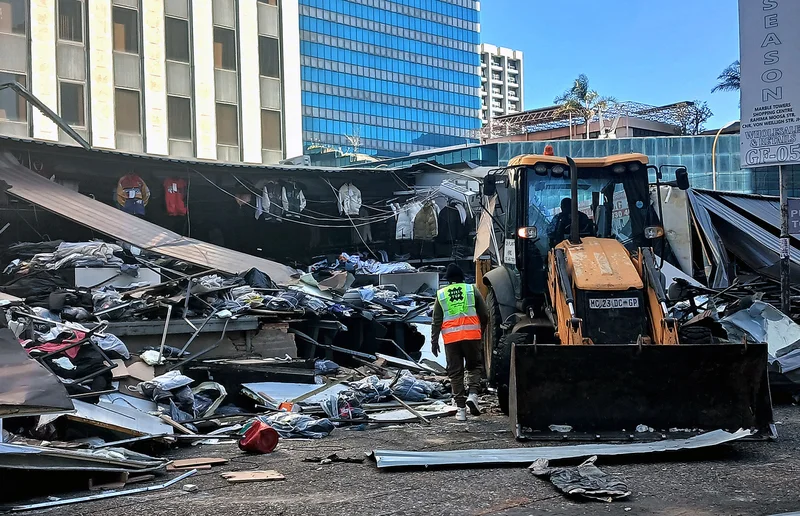
Johannesburg Mayor Dada Morero took a defiant stance last week after a construction vehicle ripped through informal tradersâ structures at Marble Towers, a popular shopping district, in the inner city.
âWe are enforcing the law, and those who continue to defy our by-laws and court orders will face the consequences,â said Morero.
Since October 2025, the City of Johannesburg has been on an inner-city âclean-upâ drive under the banner of by-law enforcement, crime control and cleanliness. Informal traders were moved from the street en masse, informal structures demolished and the odd tree planted.
Along the way, the City has been dragged to court on multiple occasions for allegedly violating the same by-laws and City regulations that Morero claims to uphold.
âThere are programmes that we will be doing in the city, in the street in particular, so that we can reclaim it and restore it as part of the broader rejuvenation of the inner city,â Morero said on 21 May.
âWe have made good progress thus far. Now we are looking at fixing the infrastructure, the water infrastructure underneath and then fixing the pavement and the roads, so we think that we have made good progress. I think communities generally and the residents are beginning to see progress on the commitment that we have made in terms of reclaiming the City of Johannesburg and reclaiming our streets in an attempt to bring Johannesburg to almost what it used to be.â
We asked residents and those working in the CBD whether the mayorâs interventions had made a difference to crime and cleanliness.
âSafer, less overcrowdedâ
Those Daily Maverick spoke to were divided. Some say the city is cleaner and safer, while others feel that nothing has changed.
Two women who call themselves ârunnersâ â buyers of clothes and goods for far-flung clients â say the inner city feels different these days.
âJohannesburg hasnât been safe, but itâs better now,â said Nomasonto Maqashalala, 26, from Tembisa.
The two women buy goods on behalf of those too far, or too fearful, to venture into the city themselves.
âImagine, I even have clients from here in Joburg who cannot buy for themselves due to safety concerns,â Maqashalala said.
She admitted the demolitions had disrupted her ability to work, but she supported the clean-up: âThe city is getting safer and less overcrowded. If shop owners want to continue selling, they must do it legally.â
For Khuselwa Kamangaliso, 46, from Roodepoort, the Marble Towers campaign was bittersweet.
âWhat is happening here â the demolitions â is too painful. They should at least have been warned to remove all their stock first. But we cannot do anything because itâs the law.â
Still, Kamangaliso said the changes had brought relief: âOther than that, I am happy with the clean-up. It feels safer. But you also need to extend your clean-up to all the buildings. We are struggling to pay electricity when there are unknown people in these buildings who use free electricity.â
She pointed out one example where the clean-up had worked: Small Street. In May, authorities demolished illegal structures on the iconic shopping street, with City leaders also claiming the shops were owned by, and employed, foreign nationals.
âTwice I was robbed of my phones there, but since the clean-up, itâs been calm,â said Kamangaliso.
Sarah Mhlongo, 79, from Soweto, told Daily Maverick, âI have not been in the city for many years because I felt it was unsafe, but as I walked from Bree [taxi rank] today, I could feel the freedom.â
âItâs still the sameâ
Two women who work for a security company in Park Station emphatically disputed any suggestion that the city was clean and safer.
âWhat difference?â one of the women asked.
âItâs still the same. Overcrowded, filthy and very dangerous because criminals are still lurking. We come across people who have been robbed almost daily here around Park Station.â
Her companion echoed the frustration: âThere is definitely no change. Itâs still the same. Walking through the city centre is still as risky. They donât seem to have the capacity to consistently implement the by-laws. They are just leading the residents down a garden path.â
Mangaliso Skosana, 47, from Orlando, Soweto, said, âNothing has changed here. You are deceived by people who pretend to be busy, and you think they are doing some work. These people are just saving face, and thatâs it. Show me one clean place, because I can take you to Small Street now, which some people credit the city for. Itâs chaotic.â
Skosana continued, âThey scared off the few illegal traders, but they are always back there. You have been pranked if you believe there is change.â
Traders sidelined
After the City forced informal traders off the streets last year, they went to court and won the right to continue working in a system that would see them verified and granted permits.
While many informal traders were issued verification cards to comply and continue trading, others told Daily Maverick that they were struggling to be accredited, impeded by the Cityâs bureaucracy.
âIn essence, you cannot trade because you do not have a licence, but families are starving, and many of us are forced to trade illegally. We have been to their offices, but no one entertained us,â a street vendor who gave only her first name, Valarie, said.
âWe donât know what to do. We are back on the street because our families are starving,â she said.
Valarie sells wigs and other hair products in the CBD.
âThey are not even speaking about permits or what to do to comply. They just do not want us here,â she said.
She said traders were always on the lookout for the JMPD. When JMPD vehicles roll around, they hurriedly gather what they can of their stock and run. When the JMPD members are out of sight, they return.
âCosmetic interventionsâ
âMayor Morero has become increasingly accustomed to taking credit for work done by others while failing to accept responsibility for the Cityâs ongoing collapse,â Democratic Alliance Johannesburg caucus leader Belinda Echeozonjoku said.
âRefuse collection still not done on time, reliance on water tankers seems to still be the order of the day and prolonged outages remain the reality of Joburg residents,â she said.
âThe so-called âclean-upâ is little more than a public relations exercise designed to create the illusion of progress ahead of the local government elections.â
âRather than pursuing meaningful reform, Mayor Morero has relied on headline-grabbing announcements and cosmetic interventions while ignoring the structural failures destroying South Africaâs economic hub.â
Johannesburg Crisis Alliance (JCA) coordinator Yunus Chamda noted that the private sector was also working on inner-city reform.
âCertain parts of the city do appear visually cleaner, in part by the efforts of the City and in part due to the partnership with the private sector. As for being safer, we would need statistics to confirm if the city is safer,â said Chamda, who noted the general decline during Moreroâs administration.
âHis term was characterised by worsening financial instability, declining transparency, deteriorating service delivery and weakened public confidence in municipal governance. He repeatedly downplayed the seriousness of the crisis the City and its entities were in, always issuing reassurances that âeverything is fineâ, and which reassurances had no basis in reality. That misrepresentation eroded his credibility.â
Marble Towers
The Marble Towers demolitions stem from a court order in May 2026 in which the Johannesburg High Court ordered Goldenrod Group, owners of the building, to regularise the property, shutter and cordon off structures built without approved plans, and file compliant blueprints.
The City raided Marble Towers last week after it concluded that Goldenrod Group had not complied with the court order. But Goldenrod returned to court and reached an agreement with the City for an inspection of the structures on the property.
That inspection took place this week. The findings have not been released. DM