There is nothing more constant than change.
People have argued about the future of football for as long as the game has existed.
Every year players, fans and football staffers await the new direction or interpretations handed down from high.
Some changes are winners and stand the test of time — such as the 50 metre arc and the centre square.
Others are destined for the dustbin of history, such as the flick pass and around the ground bounces.
Regardless, change is never far from sporting administrators of different codes and sports. The AFL is not immune from this want to improve the sport.
Ahead of the 2026 season seven rule changes and interpretation shifts were heralded as being common sense solutions to perceived long-standing problems surrounding the sport.
Changes to the centre bounce, kick-ins, shrugs, the "stand" rule and last disposal out of bounds were implemented. Some elements of the footy fan base were excited by the changes, others horrified.
"We have consulted clubs and other industry stakeholders over the past six months and taken on board their feedback and ideas, and we believe these changes will make a positive impact on the game," AFL executive general manager Football Performance Greg Swann said before the commencement of the season.
The aims of each change were varied but aligned to increase scoring, reduce game time and improve the look and feel of the game.
So far scoring has increased about 3.5 points per game compared to last year.
Scoreboard operators haven't been this busy since the 2017 season, with early season scoring rates threatening to push the clock back even further.
But that number alone may not tell the whole story.
With the season winding towards finals, research undertaken by the ABC and Andrew Whelan of Wheelo Ratings looks at whether the changes have had their intended impact.
Centring the truth
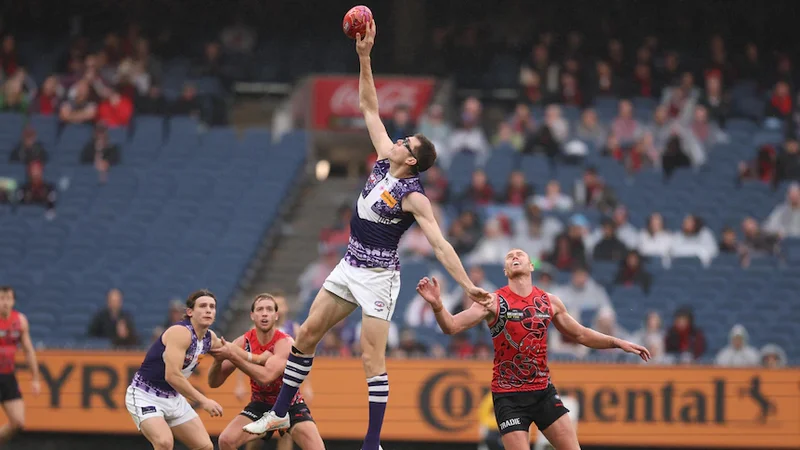
To the casual fan there were few more iconic parts of the Australian game than the centre bounce. The biggest optical change to the game in 2026 was the removal of the centre bounce and changes to how rucks engaged at the restart.
The bounce had been the start of each game since its formal introduction in 1887.
For many the bounce was integral to the look and feel of the sport — a unique element that set the native code away from the other global codes of football.
But it had become untenable in the face of umpire injuries and skill barriers, seen to reduce the ranks of vital recruits.
"Currently, umpire pathways are being narrowed by the requirement of the bounce. By removing the skill aspect of bouncing the ball, umpires can focus their energy on adjudicating the game and consistency of decision-making," Swann stated.
At the same time that they removed the bounce, the league also instituted a change to encourage more rucks to leap at centre ball-ups.
According to the AFL, just 21 per cent of centre bounce ruck contests had at least one ruck leaping last year. That's down from about two-thirds just two years prior.
After the preseason Swann was keen to sell the success of both changes.
"The unintended consequences from a good perspective is scores out of the centre bounces have gone up. It's a very small sample size, but the things that we wanted — the game length has gone back, the scoring has gone up, scoring from centre bounces has gone up, so we're hopeful that goes into the season proper as well."
At face value the rule changes — in combination — have delivered in spades. Scoring from centre bounces are at their highest level for at least 20 years.
Digging a little deeper presents more questions as to its impact.
While scoring is up from centre bounces, the major reason why they are up is a little more unconventional.
Instead of fast flowing play from the restart the biggest contributor to the jump are scores from free kicks.
Free kicks at the restart have surged in 2026, perhaps sparked by confusion around the new rules.
More points are being put on the scoreboard from these free kicks than in recent years.
Instead of the dynamic future promised from the new ruck set up, the reality is more of the same buttressed by a surge in indiscretions.
With more centre ball-ups overall, teams are scoring 0.96 points per live ball centre clearance, up just 0.02 points per clearance on last year.
There's also been a subtle tactical evolution as the season has progressed.
As teams have become accustomed to the new rules, scoring from centre bounce has also dropped.
The predictable new ball-up has become easier to defend as winter has gone deeper and teams have become better equipped at limiting damage from the middle.
In the last five weeks teams have averaged just 10.6 points per game from the middle — a big drop on the fast start to the year and the past three full seasons.
While centre bounce scoring is up about 12 per cent on last season, it still only makes up around 14.5 per cent of all scoring. That's only 1 per cent more than the contribution last year.
Teams are better at getting the ball inside 50 from centre bounces this year than years past however, contributing to the territory game so important to many teams.
While rule changes often take a season or two to fully bed down, it appears the early optimism for increased centre restart scoring may be diminishing.
The new centre bounce revolution may be more a minor change in the grand scheme of football things.
Where do I stand?
Far more contentious has been the introduction of the "stand" rule six years ago.
For a sizeable cohort of fans across the league it is the single most hated rule in the AFL rule book.
Designed to anchor the mark to a single spot, and prevent the creep of defenders, it aimed to open up aggressive ball use into the middle of the ground.
This year the rule has been slightly tightened to prevent a nearby player retreating "outside 5", instead requiring them to remain in place or to head to the actual spot of the mark or free kick.
Since 2021, many have attributed improved transition success from defence to the new rule. The accepted wisdom is that there has been at least a small improvement in the ability to move the ball due to 'stand'.
This trend has continued through 2026 so far, with a bump in both categories so far. But much like the centre bounce successes, there's more than meets the eye initially.
The increase in transition from defence to attack is largely down to stoppage and kick-in transitions. This matters because these areas are less impacted — or not impacted at all — by the 'stand' rule.
Teams usually escape the contest via broken (not set) play from stoppages.
The 'stand' rule has the biggest impact in set play in the back half of the ground. With the ball already entering in pressurised general play, the 'stand' rule has a far smaller impact on play than in the intercept game — if it has any real impact at all.
The rise in kick-in transition is even more fascinating to consider.
The introduction of a reduced time limit for restarting play has seemingly led teams to becoming more aggressive when bringing the ball back in after a behind.
The average length of kick-ins is about 3 metres longer in 2026 than three years ago. Kick in targets have also gone more central, with about 40 per cent this year heading up the corridor versus about 25 per cent in 2023.
This has led to a rise in full field transition, and an increased risk of the ball going back the other way.
By contrast, the ability to move the ball after intercepting has actually declined from last year.
Despite a rash of teams focusing on overlap handball, the overall trend has seen a decline in success of this type of movement.
There's also been a slight decline overall in the ability to move the ball from defensive 50 to the front half of the ground.
This is usually seen as the break-even success measure for teams to achieve in transition.
While the changes to 'stand' may look dramatic, the ability for defenders to trail overlap runners has not changed, nor has the ability for sides to zone off defensively up the ground.
Many of the scintillating highlights that are attributed to stand are more down to poor defending than the "intrusive" new rule.
What hasn't changed dramatically is the number of 50m penalties called due to stand infractions, or general unhappiness with the rule from some quarters of football fandom.
For these people, the only solution is complete overhaul.
In the balance the reality probably sits somewhere in the middle — not truly transformative, nor game destroying.
Stopping the stoppages
This season also brings about a radical change to the game's out of bounds laws. Following the lead of the SANFL and AFLW, the league introduced a "last disposal" rule to encourage play through the corridor and away from the boundaries.
The rule provides a free kick to the opposition where a side clearly disposes the ball via kick or handball before it passes over the boundary line — regardless of intent or whether it is on the full.
The impact of this rule change has been clear — but again with an interesting caveat.
Throw-ins are unsurprisingly down, with approximately five fewer boundary umpire overheads per game. Far more surprising is the drop in ball-ups per game.
The number of around the ground ball-ups has fallen by almost the same amount as throw ins.
The effect for both is quite dramatic through the middle of the ground. For the first time since the start of COVID there have been more stoppages in each arc than outside them.
This has led to individual stoppages being more threatening than ever before.
But as a result of the reduced volume, the stoppage game has also contributed less to the overall scoreboard than ever.
The intercept game remains the bedrock of football, despite the focus of media and fans on the dead-ball contest.
This reduction in stoppages has likely had the biggest impact on the reduction of game time.
Around two and a half minutes on average, or about two minutes on median, has been reduced from game lengths in 2026.
While better than nothing, for most fans this difference would barely be noticeable.
Next changes up?
Already focus has begun to turn to the next wave of rule changes.
Chief amongst them is the length of the game.
"We've knocked off 3 minutes per game but is it enough? Probably not," Swann told Channel 7 this week.
More radical options have been tabled to further reduce game time. The most radical of these appears to be a reduction in the length of games to 16 or 18 minutes plus time on — similar to the COVID-impacted 2020 season.
This would likely occur when the league expands its home and away schedule to 24 games per team once Tasmania enters the competition in 2028.
Such a change is popular amongst many football people, but is a harder sell to a cynical and change-fatigued public.
"The COVID quarter (length) felt about right. Now maybe (that's) too short — I don't know. But it keeps the game close. You know I think we want close games," GWS coach Adam Kingsley told the ABC earlier this year.
Kingsley is far from alone in this desire, with premiership coaches Chris Fagan and Chris Scott — as well as former AFLPA president Patrick Dangerfield — calling for similar reforms in previous years.
The unspoken part of these continuous sets of rule changes and interpretation amendments are the bigger fish that are yet to be fried.
For too long the AFL have seemingly been unwilling to substantially address the elephant in the room — that of player safety and head trauma.
For example, when introducing the changes to the ruck engagement rule, Greg Swann was clear about the risks, specifically around PCL injuries to rucks.
"I think you'd be naive to say it's not going to happen — it'll happen," Swann acknowledged at the start of the year.
"If there was a pandemic of them you might change it back."
This approach appears to run contrary to much of the rhetoric around the importance of player safety in the modern game.
When limits to run up and changes of engagement at centre bounces were originally introduced they were backed by a robust base of evidence including academic research.
Instead of leaning on this, the league appears to be throwing caution to the wind for little real gain.
As a whole, injuries still are prevalent across the league, and still often affect the best of the best.
This carries through to the biggest challenge currently facing the sport.
There is still an uneasy tension between the potential for traumatic brain injuries to occur as a result of the sport that players and fans love and the enjoyment of the sport itself.
As of next season clubs will have mandated limits around contact training following a recommendation from the Victoria State Coroner's inquest into the death of former AFL player Shane Tuck in 2023.
In that inquest the AFL provided a submission that they were considering a limitation at that time as to be guided by medical evidence.
That inquest recommended that the AFL should implement contact training rule restrictions by the commencement of the 2025 AFL/W preseason.
These rules are still yet to come into force.
While there has been a focus on training, there are also the on-field rule-based elements that seemingly have not been publicly considered by recent administrations.
Since the AFL changed the "prior opportunity" element of the holding the ball rule to better reward tacklers in 1996 the number of tackles per game has increased sharply.
In this time there has been a sharp rise in tackles per game and direct contact pressure. Tackle coaches have been introduced across the league, and an intense focus developed on locking the ball in during tackles.
In addition, the evolution of the game has meant that there is an increase of contested marking events — particularly with a third or fourth player present to spoil the ball.
Prior research funded by Monash University and the AFL suggests that these two situations account for the vast majority of head acceleration events in a game of football.
This research suggests that men's AFL players face 5.7 head acceleration events per game, and women's players 3 per game, on average. While this is less than other sports such as American football and rugby union, a reduction of these events should be a priority for the league.
Until these issues are substantively addressed the biggest need for reform will still be on the table, while much of the football landscape is inundated by relatively benign, minor changes.
One can hope that commonsense can be found soon.