Young victims of doxxing among 200 cases S’pore’s Online Safety Commission has seen in first month
AI generated
SINGAPORE - Around 200 cases of online harm have been reported to the Online Safety Commission (OSC) since it began operations a month ago, including helping to take down personal information of children who have been doxxed.
Since June 29, the OSC has helped survivors, including children, obtain timely relief by preventing harmful content from spreading further, said Minister for Law Edwin Tong on July 24 at the open house of SHECARES - a support centre for online harm victims.
Set up as a one-stop agency for victims of online harm, the commission is meant to address frustrations with slow responses from online platforms, by granting it legal authority to force platforms and group administrators to remove harmful content quickly.
Among the cases were two children, whose phone numbers and photos were posted online. Their families had turned to the OSC for help, which then worked with the platform to remove the harmful posts and suspend the offending accounts, said Tong.
He added that the parents later expressed relief and appreciation for the timely action.
Another case involved a survivor whose intimate recording had been uploaded to a pornographic website without consent.
The commission issued a takedown direction to the website, which complied and removed the video.
“These cases are a testament to the effectiveness of the OSC...but let me just underscore that laws and regulations alone cannot be enough,” said Tong, who is also Second Minister for Home Affairs. He added that avenues such as SHECARES play a vital role in bridging the gap between available support and those who need it the most.
The support centre is run by independent non-profit SG Her Empowerment (SHE), which provides free counselling, assistance in filing reports, and legal advice in partnership with lawyers from Pro Bono SG.
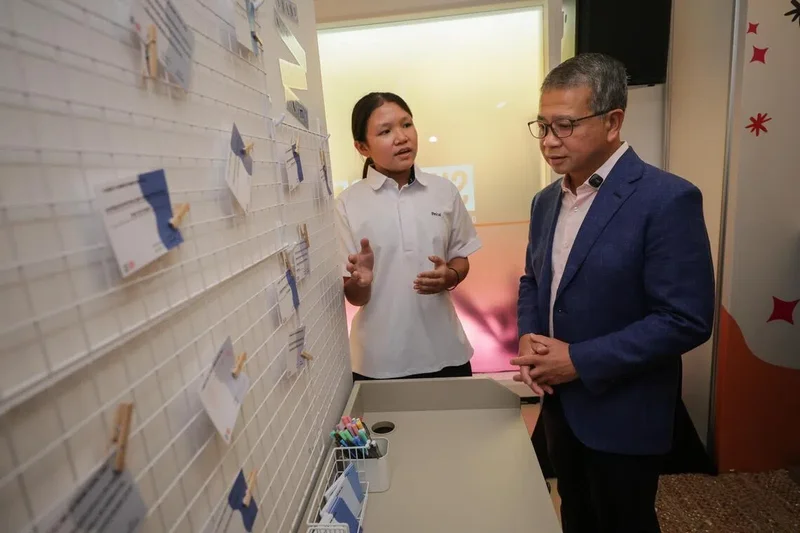
The open house, which will be open to the public on July 25, features interactive exhibits such as a telephone booth for the public to record short video messages with words of encouragement for online harm survivors.
A survey done by the non-profit in April found that nearly four in 10 people in Singapore have personally experienced at least one online harm in their lifetime. A total of 1,048 Singapore citizens and permanent residents aged 15 and above took part in the survey, which was conducted before the OSC began operations.
A quarter of respondents said they have experienced at least one online harm in the past year.
Four in 10 of online harm survivors said they experienced at least one severe impact, such as mental health challenges, impact on their physical health, and financial losses.
“This reflects the state of where we are today, but we are committed to making sure that this is a number we’ll bring down continually,” said Tong.
Preliminary findings from another study done by SHE on gender norms perceptions were released on July 23, indicating that younger men are more likely to accept spousal violence in a marriage.
These findings are a reminder that harms to do not arise in a vacuum, and are often rooted in values and beliefs that can become normalised if left unaddressed, and find expression in the form of harassment or other harmful conduct, said Tong.
“We are not, and must not be, a society that condones violence, whether against women or men,” he added.
“Strengthening online safety therefore is not just about regulating what happens online. It requires the challenging and breaking down of harmful gender beliefs and stereotypes, whilst at the same time reinforcing norms of respectful and responsible engagement with another.”
SHE’s online harms survey also found differences in the experiences of men and women.
Overall, 43 per cent of male respondents reported they had experienced online harms compared to 32 per cent of female respondents.
And among youth aged between 15 and 34, females were more likely to face online sexual harassment than males, while males were more likely to face cancel campaigns and inauthentic intimate image abuse, such as sexual deepfakes.
Nearly four in 10 respondents said they felt safe using social media platforms and digital services, while a slightly larger proportion said they were neutral. Nearly two in 10 said they did not feel safe using such services.
“Increasingly, people are choosing to self-censor, (and practice) silence and disengagement over digital participation because they fear being targets,” said SHE’s chairperson Stefanie Yuen Thio, adding that this should not be the response to the Internet.
“One of the most serious things our survey has revealed is that there are real implications for how conversations online are now less representative, can be less diverse, and are less honest in a world where people look to online spaces as sources of information and community.”
When asked what support they find helpful after experiencing online harm, respondents cited needing help with reporting harmful content to the authorities or online platforms, easily accessible information on legal rights, emotional support or counselling, and help in developing personalised safety plans.