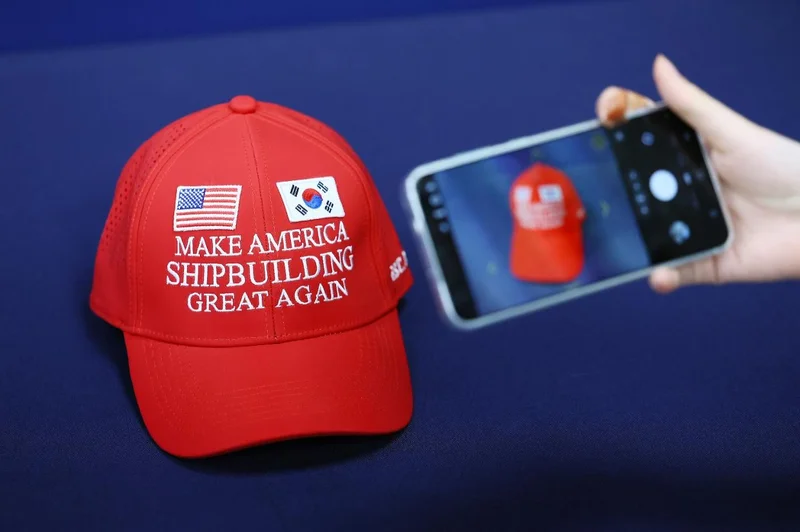
Korea's three major shipbuilders — Hanwha Ocean, HD Korea Shipbuilding & Offshore Engineering (HD KSOE) and Samsung Heavy Industries — are expanding cooperation with the United States across a wide range of areas.
Taking the launch of the Korea-U.S. Shipbuilding Partnership Center as an opportunity, they are broadening partnerships in naval ship design and construction, smart shipyard development, workforce training and supply chain expansion, positioning themselves as key contributors to Washington's efforts to rebuild its shipbuilding industry.
The two countries had previously agreed to allocate $150 billion of a broader $350 billion investment package toward shipbuilding cooperation.
Hanwha Ocean signed a Professional Services Agreement with Leidos to design the Global Fast Sealift (GFS), advancing an April memorandum of understanding (MOU) to collaborate on next-generation naval ship design, strengthen U.S. shipbuilding capacity and pursue global defense opportunities. Leidos subsidiary Gibbs & Cox has designed more than 70 percent of U.S. Navy surface combatants since World War II.
The dual-use vessel is designed to serve commercial logistics during peacetime while transporting military supplies at high speed in times of conflict.
Hanwha Ocean also signed MOUs with Hanwha Philly Shipyard, Delaware County Community College and Philadelphia business groups to develop shipbuilding workforce training programs and strengthen the local supply chain.
"Hanwha Ocean is fully prepared to contribute to the revitalization of the U.S. shipbuilding industry and the continued advancement of Korea’s shipbuilding sector," said Jung In-sub, president and head of the Management Support Office at Hanwha Ocean.
HD KSOE, the shipbuilding intermediate holding company of HD Hyundai, signed a definitive agreement with Germany's Siemens Digital Industries Software to introduce a next-generation marine platform that digitally integrates the entire shipbuilding process, from design and production to supply chain management, quality control and maintenance.
The platform will use artificial intelligence (AI), digital twin technology and a single 3D data model to connect every stage of ship construction, helping shipyards share real-time design changes and production data as part of efforts to rebuild and modernize the U.S. shipbuilding industry.
The company also plans to build a virtual shipyard capable of simulating production processes and equipment operations as it pursues an AI-driven autonomous manufacturing system incorporating robotics and automated production facilities.
"AI is more than a productivity tool. It is an innovative technology that will redefine how the shipbuilding industry operates," HD KSOE CEO Kim Hyung-kwan said.
Samsung Heavy Industries, meanwhile, highlighted cooperation in ship design, autonomous vessels, workforce development and research.
The company obtained approval in principle from the American Bureau of Shipping for the basic design of a 12,000-cubic-meter liquefied natural gas bunkering vessel developed jointly with Conrad Shipyard.
Samsung Heavy also signed a strategic partnership with U.S. startup Saronic Technologies to jointly develop autonomous surface vessels and AI digital solutions, while agreeing with MRO partner Vigor Marine Group to establish a training center in the U.S. Pacific Northwest for welding and painting workers using augmented and virtual reality technologies.
"The launch of the Korea-U.S. Shipbuilding Cooperation Center marks a new milestone for bilateral shipbuilding cooperation," Samsung Heavy Industries CEO Choi Sung-an said.