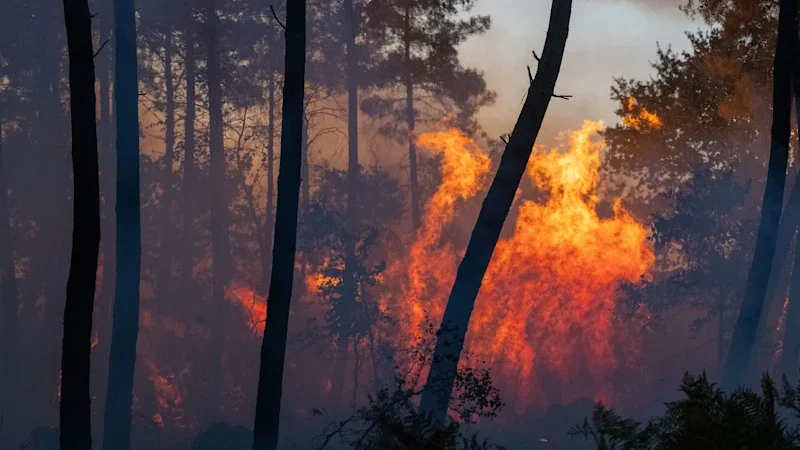
London: Tens of thousands of people are fleeing wildfires in southern France after flames spread rapidly through areas busy with families on school holidays, in the latest emergency of a European summer marked by intense heat and dry conditions.
French authorities said more than 700 firefighters were trying to contain a blaze around the Bay of Arcachon, a tourism hotspot west of Bordeaux.
They ordered the total evacuation of the Cap Ferret peninsula on Friday morning, with residents and tourists told to assemble at piers in four villages to leave by boat, or else use the only road linking to the mainland. The fire has already devastated 8700 hectares and is still raging.
French President Emmanuel Macron said he had requested help from the European Union, which funds support including firefighting aircraft.
French authorities had earlier ordered the evacuation of about 12,000 people from the area around the Bay of Arcachon, while another 8800 were being moved as a precaution.
“Overnight, the fire spread more quickly than we had imagined,” said Philippe de Gonneville, the mayor of Lège-Cap Ferret.
The pressure on fire departments in south-western France has been increased by another wildfire that began on Thursday afternoon near Biscarosse, 40 kilometres south of Cap Ferret.
That fire, which is still not under control, had devastated 2500 hectares, the prefect for the Landes area, Gilles Clavreul, said in a statement.
“Winds are blowing, and the situation remains highly dynamic and unfavourable,” he said. More than 23,000 people were evacuated from the Biscarosse district, mainly in campsites and homes. A children’s summer camp and a residential care home for the elderly were also evacuated.
Wildfires have also spread in Spain and Italy after the heatwaves of the northern summer, while a fire also spread in a district south of Paris, blamed on arsonists who lit the flames in the Fontainebleau forest near the capital.
The emergencies highlight the ongoing threat from the intense heat, when the French public health agency has estimated an “excess mortality” of 5764 deaths between June 17 and July 2, as temperatures soared above 30 degrees.
The death toll remains below the statistics reported during a similar heatwave in 2003, although the estimate is yet to reflect the impact over the full summer.
Macron said two firefighters lost their lives while responding to a fire near Bordeaux’s airport.
“I extend to their families, to their loved ones, and to the firefighters of France the condolences, the gratitude, and the support of the nation,” he said.
In neighbouring Spain, authorities were still working to put out fires that have raged for several days, while in Italy, a 59-year-old firefighter died after falling ill while battling a large wildfire near San Cataldo in Sicily.
Train traffic on Spain’s Madrid-Barcelona high-speed rail line resumed on Thursday after a wildfire near the tracks prompted the suspension of services between Mejorada del Campo and Alcalá de Henares, east of Madrid.
Europe is bearing the brunt of a rapidly warming climate, with temperatures rising more than twice as fast as the global average.
In Italy, arsonists were reported to have tied rags to the tails of cats and set them alight, causing wildfires.
Investigators also found candles and delayed ignition devices in the aftermath of the fire, according to the London Telegraph. The blaze spread through the Pollino national park in Calabria in southern Italy this week.
“These animals were released into the fields, running around and spreading the fire,” said Domenico Costarella, of Calabria’s civil protection agency.
The Reuters Climate Monitor, an interactive tool tracking weather patterns, showed that the average high across Western Europe is forecast to be 26.5 degrees on Thursday, 2.9 degrees above the normal high for July 23 over the period from 1961 to 1990.
With Reuters