[Today’s Iran war post launched before complete. Please return at 8:00 AM or refresh this page then for a final version]
Trump has not only intensified his rhetoric but the US continues to move military assets into the Gulf region. Despite independent military experts saying to a person that the US cannot defeat Iran, the Fox News nutters and other hawks who have Trump’s ear push barmy plans with high odds of failure, like seizing islands. They depict what at the very best would be minor tactical gains as knockouts that would bring Iran to its knees, as opposed to further stiffening Iranian resolve.
Trump also freshly re-tweeted:1
Troublingly, Trump’s inner circle is openly, on TV, calling not just for rejecting negotiations but a renewal of assassinations of the leadership. Either they are so cloistered that they have no idea how bad this looks or they are seeking to normalize it, at least to the American public:
🚨 NEW: RETIRED GENERAL KEITH KELLOG SAYS TRUMP MUST "DECAPITATE" IRAN… WOAH💣
"DECAPITATION MUST continue… TAKE IRAN'S ISLANDS, give POTUS LEVERAGE"
"I'm not negotiating with these guys… we're gonna DICTATE the terms of the WAR" 🔥 pic.twitter.com/8RQI4WSJ8i
— Jesse Watters (@JesseBWatters) July 22, 2026
That is a sign that the desperation and anger in the White House has reached an even more fevered level. One confirmation comes in a new talk between Trita Parsi and Mario Nawfal. The normally emotionally contained Parsi, who has been consistently optimistic about the possibility of a negotiated outcome, is, in his measured way, in despair. He assesses the odds that the war will resume in the next month at a more intense level than in first 40 days at 80%:
In another effort to restore Trump’s flagging manhood, the official US policy is to seek a head for an eye:2
SECRETARY RUBIO: "The President's policy is a head for an eye." pic.twitter.com/VcUExOl8Kr
— Department of State (@StateDept) July 23, 2026
Robert Barnes, via Daniel Davis, confirms what many have suspected, that Trump, having surrounded himself with boot-lickers, is being told only what he wants to hear. From Twitter:
Trump’s Iran War Delusion Exposed: Ignoring the Failure of the First 40 Days of Bombing, Trump Tries AGAIN to Force Open the Strait ⚠️
Robert Barnes (@barnes_law) lays out exactly how dangerous that has become:“There’s nothing we can do to open the strait militarily — that is the reality.” Yet Trump only accepts that truth on days when he is, as Barnes puts it, “mentally sober.”
He explains how Trump understood the severe economic, energy, and geopolitical risks when he signed the MOU — but then “keeps relapsing back into delusional Donald” after listening to Fox News generals and media cheerleaders.
Barnes details how Trump convinces himself that escalation will magically produce good outcomes: “The good thing is absolutely going to happen. The bad thing’s not going to happen.”
Meanwhile, CENTCOM has “not been forthcoming” about casualties, and Barnes warns the real number of wounded may exceed a thousand — including contractors not counted in official tallies.
He argues this is an unnecessary, counterproductive war enabled by a cabinet that won’t push back: “All you have are cowards for the most part other than Vance and Colby.”
John Mearsheimer re-confirms what many military experts have been saying for some time: that the US has run out of military targets in Iran and is now attacking civilian infrastructure:
From a lightly edited machine transcript:
Davis: What do you make first of all the statement [from former Administration official Robert Greenway] that because Iran can’t be trusted and they don’t they don’t meet any of their obligations, President Trump is, the word he used, compelled, to ratchet this up. What do you say?
Mearsheimer: I think he’s dead wrong. It’s the Americans who can’t be trusted…
Davis: And so what about his his comment there that we should be encouraged that President Trump has a resolution to this? So even though Iran is not doing what we want them to, forget about what the MOU actually said, but don’t worry because we have escalation dominance, do we?
Mearsheimer: Well, you want to remember that President Trump signed the memorandum of understanding on June 17th because he had no choice. The Iranians were winning the war and the Iranians held all the cards when you went up the escalation ladder. And this is why President Trump signed what was effectively a surrender document.
Now the question you have to ask yourself is what’s changed since June 17th that now gives us escalation dominance. I mean if we had had escalation dominance before June 17th we would have taken advantage of that and we would have used it to make sure we got a better agreement. The fact that we didn’t take advantage of it meant we didn’t have escalation dominance before June 17th.
So the argument here is that something has changed. Well, I’d like to know what is that something that has changed.
According to my calculations, we’ve been engaged in this tit fortat strategy since July 7th. Again, the memorandum of understanding was signed June 17th. We then welched on the deal and you got this tit for tat strategy starting on July 7th which is now taking place. And it does not look like it we have gained any coercive leverage over Iran as a result of that tit for tat strategy. They are matching us at every turn and causing us huge trouble in the Gulf. We don’t have escalation dominance.
Now, is the administration saying that we can escalate further? We can be we can go beyond tit for tat, maybe go back to the 40-day war, which was a real strategic bombing campaign that took place between February 28th uh and April 8th, we can go back to that and we’ll win that conflict. I don’t think so. There’s no evidence we can do that. uh and there’s no evidence that continuing tit for tat even at a higher level is going to produce uh the desired outcome for the United States.
Even the CIA has reached the same conclusion:
🚨 BOMBSHELL! CNN confirms the CIA officially assessed that Trump's nightly bombing campaign is completely failing to move Iran.
The Pentagon's strategy is a total disaster.
The White House is panicking as the disastrous war causes oil prices to skyrocket. Total failure! pic.twitter.com/iI3OfD3ldp
— Furkan Gözükara (@FurkanGozukara) July 23, 2026
The open rage from Administration officials confirms that the US thinks that sort of punishment campaign can bring Iran to its knees. Robert Pape says that the long historical record shows that that is not true. But contrary to Mearsheimer and Pape, the US is bringing an awful lot of additional firepower into the region.
Even though Trump is famous for his TACOs, and the Iran has repeatedly described how it can and will bring about a global depression via the destruction of petrostate energy assets, Administration actions, in connection with the extremely belligerent language, suggest that Trump will indeed try to escalate kinetically. From Hamidreza Azizio on Twitter:
Signs of a Major Escalation in the U.S.-#Iran War
🔹Multiple developments over the past several hours suggest that the U.S. war on #Iran may be approaching a significant escalation.
🔹Last night’s U.S. strike on the Shalamcheh border crossing between Iran and Iraq has been interpreted as a possible preparatory move for the deployment of special operations or ground forces. Alternatively, the strike may have been intended to facilitate the advance of armed insurgent groups.
🔹In the same context, the drone strike on the Al-Abdali border crossing between Iraq and Kuwait was likely carried out by Iran or its Iraqi allies in an effort to disrupt the U.S. logistical corridor linking the two countries.
🔹Meanwhile, reports indicate that shelters have been opened at multiple locations across Israel. Similar measures preceded earlier escalations, including the 12-Day War and the 40-Day War, suggesting that Israeli authorities are preparing for possible Iranian missile attacks.
🔹France and the United Kingdom have also reportedly evacuated their embassies in Iran as of today.
🔹Trump, for his part, has declared that he holds Iran responsible for Houthi attacks on shipping in the Red Sea and the Bab al-Mandab Strait. This statement could provide a pretext for intensifying U.S. strikes against Iran in response to future Houthi operations.
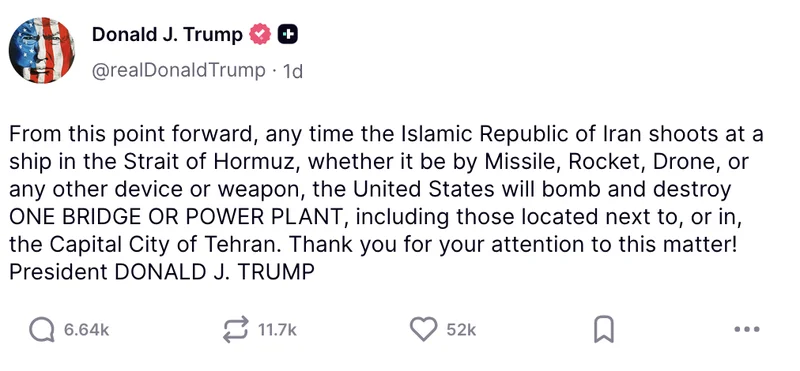
🔹The warning should be viewed alongside Trump’s earlier statement on Wednesday that any future Iranian attack on shipping in the Strait of Hormuz would be met with a U.S. strike on an Iranian bridge or power plant. He has also indicated that a U.S. attack on Iran’s underground nuclear facilities at “Pickaxe Mountain” is inevitable.
🔹At the same time, the United States appears to be reducing its military presence at bases closer to Iran, including in Qatar. Open-source reporting also points to a large-scale transfer of military equipment from the United States and Europe to Israel, along with increased activity by reconnaissance, command-and-control, and electronic warfare aircraft across the region. The United States has also deployed B-1 strategic bombers to the theater.
🔹Iran has warned that any attack on its infrastructure or nuclear facilities will be met with comparable strikes against regional targets. Several Iranian analysts also argue that, should the United States substantially intensify its campaign, Iran would likely strike strategic targets inside Israel regardless of whether Israel is directly involved in the operation.
🔹Overall, these developments suggest that the conflict may be entering a more dangerous phase, potentially comparable to the peak of the 40-Day War.
Even with the US openly putting Iranian energy infrastructure on the menu, attacks on the grid will have limited effects due to decentralization. From Global 21 Destroying Iran’s Infrastructure Is a Hard Task, and There Are No Effective Means to Do It at Scale
To obliterate both the electrical and oil sectors, multiple waves of missiles and guided bombs would be required against each of these targets. We are talking about 6,000 to 10,000 projectiles.
In many countries, striking the power grid would create immediate chaos and constitute a terrifying threat. In Iran, however, the task is far more difficult.
The Iranian electric grid is one of the most decentralized in the world, with around 130 to 150 large power plants, primarily gas-fired thermal plants. No single facility dominates large portions of the country’s electricity generation. The largest plant, Damavand near Tehran, has a capacity of approximately 2,868 MW, only about 2.9% of total installed capacity.
Other major plants, such as Shahid Salimi Neka, Rudeshur, Kerman, and several hydroelectric facilities on the Karun River (including Karun-3), range from 1.6 to 2.2 GW each. Even combined, the five to ten largest plants account for less than 15-20% of total capacity. The rest is spread across dozens of smaller and medium-sized facilities.
When these medium-sized plants and small distributed power stations are added, the total number of generation points connected to the national grid exceeds 1,000. This forms a highly decentralized system explicitly designed to withstand high-intensity conflict.
To effectively paralyze Iran’s electricity supply, an adversary would also need to target the transmission and distribution network, which stretches over 133,000 kilometers, and exceeds 1.3 million kilometers when rural and urban lines are included.
Adding Iran’s oil and derivatives infrastructure makes the challenge even greater. This sector includes approximately 350 to 400 main facilities distributed among processing, storage, and export units. These comprise 9 main refineries, 66 drilling platforms, and more than 10 large complexes, occupying a combined area of over 500 km² spread across Iranian territory.
To obliterate both the electrical and oil sectors, multiple waves of missiles and guided bombs would be required against each of these targets. We are talking about 6,000 to 10,000 projectiles, attacks that would take weeks. The ammunition simply does not exist in the American arsenal available today, except for short-range bombs. Those short-range bombs would force aviation deeper into Iranian airspace, significantly increasing aircraft losses.
But the Trump team may go even more directly after the means of survival in Iran, as in water and grain stores. From Brett Erickson on Twitter:
My concern about Trump’s (apparent) willingness to escalate here is what the most likely escalation pathway is.
While many point to the bombing that has taken place over the past week, the movement of aircraft and assets into the region, and clear choreographing of what could be a limited boots on the ground operation… that’s NOT what is most likely.
The most likely option is that President Trump moves forward with, at least, Bridge and Power Plants Day.
This isn’t about “reopening the Strait of Hormuz”, this is about terrorizing the Iranian civilians. Plain and simple.
My concern however, is that he won’t stop here. Many of the most vicious Iran Hawks, the very same people that have overwhelmingly driven our Iran strategy thus far, are pushing for Trump to go much further.
They’re calling for Trump to strike water storage facilities. Wheat storage. To bomb vital economic infrastructure in Iran that would devastate the civilian population. To force inflation to skyrocket, the Rial to collapse, unemployment to wreak havoc.
My concern is not (necessarily) that Trump will put 50,000 boots on the ground to seize Qeshm and Larak.
My concern is he will systematically target and destroy large swaths of civilian and economic infrastructure to terrorize the civilians of Iran. To create a TRUE economic crisis. A humanitarian emergency.
And of course, Iran will retaliate in an even more devastating way… I’m just not sold that Trump cares about that anymore.
Echoing Erickson’s notion that Trump no longer cares about sending the world into a depression, more evidence that the Administration is retreating further into its cognitive bubble is Trump’s apparent lack of concern that oil has risen to over $100 a barrel. Readers report sudden jumps in gas prices at the pump. Trump has abandoned his practice of trying to reassure markets with “A deal is nigh!” patter either directly or though anonymous sources to Barak Ravid of Axios. He is instead using Axios to signal his commitment to more violence against Iran, with no consideration for collateral damage. From Exclusive: Trump “close” to decision on “massive attack” on Iran:
President Trump told Axios on Thursday that he’s seriously considering restarting major combat operations in Iran — including strikes that would be bigger than the ones carried out during Operation Epic Fury.
Why it matters:In a brief interview, Trump acknowledged that such a decision would have consequences and stressed he hasn’t made a determination yet.
- Trump didn’t give a deadline for his decision. Two other U.S. officials confirmed no call has been made and no new orders have been given to the military….
What he’s saying:“I am considering a massive attack. Bigger than ever before. I am close to making a decision. We are all set for it,” the president said.
- Trump said Israel “would join in two minutes if I ask them to,” but added that “we don’t need anybody” to launch a new operation against Iran.
- He also said there would be “consequences” for Israel joining the strikes, hinting at Iranian retaliation against Israel.
The big picture:Trump said the Iranians “want to negotiate” but are not ready to make a deal at the moment.
- “They haven’t received enough pain yet,” he said.
- Two regional sources with knowledge of mediation efforts said Iranian leadership hasn’t accepted the latest proposal put forward.
- “We are trying, but the Iranians are not being helpful,” one of them said.
Trump’s team may take undue comfort from their view announced earlier this week, that they can run the Strategic Petroleum Reserve down to much lower levels than experts had thought. We quoted this section from DropSite in yesterday’s Iran war post:
DropSite reports that the US plans to go even lower that we has posited [150 million barrels]:
U.S. DOE claims that petroleum reserve can run far lower than previously estimated: A spokesperson for the U.S. Department of Energy told MarketWatch on Tuesday that the U.S. Strategic Petroleum Reserve’s “true operational minimum” is roughly 70 million barrels, well under the 250 to 300 million barrels the oil industry has generally treated as the practical limit.
The SPR, which has drained to its lowest level in 40 years, has roughly 246 barrels remaining for emergencies, the DOE claimed. It has shed more than 104 million barrels since the beginning of the U.S. war on Iran.
Not surprisingly, readers were skeptical. From comments:
TJBuffSo somebody told the WH that they could draw down the SPR to 10% of cavern water volume? And no problemo? I wonder whose butt they pulled that number from.
DingleberryTrumpty Dumpty will collapse the caverns if That’s What It Takes™️ and leave the problem for the Next Stooge™️ to solve. Great Success! 👍
The oil market continues to be rattled, albeit arguably not enough. From the Financial Times:
Oil prices hovered near $100 a barrel on Friday after crossing that mark for the first time since May the previous day as Donald Trump said he was weighing a “massive attack” on Iran and tensions escalated across the Middle East.
Brent crude, the international benchmark, was down 1.7 per cent at $99.02 in morning trading in Europe. It had risen as high as $102 on Thursday after attacks by Iran-backed Houthi militants in the Red Sea threatened to squeeze global supplies further and reignite a global inflation shock.
Oil had extended its blistering rebound this month after the Houthis said they had attacked two Saudi Arabian tankers following their move to impose a maritime blockade on the kingdom this week, adding to fears that the US and Iran are headed for a return to full-blown conflict….
Trump made escalatory threats against nuclear and civilian Iranian targets this week, saying that US forces would strike Iran’s nuclear facility buried deep under Kolang Gazla — known as Pickaxe Mountain. He added later that the US would destroy an Iranian bridge or power plant each time Tehran’s forces target a ship in the Strait of Hormuz.
Trump also on Thursday warned the Houthis and Iran that they would face “major military punishment” if the attacks continued, and later said “any and all damages done” to ships and cargo “will be paid for by Iranian Money that the United States has in its possession, and controls”.
“This continued escalation is worrisome to markets,” said Bill Campbell, a portfolio manager at DoubleLine. “Oil is spiking at a time when things are much more precarious.”
“Last time around I was more confident there was an off-ramp for President Trump. This time around it feels much more serious,” he added….
The oil surge also hit bond markets as investors bet that big central banks will have to lift interest rates more quickly to contain the resulting inflation. The European Central Bank on Thursday warned “the full inflationary impact of the energy shock has yet to play out” as it kept borrowing costs on hold.
US 10-year borrowing costs climbed 0.05 percentage points to 4.71 per cent, an 18-month high, while German 10-year yields touched their highest level since 2011 at 3.21 per cent.
Bloomberg’s landing page works hard to find some cheery news, per the “stocks get some relief” ‘headline:
Some sober assessments from Twitter:
Strait of Hormuz over the last 24 hours: Oman lane is dead.
Visible traffic continues to be nonexistent in the Oman lane, but the Iranians reported that 3 vessels attempted to transit with US escorts only to have one get attacked. The other 2 turned around.
With the Bab… pic.twitter.com/gaqfPaA9Jf
— HFI Research (@HFI_Research) July 23, 2026
Oil just crossed $100 and the market is screaming shortage
Something snapped in the oil market this week.
Buyers are now paying about eleven dollars MORE for a barrel delivered in September than one in December, a flip that only happens when somebody needs the fuel right now and doubts it will be there later.
Chris Martenson has tracked these signals for two decades, and he points past crude to what people actually burn.
Jet fuel in Rotterdam hit roughly $158 a barrel this week.
Diesel sat near $148.
American diesel and heating oil just printed their highest prices ever recorded.
Then came the move nobody could paper over.
Overnight trading, usually dead hours with thin volume, ran daytime-sized numbers as Brent punched through $100 and Treasury yields climbed right alongside it.
Traffic through Hormuz has collapsed to four or eight ships a day, down from 125 or more.
Saudi Arabia is rerouting crude to bypass its own backup route.
Empty tanks cannot be talked down, and the arithmetic runs out by September.
Even with the surge in crude, refining margins aren't falling that much because global product storage is low.
As a result, product prices will squeeze higher with crude, creating a vicious cycle. pic.twitter.com/qdQTi6jDio
— HFI Research (@HFI_Research) July 23, 2026
Some speculate that Trump may have reconciled himself to losing the House in the fall and facing impeachment proceedings, but is sufficiently confident that a impeachment process would fail to garner the needed 2/3 vote in the Senate to remove him.
Trump has added that Iran’s frozen assets will be stolen:
Recall that Ursuala von der Leyen and other top officials were keen to purloin Russian frozen assets to fund the Ukraine war. But in the end, ferocious opposition from Euroclear, which would be first in the liability line of fire, forced the advocates to stand down. A more abstract but as real worry was that investors would become loath to keep financial assets in Euro accounts out of concern of the risk of expropriation.
On the kinetic front, due to the length of this post, we will give only brief treatment of Iran’s warning to the UK. At a minimum, this means the UK base in Cyprus is now officially on the menu.
From ISNA, translated from Persian by Twitter:
IRGC to UK: We warn the Kingdom of England, which has had the greatest involvement in the recent US and Israel aggressions, not to further burden its own case; any base used for aggression against Iran is a legitimate target for us.
And from Soureh on Twitter:
IRGC: We will no longer allow the US to restock its oil and ammunition reserves with deceptive ceasefires and then resume attacks.
The aggressive US military, which used to launch cruise missiles from its ships in the Indian Ocean in its aggressions after the official resumption of the war, turned to using B1 aircraft flying from the UK’s Fairford Air Base yesterday, as the missile reserves of these ships ran out. Any base used to invade Iranian territory is our legitimate target.
And:
Iran has issued a direct threat to the UK, saying that it's facilitated US and Israeli military operations against it and and that there could be consequences. Jiyar Gol explains #IranWar pic.twitter.com/syq9gvtM00
— Jiyar Gol (@jiyargol) July 23, 2026
Additional kinetic short takes:
⭕️ IRGC Announcement No. 46 said the 26th wave of "Operation Nasr 2" targeted U.S. forces in Kuwait in retaliation for a U.S. strike on an Iran-Iraq border crossing used by Arbaeen pilgrims.
➤ A U.S. electronic warfare unit at Al-Adyeri base was struck and, according to the… pic.twitter.com/gUWK70FXea
— Drop Site (@DropSiteNews) July 23, 2026
BREAKING: Iran has launched strikes targeting the U.S. Navy's Fifth Fleet headquarters in Bahrain, with footages showing direct impacts following a fresh wave of Iranian attacks. Thick plumes of black smoke were seen rising from the area. pic.twitter.com/vJb4ZVEU6k
— The Hormuz Report (@HormuzReport) July 24, 2026
When we return, we will add a short section on the created and now killed by Trump Saudi nuclear “deal”.
1 Recall Trump said yesterday he was holding Iran responsible for Ansar Allah actions:
2 Professor Marandi is only one commentator, but as you can see below starting at 6:30, both he and Judge Napolitano were laughing at Rubio’s remarks: