Karkkadakam was usually not the most desirable of months. It rained incessantly, there was sickness and scarcity, disease and death. When everything turned grey and gloomy, people devised ingenious ways to stay healthy and positive. They relied on belief and built rituals around them to help cope with the harshness of the season. While many of these rituals disappeared with time, a few still remain.
Theyyam for hope
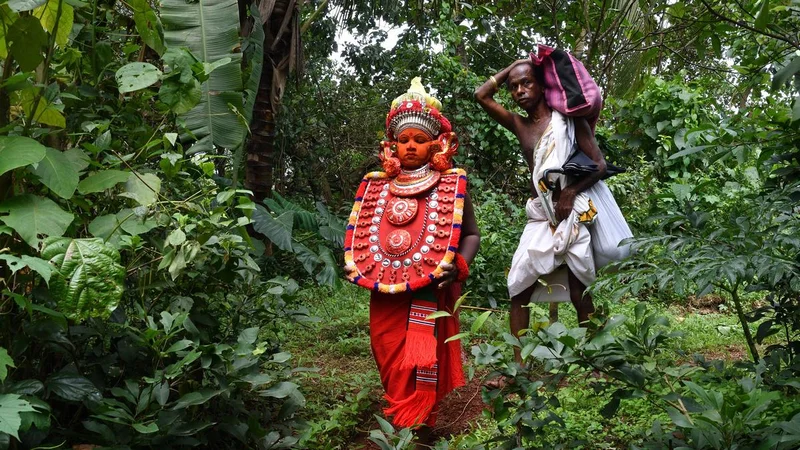
In the northern regions of Kerala, from Kannur up to Kasaragod, Karkkadaka Theyyams appear, bringing with them a sense of hope and prosperity. In unrelenting rain, amid the beats of the chenda, these Theyyams arrive, singing the songs of the Gods. These are usually performed by children from the designated communities. Among the Karkkadaka Theyyams in Kasaragod region are the Aadi Galinchan, performed by the Nalkadaya community, the Karkkadothi Theyyam, performed by the Vannan community and the Aadi Vedan Theyyam performed by the Malaya community. In Kannur, Karkkadothi and Vedan and the two Theyyams that are performed during the month. Families offer rice and money to the performers.
“The belief is that they remove all the negativity surrounding the season, including diseases and death and ring in a sense of positivity. The reason why children are chosen is that their innocence is believed to bring in prosperity,” says Venugopal Panikker, a former English teacher and Theyyam performer from Kanayi, near Payyannur, Kannur.
It has a socio-economic aspect as well, adds Venugopal. “By May, the Theyyam season ends and and the artists have no work and means of income. This way, the families are able to tide over the difficult season,” he adds.
Leave, Chetta
Warding off chetta and welcoming Sheevothi is the most popular ritual, still practised in many parts of Kerala, with regional variations. On Karkkadakam eve, chetta or Jyestha Bhagavathy who stands for all things “dirty” is asked to leave and her younger sister, Sheevothi or Sree Bhagavathy who personifies prosperity, is welcomed in. The entire process resembles a performance of sorts. One of them being the practice of taking turmeric, charcoal, coconut shell, coconut fibre, broom, taro plant and soil from four corners of the house and placing them in a clay pot or a basket and discarding them while chanting ‘Chetta po... Sheevothi’. This is both a call for the bad to leave and an invocation of the good. This is prevalent in parts of Palakkad district and north Malabar.
Here, on the first day of Karkkadakam, families perform Sheevothi vakkal, where a traditional lamp is lit and objects such as valkkannadi (traditional mirror) and dashapushpam (ten sacred flowers) are arranged. Holy texts are also kept, usually the Ramayana. Some even keep kajal, sindoor, turmeric, and a piece of sandal. Girls apply homemade mehndi on this day.
In parts of central and southern Kerala, warding off chetta is done on the last day of Karkkadakam so as to welcome the month of Chingam, the season of harvest. “When we were young, it was the senior most member of the family who used to do this. To welcome sheevothi we light the traditional lamp kept on a palaka (wooden pooja stool). Tulsi leaves and kindi (a type of pitcher with a sprouted aperture) filled with water are also kept. Back door is kept closed to keep chetta out,” says Remadevi P, a homemaker from Thiruvananthapuram, who has her roots in Kozhikode.
Alappuzha-native Rajasree Santhosh, now settled in Thiruvananthapuram, seconds this. “When you throw away the old things, you have to do that with your back turned,” Rajasree says. However, in some pockets of Thrissur, it is the youngest of the family who take out the discarded things in a clay pot placed on his head, saying ‘Pottiyum makkalum po po, Deviyum makkalum va va...’,” she says.
Appeasing Kaliyan
Another interesting ritual is Kaliyanu kodukkal, which is meant to appease the figure called Kaliyan, a mythical figure who is believed to ensure a good harvest. “The mango and jackfruit seasons are over by the time Karkkadakam begins. Since it is believed to be a month of scarcity and diseases owing to the rain, we exhort Kaliyan to ensure enough produce,” says young folk musician, Athul Narukara, who recently posted a Reel on his social media page about the ritual at his home at Manjeri in Malappuram district.
The midrib of banana leaves are cut in the shape of a little ladders and stairs. “We make the shape of a kaala (ox) from jackfruit leaves. A choottu (torch made with dried coconut leaves) is lit and all these are taken outside the house; homemade food is served in a coconut shell for Kaliyan. We keep chanting lines asking Kaliyan to bless us with a good harvest, and howl at the top of our voice. We had so much fun doing so. The practice, however, is slowly dying down,” says Athul, adding, “Another ritual is that my mother would pluck a taro plant (chembu) from the soil and hurl it on to the roof the house, standing with her back towards the house.”
Models of other agricultural equipment are also placed. In some households, these items are kept under a jackfruit tree in the compound.
A musical ode to the season
Towards central Kerala, around Ernakulam and Kottayam regions, a musical ritual known as Raveli vayana (also known as Blaveli vayana) is performed during Kakkadakam. It is a form of musical narration of the story of Lord Siva, which the singer performs, pointing to an illustration or painting with a bamboo stick. The singers are usually from the Veerasaiva community, and they visit homes in the mornings where they are welcomed by the families with a lit lamp and are offered a small dakshina (offering). “The singers used to come during the rainy mornings of Karkkadakam and would be welcomed with a sense of reverence. Nowadays, the practice is not prevalent, as few from the community continue this,” says TR Premkumar, founder of Moozhikkulam Sala, a space dedicated to natural living.
A pookkalam in the rain
Although pookkalam or floral carpets are laid only on the 10 days leading up to Onam, which falls in Chingam, in parts of north Kerala, pookkalam or floral carpets are laid from Karkkadakam itself. Also, Thiruvonam star in the month of Karkkadakam is observed as Pilleronam, a mini Onam with a feast but sans pookkalam and new clothes.
Food for the season
Karkkadakam also exerts its influence on the food consumed. Besides the Karkkadaka kanji (a medicinal gruel), some consume medicinal balls made with fenugreek (uluva) on the first seven days. “Fried and powdered uluva is mixed with jaggery, coconut and a medicinal mix available in shops to make the balls, which you have to consume on an empty stomach in the morning,” says Ramani C, a homemaker from Irinjalakkuda. These days she purchases the same from a Kudumbasree unit, Surabhi, in her neighbourhood. Dinsha Ramesh, a member of the unit says, “We have been making it for five years now. We usually buy 50 kg of uluva and dry it in the sun. To this we add cumin, aashali (garden cress), sathakuppa (dil), sesame, ayamodakam (ajwain), dried ginger, jaggery and coconut.”
For Dr Arya Naveen, it is that time of the year to consume kodangal (Indian pennywort), a medicinal plant, which she says helps develop immunity and aids digestion. “Add crushed or ground kodangal leaves and pepper powder to four teaspoons of buttermilk. Have it on empty stomach, but only two or three teaspoons. My mother, at times, adds the leaves to breakfast dishes such as idli or dosa,” she says.
Eventhough many people abstain from non-vegetarian food this month, in certain parts of Palakkad, it is a norm to have dosa with a chicken curry that has ash gourd in it for breakfast!
For the Brahmin community in Kerala, Tuesdays and Fridays of the month are special. “While pongal and thalagam (a mixed vegetable spicy curry) are prepared on Tuesdays, payasam is the special on Fridays. On the 18th day, we cook different rice varieties. We don’t recite Ramayana, instead we pray to Devi during this month,” says Sreevidya K, a homemaker from Thiruvananthapuram.
Published - July 24, 2026 02:51 pm IST