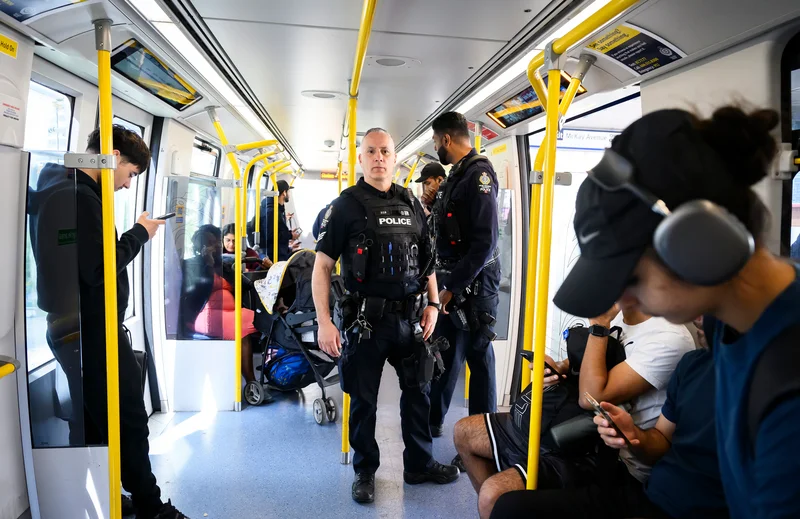
As concerns about public safety have risen across the country, the Ontario government is granting special constables the rare authority to arrest people for the possession and use of illegal drugs on transit systems.
The move will be the first practical test of such powers for transit administrators in Canada, experts say. Much like fully sworn police officers, constables will be able to arrest individuals, issue tickets for public drug use, destroy any seized illegal substances, such as cocaine or methamphetamine, and send drugs out for analysis.
Municipal transit services and police boards in Ontario are working to gradually enforce the new provincial regulation, which came into effect on July 1. Once it is implemented locally, the new powers will be awarded to special constables employed by major transit services, including southern Ontario’s Metrolinx, Ottawa’s OC Transpo and the Toronto Transit Commission.
Ontario officials, including Premier Doug Ford, have called the punitive measure a useful tool that would disrupt public misconduct and improve safety. They have linked the rise of open drug use to violence on transit, with Mr. Ford repeatedly stating in press conferences that “transit riders have had enough.”
But opponents argue that expanded policing is not an effective response to drug use, and risks further marginalizing a vulnerable population.
Ontario’s drug-arrest policy is “just removing people from one precarious place to another without addressing the root causes of their displacement,” said Thomas Kerr, a senior scientist with the BC Centre on Substance Use and professor of social medicine at the University of British Columbia, in an interview.
Over the last few years, police in cities such as Toronto, Ottawa, Winnipeg, Edmonton and Calgary have logged surging rates of violent occurrences on transit, leading to an escalated presence of uniformed officers on transit systems.
These systems have now become a visible display of converging crises.
Plagued by increased loitering, many bus and train stations function as informal and last-resort shelters, as wide-ranging homelessness, encampment shutdowns and the lack of affordable housing have displaced thousands of people.
Addiction rates, meanwhile, remain stubbornly high, while resources for drug users have declined: Ontario has closed down nearly every supervised drug-use site in the province, including at least six in Toronto.
In each of Canada’s largest cities, there exists at least some form of staff dedicated to curtailing crime on transit. Even in Ontario, earlier government bills had already allowed police and some special constables to force people to leave a public place if they were using drugs or causing a disturbance.
However, the authority to arrest individuals without a warrant is a rarity.
Save for British Columbia, where a police force patrols Vancouver’s transit system, such powers have not been allowed for transit employees in other provinces; even in B.C., records show the use of this authority for minor drug-law violations is highly uncommon.
“There is no evidence, no data of any sort, to suggest Ontario’s legislation would really help,” Kora DeBeck, a professor specializing in substance use and drug policy at Simon Fraser University, told The Globe and Mail.
Historically, transit police in Canada can be traced back to railroad forces in the 1850s. They were largely hired by private railway companies to protect trains and their cargo from freight robberies, though some railroad police were also dedicated toward fare inspection, pickpocketing, vandalism and drug-law violations on passenger trains.
Today, in most provinces, special constables and peace officers – usually unarmed – work in tandem with civilian security guards and local police to keep transit systems safe, issue fines and, in some cases, detain individuals.
For example, a new bylaw that rolled out in Edmonton last spring prohibited the use of controlled substances in public; in response, a larger number of peace officers started patrolling transit areas – but they have limited powers to arrest anyone without city police involvement.
Only Metro Vancouver employs a team of armed officers specifically for transit, who have the power to investigate crimes, recommend charges and make arrests.
The Metro Vancouver Transit Police, which became operational in 2005, is the country’s first dedicated service of its kind, and a separate entity from the Vancouver Police Department. With more than 200 police officers, 24 community safety officers and 106 civilian professionals, the MVTP serves an area spanning 23 communities and one First Nation in B.C.
When asked if the MVTP has observed a deterioration of crime since its founding, spokesperson Sunny Kainth said, between 2012 and 2025, the volume of crimes against persons reported to transit police declined by 19 per cent.
But while drug enforcement is a central plank of the MVTP’s mandate, Constable Kainth said the force handled only 150 drug-related files in 2025, representing just 0.7 per cent of its total caseload. Only a total of 22 charges were submitted for drug offences last year, he added.
Part of that, he explained, is the “local context.” Between 2023 and 2026, the B.C. government authorized a decriminalization program that allowed individuals to possess about 2.5 grams of opioids, psychedelics and other illicit drugs. As the province faced political pressure over open-air drug use, the government amended its laws to allow police, including the MVTP, to seize those drugs in public spaces in 2024.
The MVTP does not track data about arrests made specifically for drug-related offences. Anecdotally, even before decriminalization, both Dr. DeBeck and Dr. Kerr said drug-use arrests were uncommon on B.C. transit. The West Coast province is well-known for legislatively embracing a harm-reduction approach rather than adopting punitive measures for drug-law violations.
Dr. Kerr believes Ontario’s legislation would “create more problems” than it is hoping to resolve. Seizing drugs is harmful for people with addictions because it disrupts their supply without addressing their underlying health conditions, he said.
Citing some high-profile instances of excessive use of force by MVTP officers, he added that “explicitly allowing police to make arrests on transit would make many people in Ontario, especially people of colour, feel unsafe and further decline ridership.”
Asked whether Ontario is looking at B.C. or any other jurisdictions as a template for its new policy, Solicitor-General Michael Kerzner declined to provide an answer.
Speaking to The Globe at an unrelated event last month, he did not directly address questions about whether the province has seen any evidence linking the possession or use of illegal drugs to violent crimes on transit, or whether arrests would make communities safer.
“People are uncomfortable in transit when they see people carrying on like this. What we want to do is send a message of confidence,” Mr. Kerzner said. (A spokesperson from Mr. Kerzner’s office later sent an e-mailed statement that also did not directly answer The Globe’s questions.)
Lisa McDonald, communications and public policy director of Casey House in Toronto, a hospital providing care for people living with and at risk of HIV, said the issues the province is purporting to address stem from the homelessness crisis and severe shortage of shelter beds.
“While it can be distressing to see people who are unwell or under the influence of substances in public, we try and remind ourselves that there’s a difference between feeling uncomfortable and being unsafe,” she said. “And I think what this does is suggests that somehow this is a safety issue rather than a discomfort issue.”
Sarah Kennedy, president of the Ontario Special Constables Association, said she approves of Ontario’s measures, but is advocating for special constables to be authorized new weapons. Putting constables “in front of people that are unpredictable” is dangerous, she said, when they are largely only armed with batons, handcuffs and pepper sprays.
She argues that tasers should also be provided to constables on transit: “We don’t want to be out there swinging that baton around. We want a tool that protects distance. And a taser does that.”
For most municipalities, Ontario’s policy change will not be a relevant concern, said the Association of Municipalities of Ontario, which represents more than 440 towns and cities.
“Across the province, the bigger issue remains the steady rise in policing costs, which continues to challenge municipal budgets and local service delivery,” said AMO spokesperson Anne Marie Aikins.
The mayors of the Ontario cities of Sudbury, Brampton and Windsor told The Globe they welcome the provincial legislation, as safety has become a bigger issue in their cities. Nonetheless, each of them noted that jurisdictions with higher ridership volumes and urban density would be better suited to effectuate the policy.
TTC spokesperson Stuart Green said the power to arrest individuals for drug laws is simply another tool in the box for constables.
Before the TTC can begin to use this authority, it will need to work through the logistics of additional training for its staff on matters such as how to handle and store illicit substances, including narcotics, he said.
But Dr. Kerr worries about the precedent set by the new measure.
“We shouldn’t have to rely on police to create healthier or safer communities,” he said.
With reports from Jeff Gray, Molly Hayes and Laura Stone