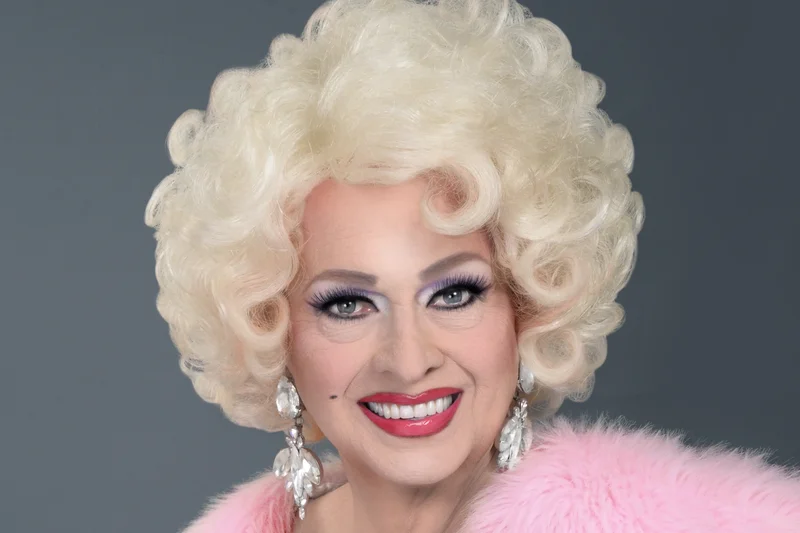
The queen is dead. Long live the queen.
Michelle DuBarry, Canada’s oldest drag queen, died in her sleep July 1 at the Rekai Centres in Toronto. She was 94 years old.
The entertainment legend presided over the Toronto drag scene for seven decades, getting her start at private parties in the 1950s at a time when the word “queer” was considered a nasty slur and drag was an underground, derided form of expression. She was part of a brave vanguard of performers who helped change that. She gained true fame in the 1970s as part of the groundbreaking drag troupe the Great Imposters. Then, as a solo act, she became a fixture on Church Street in the heart of Toronto’s LGBTQ community, celebrated for her glamorous looks and generous spirit. Hers was a unique and effective form of activism: her platform, the stage and her cudgel, a handbag and matching shoes.
“She was a legend,” friend Kevin Levesque says. “She paved the way for all of us.” Mr. Levesque is better known as Miss Conception, one of the more successful queens to come out of Toronto, who currently performs regularly in Provincetown, Mass. “She was our mother, she was our grandmother, she was everyone.”
Ms. DuBarry began life as Russell Alldread, born Nov. 23, 1931 in Bowmanville, a rural community east of Toronto. Russell’s family was poor: his father was a welder and his mother, a nurse. Theatricality and glamour called to him from an early age. He was very proud of a childhood photo showing him at the age of nine dressed in a strapless black velvet gown and fashion turban, a costume cooked up by some female cousins. Playing dress-up, singing and theatre were youthful pursuits. By 21, he had moved to Toronto and found a place to live on Church Street. That’s when his forays into drag began in earnest, during an era of police shakedowns and homophobic and transphobic witch-hunts.
“I only wish I could reach a lot of people who don’t even understand what it was like in the forties, fifties and sixties to be gay,” Mr. Alldread told Xtra Magazine in 2007. “The general public back then didn’t know anything about gay life, unless they saw someone very effeminate they could call a ‘queer.’ We had this double-life, these jobs during the day where you could be fired if you were found to be gay. I do occasionally meet a person from a new generation who totally understands, but very few. Most don’t know; most don’t want to know.”
His first job was working in the mailroom of Canadian Fairbanks-Morse, a munitions manufacturer. But Mr. Alldread would soon find his calling as a ladies’ shoe salesman, working at Town Shoes at Bay and Bloor.
“You see I’m queer for shoes,” he told Xtra Magazine in 2001.
In the 1960s, after a short marriage to a woman, Mr. Alldread began performing drag at alternative cabaret spaces and coffee houses in Toronto such as the 511, the Music Room, Global Village and Theatre in the Dell.
At first he was known as Anita Modé, an alter ego inspired by Canadian singer Juliette. By 1969, he had been rechristened Michelle DuBarry (after the 1943 Lucille Ball film Du Barry Was a Lady) and began touring with a troupe called Phase One. By 1972, Ms. DuBarry had co-founded a new troupe, the Great Imposters, with Rusty Ryan and Tammy Autumn. Less than three years after the partial decriminalization of homosexuality in Canada, the troupe became famous for plying the highways and byways of Ontario, playing small-town bars across the province.
“I had the van, and we packed up and drove around all of the northern towns as far north as Timmins,” Mr. Alldread told the CBC in 2021. “We moved into little hotels carrying our bags and got made up in our rooms, and then went out to do some shows in the little bars.” The Great Imposters was often audience members’ first exposure to the LGBTQ community, though, famously, many didn’t realize they were watching men in dresses.
Dean Odorico, long-time manager of popular gay bar Woody’s, saw Ms. DuBarry and the Great Imposters perform at a roadhouse in Sutton, Ont., on the shores of Lake Simcoe, when he was a youngster in the early seventies. “I got to help out behind the bar, like get the ice, even though I was underage,” he recalls. “So I got to see them on stage. They were hilarious, and the audience loved it. It was packed, and they were all having the best time.” And yes, he did know he was watching men in dresses. It can’t be coincidental that Mr. Odorico would go on to manage one of the premier drag venues in the country.
The original trio spent the next 10 years or so touring across Canada. The Great Imposters (and its offshoot, the Imposters), with a rotating cast of performers, continued for decades.
By the 1980s, though, Ms. DuBarry had had enough of touring and settled down to become a permanent fixture on Church Street in Toronto, regularly performing in bars such as Trax, the Manatee and the Stables. If she wasn’t performing she was out and about in full sparkly evening dress ensembles, holding court on a street corner or from a barstool, and supporting other drag performers – she always tipped. Ms. DuBarry’s smiling visage, in or out of drag, was a near constant presence. “Church Street really was her life, it was her oxygen,” performer Mr. J.J. Murray, a later member of the Great Imposters, says.
Ms. DuBarry worked tirelessly to raise funds for myriad good causes, during the terrifying early years of AIDS and beyond. “She showed up,” Mr. Odorico says. “She did every fundraiser under the sun, without getting paid. She showed up to help raise money for AIDS and for anything going on, for people’s birthdays, for bar anniversaries, for New Year’s.”
When performing, Ms. DuBarry’s look was always polished. But there was something unique about her performance style. “She didn’t know a stitch of lip sync, not a stitch, not a word,” Mr. Murray, considered one of the best lip-syncers in the business, says. When he would ask how she got away with it, she’d repeat her famous mantra, the words she’d mouth when she didn’t know the lyrics to a song: “Apples, pears, peaches and pies.”
“It’s what endeared her to a lot of people,” Mr. Murray says.
“And she was loving,” Mr. Odorico adds. “You can see that in a person”
In 1993, Ms. DuBarry was crowned empress by the Imperial Court of Toronto (TICOT), part of a North American network of LGBTQ social clubs built around a bejewelled mix of pageantry, protocol and philanthropy, raising funds for worthy causes.
It was around this time that Ms. DuBarry, then in her 60s, and Mr. Levesque, a young, rising star on the scene, became friends. “People weren’t hiring her for gigs any more,” Mr. Levesque says. “So I would let her do numbers at my shows because she deserved that recognition. She deserved to have the spotlight, always.”
In 2013, Ms. DuBarry was again crowned empress by TICOT. By this point the court was running out of superlatives. She was styled: “Empress XXVI, Michelle DuBarry, Queen Mother of all Ontario and Matriarch to the Imperial Court of Toronto, the Absolute Queen Mother Empress.”
Two years later, when she was 84, the Guinness Book of Records named Ms. DuBarry the “world’s oldest performing drag queen.” The next year, a usurper from Oregon surfaced who was one year older. Ms. DuBarry’s other achievements include being named grand marshal of the Toronto Pride Parade in 2007 and being a guest judge on Canada’s Drag Race in 2020.
In what might be considered an unusual move for a respected legal advocacy group, Egale Canada launched a campaign in 2019 to secure Ms. DuBarry a guest spot on her favourite talk show Ellen. “It was a combination of Michelle and her iconic status in the community and that advocacy piece that she brought to the space,” Egale executive director Helen Kennedy says. “As Michelle was aging, she was very engaged and committed to issues around seniors, queer seniors’ health, housing, long-term care, social isolation and chosen family and what it actually means.”
And while the campaign was unsuccessful it did raise the profile of issues that would come to the fore when COVID-19 shuttered DuBarry’s beloved Church Street and, a year later, she moved into long-term care after a dementia diagnosis.
Her unwavering commitment to the community “is to be cherished,” Ms. Kennedy says.
A small group of friends did their best to keep Ms. DuBarry connected to the wider world. She was grateful for their acts of kindness to the end.
One of Ms. DuBarry’s signature songs was a nineties ballad called We Can Be Kind, with the lyrics: “We can be kind/ We can take care of each other/ We can remember that deep down inside/ We all need the same things.”
Michelle DuBarry never forgot those lyrics; she lived them.
You can find more obituaries from The Globe and Mail here.
To submit a memory about someone we have recently profiled on the Obituaries page, e-mail us at obit@globeandmail.com.