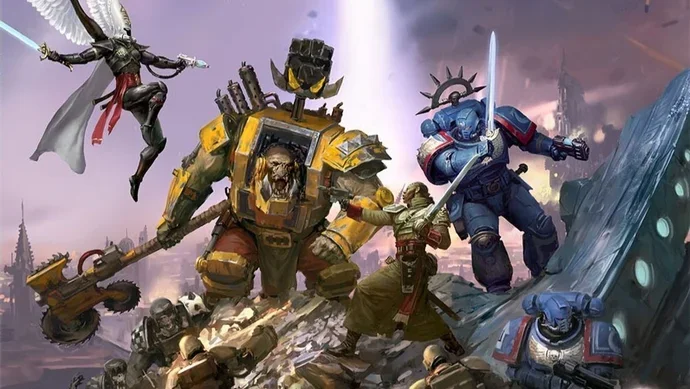
Perhaps predictably, Creative Assembly's Total War: Warhammer 40,000 could be quite the step change for how Total War handles ranged combat. Yesterday, the developers livestreamed a battle between the Imperium and the Orks, while chatting enthusiastically about the nuances of drop pods and flamers and evasion stats.
Like a gretchin war reporter – there are Ork journalists, right? Newswaaaagh? Gubbinzfeed? The Wall Street Choppa? – I've been running from foxhole to foxhole, jotting down notes. The conclusion I've come to is that the new strategy game could diverge quite significantly from the archers-behind-spearguys square dance of older Twars. Your units are more autonomous and also, more flexible and smarter in terms of who they shoot with what.
If you don't have an hour and a half spare, here are a few highlights. Firstly, army composition: as with the tabletop game, your units can be built out into proper combined arms forces, encompassing specialists such as commissars. Each individual warrior can be equipped with a variety of weapons, switching between them according to the context. Vehicles, similarly, may pack a bunch of different bolters, rocket pods and so forth, unleashing each weapon against the most appropriate victim. Some units have a "sweeping fire" option that spreads damage over the largest quantity of attackers. You can also suppress attackers for a stat cut.
Yes, older Total War units also had a choice of gear, but TwartyK's approach feels more organic and context-driven – for example, troops will switch to ranged fire during melee if they've got a shotgun handy for close encounters. Please excuse me referencing Aliens in a Warhammer article - I like to keep my readers on my toes. The game also simulates individual character behaviour with more complexity. Individual soldiers will target other individual soldiers, based on their weapons and the conditions.
Accordingly, units will also smear their fire across several enemy units, rather than focusing on one. When a unit is enveloped by several others, your gunfolk will defend themselves in all directions. Line of sight is simulated from individual to individual, rather than the unit as a whole, and the game will also track the contents of individual magazines.
Units can also now fire and perform other actions on the move, though they will be less accurate, depending on the unit and context: Space Marines are good at strafing, Imperial Guard prefer to dig in. There's a very appealing Sentry feature that lets you priority-target an approaching unit before they enter shooting range. Needless to say, cover - preferably, elevated cover - will be important. As will getting rid of any cover your enemies are using. You can drop buildings on units and gouge out fresh craters for your own gundudes to lurk in.
It's hard to know how impactful all this will actually prove without playing, but it feels like a Total War that's taking lessons from nippier, more freeform RTS games such as Dawn of War. Anyway, this is all the insight my gretchin reporter persona could muster before they got mulched by a Manticore. What do you make of it all? As ever, I'm keen to see how the Eldar handle. Read more about the factions here.
Read this next
- Total War: Warhammer 40,000's map destruction is "the biggest mental shift" for the strategy series in years, but "we've kept it to areas where it really works"
- Creative Assembly explain Total War: Warhammer 40,000's factions - the Eldar "play totally differently to anything we’ve ever done"
- Total War: Warhammer 40,000 devs detail future factions, and when you can expect official modding tools