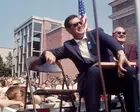
When Ted Williams, the last man to hit .400, was inducted into the National Baseball Hall of Fame, he had an iconic career to reflect on. But he decided to dedicate a portion of his speech to championing Black players who had been excluded because of baseball’s longtime color barrier.
“I’ve always been a very lucky guy to have worn a baseball uniform, to have struck out or to hit a tape-measure home run,” Williams said in his 25 July 1966 speech – 60 years ago Saturday. “And I hope that someday the names of Satchel Paige and Josh Gibson in some way could be added as a symbol of the great Negro players that are not here only because they were not given a chance.”
Williams’s plea helped build support to admit Negro League players into the Hall five years later, starting with Paige. Today, there are 37 former Negro League players in the Hall.
“That was a political speech,” Ben Bradlee Jr, Williams’s biographer, told Axios in 2024. “And Williams was so influential as a player, and this … had a huge effect.”
The famed Red Sox slugger was inducted alongside manager Casey Stengel, in front of a crowd of 10,000 people in Cooperstown, New York. Wearing a suit sans tie, Williams delivered a speech he said he had written the night before in his hotel room.
It came less than 20 years after Jackie Robinson had broken baseball’s color barrier with the Brooklyn Dodgers, and a year after President Lyndon Johnson signed into law the landmark Voting Rights Act of 1965.
Williams was no liberal. He was a huge fan of Richard Nixon, especially when Williams became manager of the Washington Senators in 1969, coinciding with Nixon’s first year as president.
“If You Don’t Like Policemen,” read a bumper sticker on Williams’s car, “Call A Hippie.” Senators broadcaster Shelby Whitfield, a friend of Williams, once described him as an “ultraconservative in the tradition of Barry Goldwater and John Wayne”.
But Williams, who had a Mexican American mother, had a progressive attitude toward Black players, dating back to his career. When the Red Sox in 1959 finally signed their first African American player, Elijah Jerry “Pumpsie” Green – becoming the last team in the majors to do so – Williams was one of the first players to greet him, Green told journalist Steve Buckley in 1996.
In 1971, MLB finally came up with a plan to admit Negro League players to the Hall of Fame. However, it was a convoluted PR disaster, calling for the admittance of one Negro League player per year “as part of a new exhibit commemorating the contributions of the Negro Leagues to baseball”. The justification for this separate treatment was that Negro League players didn’t have the required 10 years of MLB service to qualify.
Critics slammed the approach. Paige said, “I was just as good as the white boys. I ain’t going in the back door to the Hall of Fame.” Robinson urged him to boycott that summer’s induction ceremony.
“It’s not worth a hill of beans,” said Robinson, who had been inducted as the first Black Hall of Famer in 1962. “It’s the same thing all over again.”
In his autobiography, Commissioner Bowie Kuhn wrote that some in the MLB establishment didn’t want Negro Leagues players to be admitted at all – not even in a separate wing.
“I found unpersuasive and unimpressive the argument that the Hall of Fame would be ‘watered down’ if men who had not played in the majors were admitted,” he wrote. “‘The rules are clear,’ said my opponents. ‘You need 10 years of major league experience. Moreover, where are the statistics to support them? There was only sketchy and sloppy record keeping in the Negro Leagues.’”
“I thought these arguments were much too technical under the circumstances,” Kuhn recalled. “Through no fault of their own, the Black players had been barred from the majors until 1947. Had they not been barred, there would have been great major-league players, and certainly Hall of Famers, among them.”
But when Kuhn tried to go around the opponents with a plan for a separate Negro Leagues exhibit, he wrote, “A predictable furor ensued. Cries of ‘Jim Crow’ were heard. … I was placed under personal attack for putting forth the idea.”
Los Angeles Times columnist Jim Murray made that very point.
“The notion of Jim Crow in Baseball’s Heaven is appalling,’’ he wrote. “What is this – 1840? Either let him in the front of the Hall – or move the damn thing to Mississippi.”
MLB was forced to reverse course, and in August 1971 Paige was inducted as a regular member – the first player selected by the Committee on Negro Baseball Leagues. Although Paige played for several seasons in the American League – making his debut in 1948 at the age of 42 – he was inducted primarily because of his outstanding Negro League career. Between the Negro Leagues and the AL, he finished with a 132-82 record and a 2.83 ERA. Six white players and a former executive were inducted with him.
“I am the proudest man on the Earth today, and my wife and sister and sister‐in‐law and my son all feel the same,” Paige said. “It’s a wonderful day and one man who appreciates it is Leroy ‘Satchel’ Paige.”
Williams also felt gratified about his own induction speech.
“One of the things that I really am kind of proud of myself about is that in my induction into the Hall of Fame, nobody encouraged me on this, I thought this thing alone,” he told Bob Costas in 1993. “And I thought, ‘I’ve seen Satchel Paige. And I’ve seen Josh Gibson. And I heard about Buck Leonard. I heard about some of the other great Black athletes.’ And it just came out that day, that I wrote in my speech, that I hope someday, that the great Black players of the past, who only because of their color, never had a chance to play in the big leagues [are inducted]. And it hit a little note.”
Williams was not impressed with MLB’s original plan for a separate wing.
“They come out with, I gotta say, a half-assed program for the Black players to get into the Hall of Fame,” he said. “And finally they changed that … It was a very important move.”
In 1972, the year after Paige’s induction, Josh Gibson and Buck Leonard, two stars from the old Homestead Grays known as “the Black Babe Ruth” and “the Black Lou Gehrig”, were inducted into the Hall of Fame. They became the first inductees who played their entire careers in the Negro Leagues.
Gibson died of a stroke at the age of 35 in 1947, so his son, Josh Gibson Jr, accepted the plaque on his behalf. But Leonard, 64, was still alive and able to relish the induction on that August afternoon.
“My getting in is something I never thought would happen,” he said.
- Frederic J Frommer, a sports and politics historian who has written for the Washington Post, the New York Times, the Atlantic and other national publications, is working on a book on ’70s baseball.