- See more Daily Mail on Google - save us as a Preferred Source
On Monday, our new Prime Minister stood on the steps of Downing Street and declared: ‘In the 1980s, Britain took some wrong turns.
‘Political power was centralised, economic power privatised, large parts of the country de-industrialised, and they still haven’t recovered.’
By this he meant: Down with Thatcher!
It is an observable fact that the back-bench Labour MPs, especially those representing Red Wall constituencies, still have a visceral loathing of Margaret Thatcher, which borders on the fanatical.
It is understandable, even if it is unfair, that they hate her. Throughout her time as Prime Minister, Britain, in common with almost all European nations, failed to compete with American and Asian markets in the manufacturing industries. Having been the greatest shipbuilding nation in the world and a leader in steel production, motor-manufacture and hundreds of profitable skilled industries, we lost out.
Stoke-on-Trent and the surrounding district known as the Potteries, where I come from, used to employ nearly 80,000 people making the most useful and profitable ceramics in the world. Now, fewer than 5,000 people work in the Potteries.
It’s easy to blame Thatcher, but Andy Burnham and his cronies might instead ask his mother – who was shedding a proud tear in Downing Street as he entered No 10 – what it was really like when he was born in 1970, a time they are so keen to hark back to, before the Iron Lady came to power.
I also had two babies during the 1970s and it was a grim decade. The economy had collapsed, thanks to successive governments following reckless tax and spend policies, the likes of which Burnham wants to pursue today.
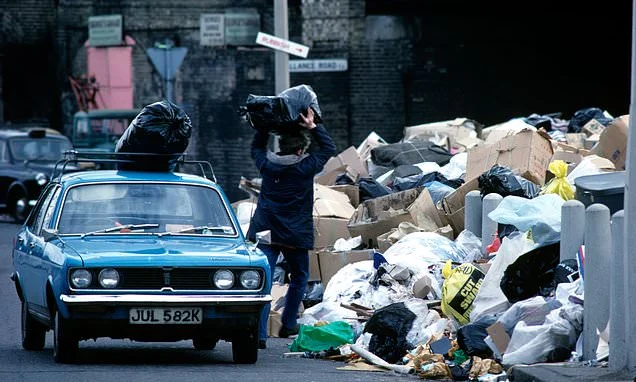
Rubbish piles high in east London during the infamous Winter of Discontent in 1979
Households across the country were forced to live by candlelight throughout the miners' strike
For half the week there was no electricity: the power was switched off. Prime Minister Edward Heath instructed citizens to lower their thermostats to a maximum of 17C and dim the streetlights to half-strength. We raised our children in the semi-dark.
I remember going to a funeral and when we got to the cemetery gates, carrying the coffin, we found them locked. The cemetery workers and gravediggers were on strike. You could see coffins piled up inside the graveyard.
No one collected the rubbish for weeks. The whole country was going through what the people of Birmingham have experienced in the past couple of years. Rats pranced about on the rotting filth. The air stank. Britain, once the richest and most powerful nation on earth, was, quite literally, a stinking pile of rubbish – the laughing stock of the world.
This was all because the economic policies of Labour and Tory governments after 1945 pursued the theories of John Maynard Keynes. They thought that they could borrow their way out of every difficulty, and as a result inflation soared.
‘What’s wrong with inflation?’ asked Tory PM Harold Macmillan. Under his socialist successors, the Harold Wilson governments, wages could not keep up with inflation. The unions had a stranglehold over the economy and politicians were terrified of them.
Fleet Street – before the internet – was in hock to the print unions. The Times was closed down for over a year rather than submit to the unions’ tyranny.
At the time I was a lecturer at one of the bigger Oxford colleges. A trade union baron, Len Murray, – a very nice chap, incidentally – used to come for dinner there every few weeks. He would arrive at Oxford in his own private train, just like a member of the Royal Family. They weren’t called the ‘union barons’ for nothing.
The country was on its knees. It was humiliated by bankruptcy. In 1976, the International Monetary Fund arrived and told our Chancellor enough was enough.
Prime Minister Andy Burnham hugs his mother Eileen as he arrives to take the reins at No 10
No politicians in Britain, however, seemed to have the guts to do what was necessary, which was to limit the power of the unions, stop borrowing money and cut back on welfare, however harsh that might have seemed.
Until the arrival of the Iron Lady.
Margaret Thatcher did all these things and won three successive elections because of it. Tony Blair imitated her, and he, too, won election after election. The economy flourished and we became prosperous – albeit at the terrible cost of losing our manufacturing industry.
Now, any reasonable and compassionate person would fully understand Andy Burnham when he says that something must be done for those who live in the ‘Red Wall’. Voters there are increasingly alienated by political parties and have watched the source of their wealth and pride evaporate – the steelyard, the coal mine, the docks where ships were manufactured, the potteries and the car factories.
But such places will never be revived by a government repeating all the mistakes of the 1960s and 1970s; addicted to borrowing and to dishing out welfare, often to those who do not need it.
Worse still, the last time socialist economics brought the country to the brink of ruin, in the 1970s, we were still a reasonably cohesive, united community. That is no longer the case. We are now a much more divided society: by ethnicity, by religion, by culture.
Those living in the old Labour heartlands do feel let down. They are generally poorer than those in the prosperous South-East. But their problems will not be solved by going back to the 1970s.
All socialist governments behave the same way under pressure from public-sector unions. We have seen this most recently in Labour’s dealings with the junior or ‘resident’ doctors, who have trousered a 33.4 per cent pay rise over the past four years.
Back in the day when Harold Wilson was Prime Minister, civil servants also got pay rises of 32 per cent, doctors wages rose by a similar 35 per cent, while those not lucky enough to belong to a powerful union struggled.
T he same will happen under Burnham. Unemployment will rise. Those who do not work in the public sector will be hammered. The pound will collapse. And amid our already fractured society there will be anarchy, street violence and unrest such as we have never seen.
So long as we have politicians who do not dare to tell us the truth about the economy, we are heading for real social disaster.
In the 1970s, we meekly sat in the candlelight, wrapping our cold babies in blankets. This time round, we’ll be rioting, and looking for someone to blame.
We must stop borrowing. We must stop spending money on benefits which we can’t afford. We must have politicians who allow the wealth of cleverness and enterprise in this country, which still exists, to be released, rather than being hampered by taxation and regulation.
Sometimes the lessons of history can only be found in books. In the case of Burnham’s nostalgia for the 1970s, there’s no need to read a book.
Those of us who were alive at the time can tell him just how horrible life was. He should listen. His policies will lead to national bankruptcy, anarchy, street violence and horror. And those he wants to help, those living in the poorest areas, will be the ones who suffer the most.