- READ MORE: SHIVALI BEST joins mountain rescue in the French Alps
- See more Daily Mail on Google - save us as a Preferred Source
When it comes to iconic British mass–participation sporting events, the London Marathon or the Great North and South Runs might spring to mind.
But what many people don't realise, is that down on the Isle of Wight there's another hugely popular event – the Round the Island Race.
This annual event sees around 10,000 sailors from around the world race around the island, on a tricky 50 nautical–mile course.
Starting in Cowes, the fleet of more than 800 boats races west to the infamous 'Needles', round St Catherine's Point and Bembridge Ledge buoy and back into The Solent to the finish line.
While most spectators enjoy the race from the mainland, the Daily Mail's Science & Technology Editor, Shivali Best, was given the rare opportunity to watch from the water.
Invited by Helly Hansen – the official clothing partner of Round the Island Race – I took to the water on a rib for the day, zipping between the boats as they navigated the infamously tricky course.
So, what makes this race so special?
From the magical atmosphere to the sense of camaraderie, here's why I think this lesser–known event has become such a legend in the sailing world.
When it comes to iconic British mass–participation sporting events, the London Marathon or the Great North and South Runs might spring to mind. But what many people don't realise, is that down on the Isle of Wight there's another hugely popular event – the Round the Island Race
Starting in Cowes, the fleet of more than 800 boats races west to the infamous 'Needles' (pictured), round St Catherine's Point and Bembridge Ledge buoy and back into The Solent to the finish line
While most spectators enjoy the race from the mainland, the Daily Mail's Science & Technology Editor, Shivali Best, was given the rare opportunity to watch from the water
The Round the Island Race has been running for 95 years now, and what really makes it special is the fact that it's a 'race for all'.
While many professional sailors take part, they're joined by families and amateur club sailors – who all compete on the exact same course.
With the sun shining, we hopped on our rib bright and early at 6:45am, just in time to see the boats lining up at the start line.
Sure enough, at 7am on the dot, a cannon sounded, and the boats were off!
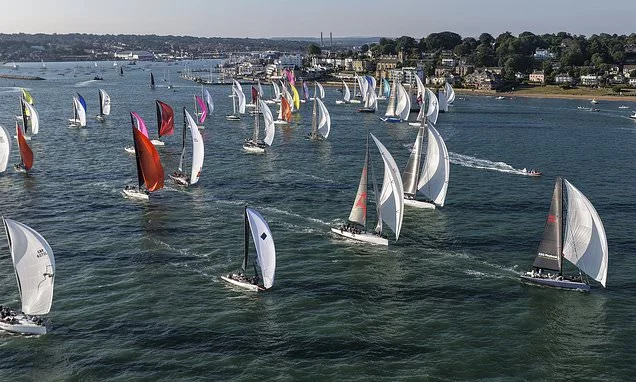
This year, more than 800 boats were competing in the race – and this sheer scale soon became clear.
As the boats started their 50–mile journeys around the island, many began flying their spinnakers – a billowing balloon sail designed to catch maximum wind when traveling downwind.
Coming in a range of designs and colours, the spinnakers truly look remarkable from the water, and as our rib zipped in and out of the boats, I really could feel the excitement in the air.
Our aim was to track down Pip Hare – a world–class offshore sailor who is sponsored by Helly Hansen.
As the boats started their 50–mile journeys around the island, many began flying their spinnakers – a billowing balloon sail designed to catch maximum wind when traveling downwind
Our aim was to track down Pip Hare – a world–class offshore sailor who is sponsored by Helly Hansen. While Pip had given us her sail numbers, finding her proved tricky, with hundreds of boats clumped together at this early race stage
From the magical atmosphere to the sense of camaraderie, here's why I think this lesser–known event has become such a legend in the sailing world
While Pip had given us her sail numbers, finding her proved tricky, with hundreds of boats clumped together at this early race stage.
Thankfully, as we reached The Needles – a row of three stacks of chalk that rise about 30 metres out of the sea – we spotted her boat, and zipped over.
Speaking to the Daily Mail, Pip explained what makes this race so special.
'It's an iconic race and has been part of my sailing calendar since I was 18,' Pip said.
'One day, a huge mass participation event, it is really special to be a part of it and different every year.
'It's the atmosphere, the number of boats on the water, it always delivers. A serious racing event, a time to have fun with friends, it makes you feel like part of a huge community.'
While the race looks like it's fun, a huge amount of preparation goes into it, Pip explained.
'You need to prepare for the race by looking at the currents around the island shore and the forecast weather including the local effects,' she added.
The Round the Island Race has been running for 95 years now, and what really makes it special is the fact that it's a 'race for all'
While many professional sailors take part, they're joined by families, amateur club sailors, and first–timers – who all compete on the exact same course
'There is a lot of preparation but then you can't prepare for how other boats will interact with you, sometimes you don't get to take the line you want so you have to adapt on the move.'
From our rib, Pip's race around The Needles looks fairly smooth sailing.
However, she later explained that things in this area were actually quite dicey.
'A boat outside us did not allow enough room for us clear the rocks off the lighthouse, we had to call to them to give us enough water to pass,' she said.
'It was close, I could see the rocks under the water.'
Having seen Pip, we left her to focus on the race, and headed back to Cowes to catch the first boats across the finish line.
Pace, owned by Jonny Vincent, was the first boat to finish, in an elapsed time of 06:32:39.
Jonny said: 'What a great day and a great race. It was hard work going down the mainland shore at the start, and there was a really funky bit around The Needles, which was a bit tricky.
Starting in Cowes, the fleet of more than 800 boats races west to the infamous 'Needles', round St Catherine's Point and Bembridge Ledge buoy and back into The Solent to the finish line
'We stayed pretty close to the Island shore but so nice to head back into the sunshine.'
However, Pip wasn't far behind, finishing in an impressive 10th place overall.
'This year it was a long race, because the wind was from the East and that meant that between St Catherine's point and Ventnor, we were sailing upwind against the current,' she explained.
'You can't sail directly into the wind so you have to zig zag, sailing at about 40 degrees to the wind – we call it tacking upwind.
'We were against the current and the deeper water has a stronger current, so we had to tack every minute in and out of the shore to stay in the shallow water.
'We must have done over 40 tacks in an hour!'
Overall, this year's race has been hailed as one of the best in years – and I can see why.
Dave Atkinson, Race Director, added: 'It has been an amazing day and a terrific race.
'We've been wishing for good weather for years, and today has really delivered for us, as we've had fantastic sunshine and a good breeze.
'The sight of all the spinnakers up for the start was one to behold, and really showed the race in all its glory.'