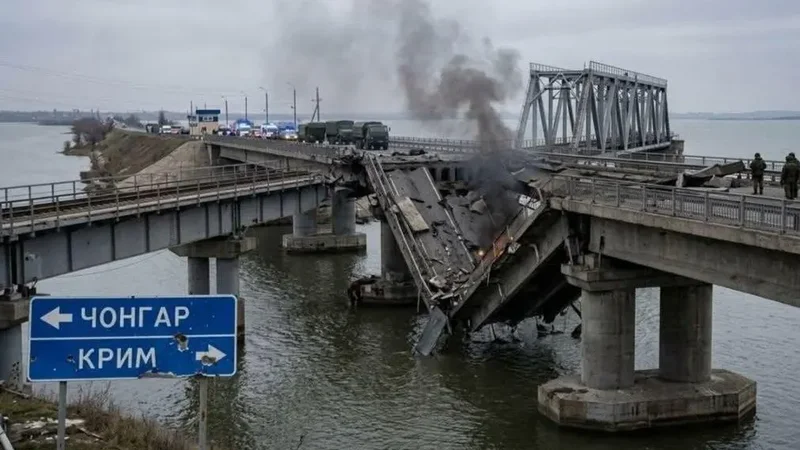
Although the Russia-Ukraine War has become increasingly defined by advanced technologies, rivers continue to play a decisive role in shaping the battlefield. Over the past four years, both sides have destroyed numerous bridges along the front lines to disrupt offensive operations. In recent months, Russia and Ukraine have expanded these efforts by targeting bridges well behind enemy lines. The goal of these attacks is to disrupt logistics, making it more difficult to sustain combat forces. However, this strategy also has longer-term implications. By destroying bridges that they would eventually need for future offensives, both sides may be signaling that they no longer expect a major breakthrough in the near term.
Why Russia And Ukraine Are Targeting Bridges
Bridges have traditionally been prime targets on the battlefield because they are difficult to replace and serve as critical nodes in military transportation networks. Unlike depots, bridges cannot be dispersed, relocated, or concealed, and their locations are well known, making them relatively easy to identify and target. More importantly, destroying a single bridge can halt the movement of hundreds of vehicles carrying fuel, ammunition, and reinforcements. Rather than destroying each vehicle individually, a single strike can disrupt an entire logistics route.
These strikes have become increasingly important as both Russia and Ukraine have only limited military bridging capabilities. Both sides have lost a significant portion of their engineering and bridging assets over the course of the war, particularly during attempts to cross major rivers such as the Siverskyi Donets and the Oskil. As a result, replacing a destroyed bridge is often difficult and time-consuming. In some cases, frontline soldiers have resorted to improvising temporary crossings from locally available materials, highlighting the shortage of dedicated bridging equipment.
The true impact of these attacks extends well beyond the destroyed bridge itself. Logistics networks are built around a limited number of major road and rail crossings. When one is lost, traffic must be rerouted through alternate crossings, adding considerable distance and time to every resupply mission. This reduces the volume of supplies that can reach frontline units each day while increasing fuel consumption and vehicle wear. The remaining routes also become more predictable, allowing drones and long-range fires to concentrate on a smaller number of choke points. In a war of attrition, these cumulative effects steadily increase the cost of sustaining combat operations.
Russian Attacks On Bridges In Ukrainian-Controlled Regions
Although Russia has consistently targeted Ukrainian infrastructure as part of its strategic strike campaign, bridges were not a frequent target. However, they have become an increasingly important objective for Russian forces and now regularly appear in the Russian Ministry of Defense’s daily summaries of strikes against Ukrainian military infrastructure.
An interview with the deputy commander of an assault detachment from the 10th Tank Regiment highlights Russia’s emphasis on bridge attacks. Discussing the strategy for capturing Kostiantynivka, he stated that they were “collapsing their bridges, disrupting their supplies.” Although he did not specify which bridges were targeted or how they were destroyed, he implied that Russian forces had destroyed several bridges as part of their infiltration tactics around the city. By destroying these bridges, they are interrupting the flow of supplies that the Ukrainian soldiers need to hold the city.
More broadly, the Russian Ministry of Defense has reported multiple drone and glide bomb strikes against Ukrainian bridges. In late June, the Russian MoD released footage of a FAB-500 glide bomb destroying a road bridge in Sumy Oblast to disrupt Ukrainian logistics. An earlier strike used a similar glide bomb to destroy a bridge in Kherson Oblast after Russian forces identified it as a key logistics route. Additional bridge strikes have also been documented through open-source reporting and social media.
Ukrainian Attacks On Bridges In Russian-Controlled Regions
Over the past month, the Ukrainian military has similarly increased its attacks on bridges in Russian-occupied portions of Ukraine. According to the Institute for the Study of War, Ukrainian forces have recently struck the Chonhar Road Bridge, Henichesk Road Bridge, Stylovyi Road Bridge, Armyansk Road Bridge, and the road bridge east of Vorona. These crossings connect Crimea with the occupied Kherson and Zaporizhzhia Oblasts, forming the primary road network supporting Russian forces in southern Ukraine. Open-source reporting indicates that many of these attacks were conducted using long-range Ukrainian strike drones, including the domestically produced Fire Point and Behemoth systems. Although many of the bridges were damaged rather than completely destroyed, the strikes reduced traffic capacity and forced Russian logistics convoys onto alternate routes.
Ukraine has also expanded its campaign deeper into occupied Crimea, Russia’s primary logistics hub for operations in southern Ukraine. While the Kerch Strait Bridge remains the highest-profile target, Ukraine has recently focused on the transportation network that distributes supplies after they enter the peninsula. During June and July 2026, Ukrainian forces struck multiple bridges along the M-17 and M-18 highways, as well as rail bridges near Rozdolne and Ichki. Ukrainian officials also reported strikes on bridges along the A-291 Tavrida Highway, disrupting a principal logistics corridor for the region.
Although more limited in number, Ukraine has also struck several key logistics bridges inside Russia. In early July 2026, Ukrainian forces destroyed road bridges near Shelayevo and Urazovo in Russia’s Belgorod Oblast, approximately 20 to 25 km from the border. These rail lines are important for moving military supplies into southern Ukraine, and their destruction forces Russia to reroute cargo through less efficient transportation networks. Beyond their military impact, attacks on rail infrastructure impose economic costs by disrupting commercial freight traffic, consistent with Ukraine's broader strategic strike campaign.
Broader Implications Of Destroying Bridges
Over the past year, the battle lines between Russia and Ukraine have largely stabilized as Ukraine established a layered defense. Russia initially attempted to break through these defenses but was halted by Ukraine’s drone-based kill zones. In response, Russian forces shifted to small-unit infiltration tactics to seize key terrain and make incremental gains. Meanwhile, Ukraine has focused on extending its drone kill zones deeper beyond the front line, effectively expanding its defensive reach. The recent increase in bridge strikes suggests that neither side expects this operational approach to change in the near term.
Earlier in the war, both Russia and Ukraine generally preserved bridges they expected to use as they advanced. That approach now appears to have changed. By destroying bridges deep in the enemy’s operational rear, both sides are signaling that disrupting an opponent’s logistics has become a higher priority than preserving infrastructure needed for a future breakthrough. Instead of preparing for large-scale maneuver, both sides appear focused on holding their current positions, making incremental gains, and imposing costs through attrition.
This strategy will likely have a greater impact on Russia than on Ukraine. Ukraine has shorter supply lines and access to a denser road and rail network, allowing it to reroute logistics more easily. In contrast, Russia's longer supply lines are more constrained, making the loss of a bridge more disruptive. Ukraine's operations also rely increasingly on drones, which are largely unaffected by destroyed bridges and can continue to operate across rivers. As a result, Ukraine is better positioned to absorb the effects of this strategy while continuing to pressure Russian forces.
While the future of the conflict remains uncertain, it will eventually end, and the true cost of these destroyed bridges will become apparent. Their loss will have significant economic consequences, particularly as affected regions begin to rebuild. Communities will face longer travel times, disrupted commerce, and higher transportation costs until permanent replacements are constructed. Rebuilding these bridges will also require substantial time and financial resources.
However, both sides appear willing to accept those long-term costs. The immediate military benefit of disrupting an opponent's logistics outweighs the future value of preserving these crossings. As long as the war remains one of attrition, bridges will continue to be among the highest-priority targets on the battlefield.