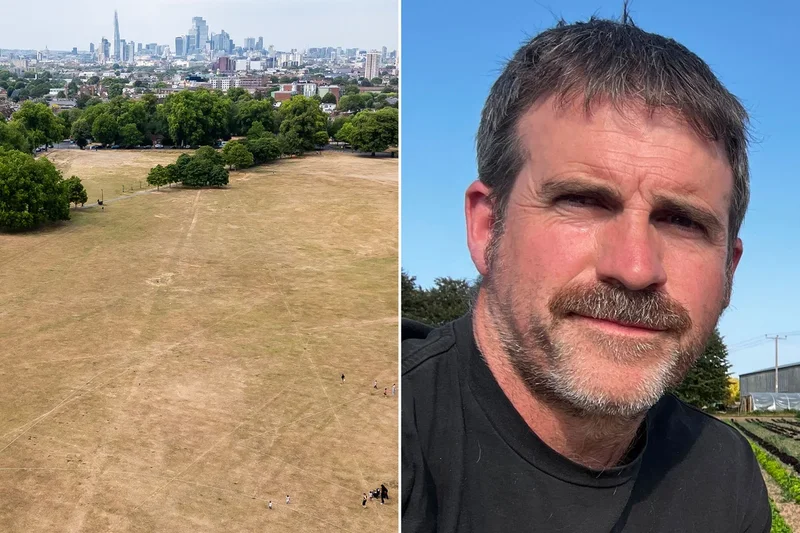
Farmers have warned the industry "can't carry on like this" as they struggle following back-to-back heatwaves and prolonged periods of dry weather across the UK.
With drought declared in parts of Wales on Thursday, regions across the East and South continue to suffer exceptionally low or no rainfall, leaving agricultural workers under severe pressure.
Ben Andrews, who runs Broadward Hall Farm in Herefordshire, told The Independent: “Our veg is seriously struggling this year. At this point, we’re really having to sit down and consider whether we’re even going to plant vegetables next year.
“For many farmers, this is the worst harvest yet, and for the second year in a row. We can’t carry on like this.”
Mr Andrews is a fourth-generation farmer who keeps up to 600 acres of land with permanent grazing cattle, and grows vegetables including potatoes, broccoli, kale and lettuce for a national veg box scheme.
“I'd say a lot of farmers have taken big hits because of this weather,” he warned.
The National Drought Group earlier this week identified eight areas as being in "prolonged dry weather", which is the final stage before an official drought is declared.
Simon Wright, who runs Lamb Farm in Romney Marsh, on the Kent-East Sussex border, told The Independent: “I farm livestock and it’s probably one of the driest times we’ve ever had, I think.
“All of our fields are divided by ditches which obviously keep our sheep and cows in the right place, but all the ditches are now dry so basically the sheep and cows just wander where they like. Water is a problem too. Luckily we have got mains water, but it’s obviously going to cost us a fortune."
The farmer, who keeps several thousand sheep and cattle across 1,200 acres of property, added: "We’ve run out of food. We’re starting to use our winter food. We’ve just started feeding the sheep hay now, and then hopefully the weather’s going to break. It’s very expensive. Normally they rely on eating grass at this time of year.
“There’ll be no profit in the job if it carries on like this for much longer – we’ll be digging into the reserves.”
National Farmers’ Union deputy president, Paul Tompkins, said growers are working "around the clock" to water crops and care for livestock, coming off the back of consecutive years of volatile weather.
"For many arable farmers, this could be another difficult and expensive harvest after extreme weather impacts in both 2024 and 2025, which saw both drought and flood,” he said.
Mr Tompkins urged the government to strengthen long-term resilience against climate change by overhauling licensing and easing planning rules to make building on-farm water reservoirs easier.
Mr Andrews added: “It’s only getting hotter. The weather is getting more extreme – six months ago, our crops were basically underwater.
“Farms in the North, who haven’t been too badly affected yet, will be. This is a warning not to wait; farmers need to be prepared.
“We need to have better weather-proofing so we can be more resilient, because nobody is escaping this.”
Retailers say they are also monitoring the situation closely as reduced crop yields threaten to push up grocery prices.
Andrew Opie, director of food and sustainability at the British Retail Consortium (BRC), said: "Extreme weather, including drought, can affect crop yields and place upward pressure on prices.”
He added retailers are looking into alternative suppliers where appropriate to minimise the impact on shoppers.
Forecasters offer little prospect of immediate relief. Will Lang, chief meteorologist at the Met Office, warned rainfall over the coming weeks is "unlikely to be widespread or substantial", particularly in the driest southern regions.
Helen Wakeham, chair of the National Drought Group and director of water at the Environment Agency, said hot conditions were rapidly depleting resources while pushing demand higher.
"This is a difficult combination, and we are seeing the effects on our farmers, our wildlife, and the amount available for public and business use," she said, urging the public to conserve water where possible.
A spokesperson for the Department for Environment, Food and Rural Affairs (Defra) said the government recognises the toll extreme weather takes on the sector.
"We are helping the sector build greater resilience to climate shocks through our farming schemes and through our work with the National Drought Group," they added.