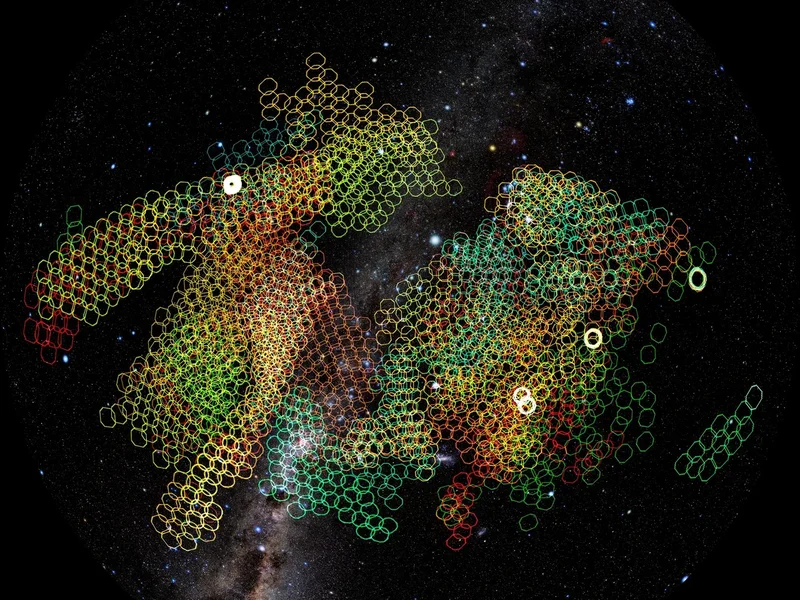
After decades of arduous preparation, the largest, most ambitious survey of the night sky ever created has at last opened its eye.
This sweeping project, which started its observations in June 2026, has a deservedly grandiose name: the Legacy Survey of Space and Time (or LSST). Its purpose is to take deep panoramic images of the sky, over and over again, every clear night across the next 10 years, making what amounts to a decade-spanning ultrahigh-definition timelapse movie of the entire heavens. Transients—objects that move or change in brightness over time—are LSST’s primary science target because they represent a dizzying variety of cosmic events.
You may not have heard of this project, but there’s a better chance you know of the Vera C. Rubin Observatory, the telescope where it takes place. In many respects, LSST is the reason Rubin was built, because Rubin’s unique capabilities are what make LSST possible. The observatory has a massive 8.4-meter starlight-gathering mirror with an exceptionally wide field of view, and it is perched more than 2,700 meters up the slope of Cerro Pachón, a mountain in Chile. The skies there are exceptionally clear and steady, perfect for a long baseline survey.
On supporting science journalism
If you're enjoying this article, consider supporting our award-winning journalism by subscribing. By purchasing a subscription you are helping to ensure the future of impactful stories about the discoveries and ideas shaping our world today.
Rubin’s enormous eye on the sky is only part of the technical wizardry behind LSST; the “retina” for Rubin’s eye is important, too, and is the largest digital camera ever built. It boasts a staggering 3.2 billion pixels and is 64 centimeters on a side; that’s roughly the size of two cafeteria trays put together—compare this with a typical smartphone’s one-square-centimeter camera sensor, and you start to appreciate just how huge Rubin’s camera is.
The survey itself will be comprised of 30-second exposures of the night sky taken using six different filters, each tuned to a specific color of light. Those filters will allow astronomers to differentiate between the myriad stars, galaxies and other heavenly bodies observed. Each half-minute exposure yields an image 3.5 degrees across, roughly equivalent in area to 50 full moons on the sky. Added up across three successive nights, one set of these images will capture the entire sky visible from Rubin’s lofty locale. During LSST’s 10-year program, each spot on the sky will be revisited more than 800 times, yielding a total of several million images.
As if all this isn’t enough to choke your brain, here is where the numbers get truly impressive. By adding together the images taken on a single spot, fainter objects become visible. Astronomers use a brightness scale called “magnitudes,” and the survey will be able to see objects as faint as magnitude 27.8. (For context, the faintest star you can see with your unaided eye is about 500 million times brighter than this.)
This means that LSST’s predicted haul of astronomical objects is an astounding 20 billion galaxies, 17 billion stars, 10 million supernovae and six million solar system objects. While other observatories have seen more of the sky, and some have gone deeper, no other has come close to the depth and breadth of LSST.
Trying to list every member of the cosmic menagerie it will see is a hopeless game, so instead, here are just a few of the likely finds I’m particularly excited about. Even then, consider this list woefully incomplete.
Supernovae: These are exploding stars, and every new one seen helps us better measure the universe in some way. Now brace yourself: LSST is predicted to see a new one, on average, every 30 seconds. Critically, we use one particular type of supernova to measure the expansion of the universe. LSST will see so many of these that astronomers will have their hands full just keeping track, never mind the more complex matter of studying any in depth. The universe’s expansion rate is still a matter of significant debate in cosmology, so having more data is always welcome, even if it’s a deluge.
Also, with so many detected, we’re bound to see outliers—rare and unusual supernovae that would normally be missed because of their low numbers. These oddball explosions can help test and refine astronomers’ ideas about how exactly supernovae occur and evolve over time, among other things. We love seeing nice, normal events, but sometimes the real science lies at the margins.
Exoplanets: Although not optimized for this kind of search, LSST could discover quite a few exoplanets, worlds orbiting other stars. We have many ways to do this now, but it could find them in places where other telescopes have difficulty, such as in densely packed star clusters and even within our Milky Way’s companion satellite galaxies. That last would be amazing—planets in other galaxies!
Near-Earth Objects (NEOs): LSST is predicted to see millions of asteroids in the main belt between the orbits of Mars and Jupiter, which will be a boon to understanding their populations. But it should be able to spot more than 100,000 NEOs, asteroids and comets that approach within about 50 million kilometers of Earth. These include potentially Earth-impacting objects, and it’s no secret I’m fascinated by these. While there are currently no large potential impacts predicted in the next century, the more of these space rocks we find, the better we’ll understand their behavior and potential for danger—and what we can do to stop them from hitting us.
Trans-Neptunian Objects (or TNOs): Out past Neptune is a vast array of icy, rocky bodies left over from the solar system’s formation. These objects tend to be small and faint, and right now only about 5,000 are known. LSST should find an additional 30,000 more. Besides being interesting on their own, some of these distant cometlike bodies have odd orbits that hint at the existence of another major planet out there in the inky black. Speaking of which:
Planet Nine: There could be a Neptune(ish)-sized planet orbiting the sun many tens of billions of kilometers away. Nicknamed Planet Nine and sometimes more generically called Planet X, its existence is hotly debated, but most predictions of this putative world’s characteristics put it squarely in the range of LSST’s capabilities to spot. And even if LSST doesn’t directly see Planet Nine, scientists should still be able to firm up the case for its existence or decisively rule it out as the project uncovers more TNOs and their orbits become better known. It’s been 180 years since a new major planet has been found orbiting the sun, so this is a very exciting prospect.
The Unknown: What I’m most excited to see from LSST are the things we can’t predict. With this kind of survey, there are bound to be phenomena we neither expect nor immediately understand. This happens all the time when we look at the sky in a new way. Stars shredded by black holes, little red dots, gamma-ray bursts—the universe is full of surprises, and many remain hidden until we create some novel method of observing the heavens.
Tracking the sky to such depths, such resolution and for such a long time practically guarantees that a bevy of weird and baffling phenomena will emerge from the LSST data. And when that happens, astronomers will set about studying these new beasties with other eyes on the sky to learn more about them and hopefully understand them. It’s what scientists do, powered by insatiable human curiosity, and it’s why we built the Rubin Observatory in the first place.