By Oh Seok-min
MANILA, July 24 (Yonhap) -- Foreign Minister Cho Hyun sought to deepen cooperation with regional partners during a series of Association of Southeast Asian Nations (ASEAN)-led meetings in the Philippines this week, as Seoul has faced mounting security and economic challenges stemming from the Middle East conflict and North Korea.
But Cho's two-day visit to Manila, which concluded Thursday, also laid bare an increasingly divided regional landscape, with Pyongyang absent from the ASEAN Regional Forum (ARF) for the second consecutive year and no meaningful exchanges taking place between South Korea and either China or Russia.
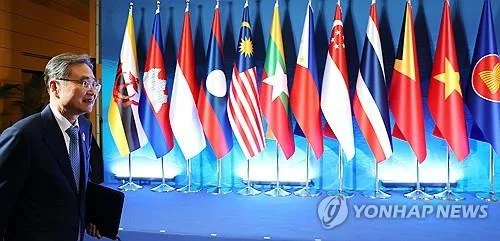
Cho attended a series of ASEAN-related meetings, including the South Korea-ASEAN foreign ministers' meeting, the ASEAN Plus Three (APT) foreign ministers' meeting, the ARF and the East Asia Summit (EAS) foreign ministers' meeting, while also holding bilateral talks with regional partners.
Throughout the gatherings, Cho reaffirmed Seoul's commitment to pursuing peaceful coexistence on the Korean Peninsula and continuing efforts to resume dialogue with Pyongyang "with patience."
Many participating countries voiced support for Seoul's approach and called on North Korea to halt its nuclear and missile development while reaffirming the need for the denuclearization of the Korean Peninsula, according to the foreign ministry.
The discussions, however, took place without North Korea's participation.
The ARF has long been regarded as the only regional multilateral security forum involving the two Koreas. But Pyongyang skipped last year's forum for the first time since joining the ARF in 2000 and remained absent again this year, further narrowing one of the few remaining venues for inter-Korean engagement.
The absence reflects Pyongyang's growing preference for bilateral diplomacy with Russia and China over multilateral engagement, officials and experts said.
Washington's preoccupation with the Middle East conflict and other global issues also appears to have reduced the forum's relevance for North Korea, they added.
Chinese Foreign Minister Wang Yi did not attend the ARF session, while Russian Foreign Minister Sergey Lavrov left after delivering his prepared remarks.
Though Cho and Lavrov were seated next to each other during the ARF meeting and greeted each other in the aisle, no substantive exchange took place, officials said.
"Even brief high-level exchanges can help reaffirm personal ties and build trust, but given the current international situation, that did not seem to be the case with Russia," a senior foreign ministry official said.
Seoul and Beijing, meanwhile, are coordinating the timing of Wang's visit to South Korea, which could take place as early as next month.
By contrast, Seoul's coordination with Washington and Tokyo remained active.
Cho held a trilateral meeting with U.S. Secretary of State Marco Rubio and Japanese Foreign Minister Toshimitsu Motegi on the sidelines of the ASEAN-related meetings Wednesday, which came just two weeks after their trilateral talks on the margins of the North Atlantic Treaty Organization summit in Turkey.
The three sides reaffirmed their commitment to maintaining a robust deterrence posture against North Korea while upholding the goal of the denuclearization of the Korean Peninsula, according to Seoul's foreign ministry.
In a separate readout, the U.S. State Department said the ministers emphasized the importance of maintaining peace and stability across the Taiwan Strait and expressed concern over China's recent intercontinental ballistic missile launch into the Pacific.
Cho held separate pull-aside talks with Rubio and U.S. Deputy Secretary of State Allison Hooker on Wednesday to discuss pending issues, including security consultations on Seoul's push to develop nuclear-powered submarines and revise the allies' civil nuclear cooperation agreement. Cho also raised concerns over recent student visa issues affecting South Korean students, officials said.
The top South Korean and Japanese diplomats also had brief bilateral talks.
At the APT meeting, South Korea, China, Japan and the 11 ASEAN member states reaffirmed the need to address issues on the Korean Peninsula through dialogue and diplomacy, while agreeing to strengthen practical cooperation on supply chain resilience and food and energy security.
At the EAS ministerial talks, participants discussed regional flashpoints, including the South China Sea, Myanmar and the Middle East.
In addition to the multilateral meetings, Cho met separately with his counterparts from Britain, the European Union, Canada, Australia and New Zealand, as well as six ASEAN member states -- Thailand, Brunei, Indonesia, the Philippines, Cambodia and Vietnam.
The bilateral meetings largely focused on expanding practical cooperation in response to supply chain disruptions, regional security uncertainties amid the Middle East conflict and the rapid restructuring of advanced technology industries.
The meetings reflected Seoul's effort to strengthen ties with like-minded partners while reinforcing ASEAN's central role as a platform for regional cooperation at a time when geopolitical divisions continue to deepen, the ministry said.
graceoh@yna.co.kr
(END)
- 'Dracula' featuring Jennie maintains No. 5 on Billboard 100
- (LEAD) BTS headlines first halftime show at World Cup final
- Hybe to launch new 7-member girl group Tuide this year
- 'Agent Kim Reactivated' reigns atop Netflix's weekly non-English chart for 3rd week
-
BTS headlines first halftime show at World Cup final
-
Hybe to launch new 7-member girl group Tuide this year
- (LEAD) BTS headlines first halftime show at World Cup final
- Disney+ to release 2nd season of 'Made in Korea' in Sept.
- (LEAD) S. Korea, U.S. open shipbuilding partnership center to advance MASGA initiative
- (URGENT) S. Korea's Daejeon selected as host city for 2029 Invictus Games: veterans ministry