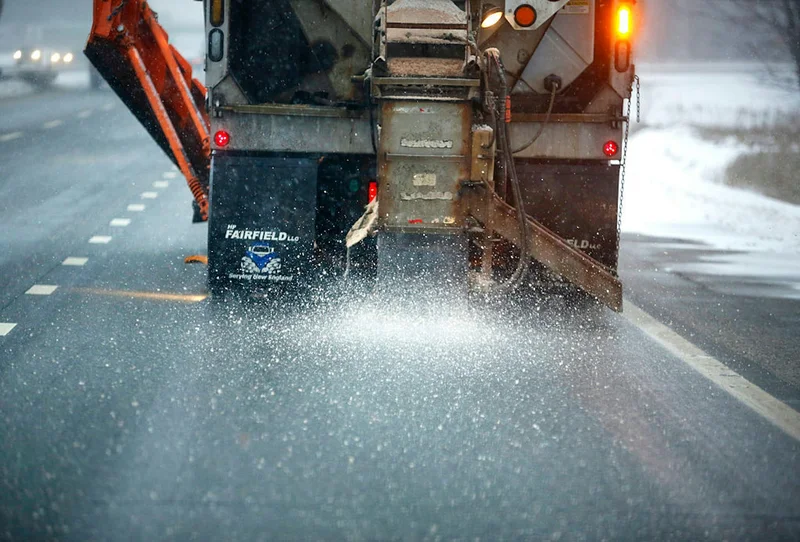
Pennsylvania’s roughly 100,000 oil and gas wells produce wastewater that’s many times saltier than seawater and contains radium, a known carcinogen. For decades, that saltwater, called brine, was spread on dirt and gravel roads across the state to control dust and also on paved roads to melt ice.
The state Department of Environmental Protection halted the practice in 2018, but residents continue to report oil and gas brine being spread in their communities. Now, a permit issued by the Department of Environmental Protection in May 2026 could open a new path for oil and gas well wastewater to be sold as a commercial product that could be purchased by road maintenance operators or snow removal businesses.
William Burgos and Nathaniel Warner, professors of environmental engineering at Penn State, have spent years testing whether oil and gas brine actually works as a road dust suppressant. Road dust is an issue because fine particles generated from traffic can get into residents’ lungs and cause respiratory issues, and the dust also reduces visibility, which can lead to accidents. Burgos and Warner spoke with The Conversation U.S.’s Pittsburgh Editor Cassandra Stone about what’s in the brine, why it fails at the job it’s supposed to do and what the new permit means for Pennsylvanians.
What is oil and gas brine, and why is it being spread on Pennsylvania roads in the first place?
Oil and gas wells produce a significant amount of water, called produced water or brine, along with the oil and gas they recover. In northwestern Pennsylvania, the ratio is around eight barrels of water per barrel of oil. The water is very salty – often five to 10 times as salty as seawater. It is generated from both conventional oil and gas wells and unconventional, or “fracked,” gas wells – such as those used to extract natural gas from the Marcellus and Utica shales in Pennsylvania.
The Pennsylvania Department of Environmental Protection banned using brine from fracked gas wells for dust suppression or anti-icing in 2016, and issued a moratorium halting the road spreading of conventional oil and gas brine in 2018. Well operators had previously provided the brine to local townships for free.
What’s in this water, and what do we know about its health and environmental risks?
Lots of calcium, sodium and chloride, but also radium – a radioactive element and known human carcinogen – as well as petroleum hydrocarbons and lead.
Most of these contaminants wash off the road and end up in streams and sediments. The salt can harm fish and other wildlife, and corrode bridges and automobiles. Salt from roads can also enter nearby drinking water wells.
Why are conventional and fracked well brine treated differently?
Geochemically, there is no obvious reason. Brines from conventional and unconventional wells are chemically very similar: Both are extremely salty and radioactive, and both contain heavy metals and organic contaminants.
For example, in Pennsylvania, the combined activity of two radioactive forms of radium averaged 2,000 picocuries per liter in conventional oil and gas brine and 1,800 picocuries per liter in unconventional Marcellus Shale brine.
There are numerous federal regulations from different agencies around discharges of radium to the environment, but many do not directly apply to oil and gas wastes. The EPA tries to follow the principle that radioactivity exposure should be “as low as reasonably achievable,” also known as ALARA. Their drinking water standard for combined radium activity is 5 picocuries per liter.
Obviously people are not drinking the oil and gas brine directly, but the problem is that we don’t know where the radium ends up after the brine has been applied to the road. It mostly washes off with runoff, but radium dried to the road could be remobilized as dust that someone inhales, or radium could accumulate in game fish eaten by fishermen.
Operationally, unconventional gas wells produce much more water than conventional oil wells, which may be the reason for the additional restrictions on disposal options. And historically, the two industries emerged under very different rules. Environmental regulations were already in place in 2008 when the unconventional Marcellus Shale gas boom began, but conventional drilling dates to the Drake well in 1859 – long before modern environmental oversight existed.
How are these wastes regulated?
Produced water is regulated by the Office of Oil and Gas Management within the Pennsylvania Department of Environmental Protection. Most regulations rely on self-reporting by well operators. Operators of conventional wells are required to report the volumes of oil, gas and brine produced from each well every year.
If an operator wants to classify their brine as a coproduct and use it for some purpose, they must submit a form to the department’s Bureau of Waste Management. There are no requirements to measure radium concentrations or demonstrate that the brine works for its new intended use.
Does oil and gas brine work as a dust suppressant?
No. We designed multiple studies to determine whether oil and gas brine can suppress road dust. In the first, we used a laboratory method to measure the amount of dust generated from road material treated with various dust suppressants. Oil and gas brine was little to no more effective than rainwater – and some cases, they even increased dust compared with rainwater.
We also conducted large-scale laboratory experiments and found that most contaminants in oil and gas brine, such as radium, completely washed off treated roads after a typical rainstorm. More road material washed off roadbeds treated with oil and gas brine than off those treated with calcium chloride, a commercial dust suppressant. Roads treated with oil and gas brine will not suppress dust, and they degrade faster and cost more to repair than those treated with plain water.
What is the Department of Environmental Protection’s new permit for, and why does it matter?
In May 2026, the department issued a permit for a brine production well that is drilled into an oil and gas formation.
This means that the same radioactive oil and gas brine wastewater could now be sold as a product from the well. The well operator is not yet required to demonstrate that it works for its intended use.
How would road maintenance operators or snow removal businesses know if brine ends up in products they buy?
They wouldn’t. There are no disclosures required to inform a consumer that the product was sourced from oil and gas brine.
Is there anything currently happening about this issue in the state Legislature?
On June 10, 2024, the Pennsylvania House Environmental Resources and Energy Committee held a hearing on a bill for a complete ban on road-spreading of oil and gas brine. On June 8, 2026, the corresponding House Bill 84 was passed out of committee to the full House. Currently, there is no timeline for floor consideration.
Read more of our stories about Pittsburgh and Pennsylvania.