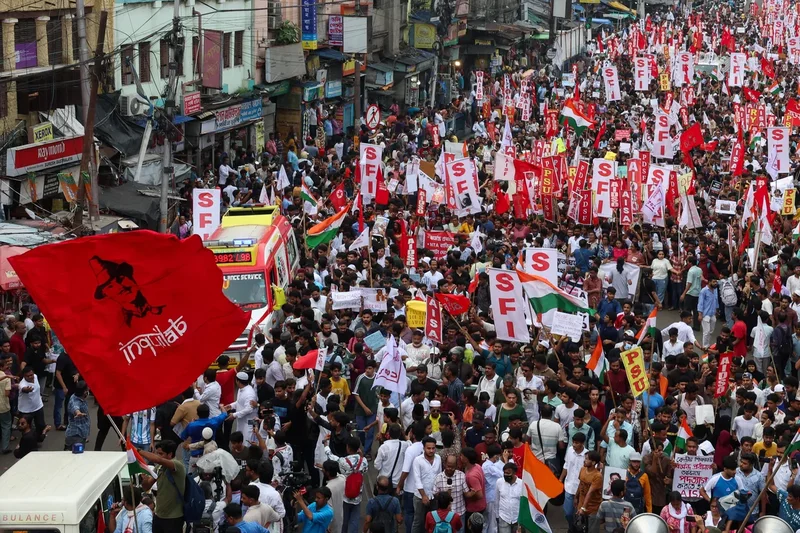
It is well past midnight at Jantar Mantar, and the crowd shows no sign of thinning. Music drifts across the humid air, tabla beats mixing with snatches of Bollywood songs, as new arrivals keep streaming in on foot — students, labourers, parents — even at this hour.
Somewhere near the stage, a spokesperson is trying, and failing, to keep the swelling numbers from tipping into a stampede. On walls near the protest site, fresh graffiti is still wet. "Modiji, return us our bad days," one pleads, a jab at the prime minister's campaign slogan “Achhe Din”, the promised good days that many say never came.
In the crowd is Mohan Yadav, 43, a man who doesn’t fit the profile that the government’s supporters imagine when they picture these protests. He is not, he insists, an opposition plant, or a professional agitator. He voted for Narendra Modi’s BJP party. He voted for its ally Nitish Kumar in Bihar state. Yet, he’s standing at Jantar Mantar, trying to explain why the government he once trusted has, in his eyes, turned on people like him.
"I have a son and a daughter," he says. "And I can understand that pain of a parent. Because I know how much sacrifice it takes to raise a child and then to lose them like this."
He is far from alone.
What started out as a joke by a group of students is now one of the most sustained waves of public dissent against Modi's government. Now with millions of followers online and clear displays of support on the ground, the Cockroach Janta Party has said it will not stop protesting until Modi’s education minister – the powerful veteran politician Dharmendra Pradhan – resigns.
The protesters say Pradhan must take responsibility for the shambolic handling of a key university entrance exam for would-be medical students, the cancellation of which affected 2.3 million young people. Activists say at least 21 students died by suicide during the debacle.
Nitesh Aryan, 26, from the northern city of Lucknow, has been at the protest site daily since 19 July. He says he is driven by the fact “that exam papers are repeatedly leaked. And when we demand our rights, the government responds by baton-charging the students, cracking our skulls, breaking legs and back.”
Akanksha, 31, who has lived in Delhi her whole life, frames her motivation as a slow, cumulative betrayal rather than a single scandal. "I’m a victim of the education system," she says. "I know how rigged the system is, how messed up our schools are. Teachers are demotivated. Nobody is studying in a government institution."
For Muskaan, 40, leaving the protest site with her two children close to midnight, the stakes are more immediate. She’s a labourer and her husband drives an autorickshaw. "There are poor people who with great difficulty manage to educate their children," she says. "My children will also study with as much hard work. Right now they are young. My son is in 8th standard and daughter is in 11th standard. It is about their future as well."
When papers leak, she argues, "the future of my children is being ruined. I’m here to protect their future and prevent it from being ruined."
What turned a grievance into a full-blown anti-government movement was the events of 20 July, the day police moved against the protesters at Jantar Mantar as they prepared to march towards parliament, using batons and teargas against them and leaving scores injured.
Birku Yadav, 26, who joined the movement after learning about it on 18 July, describes what happened to her two days later. "I was charged with baton by a male police officer who did not even have his name tag on," she says. "I feel like they were not wearing name tags because they were not police officers but supporters of the ruling regime."
Ashutosh Ranka, 30, a spokesperson for the Cockroach Janta Party, says the scale of the crackdown caught even the organisers off guard. "The kind of brutality meted out against the students, young protesters and our own volunteers who were helping them manage the crowd crossed all levels of brutality," he said. "Crossed all levels of shamelessness."
It’s this moment – the baton-charge against unarmed students demanding accountability – that Mohan Yadav can’t reconcile with the government he voted for. "I still don't know why we were assaulted by the police," he says. "It was only about the resignation of one person. The government should have just conceded to the demands of the public, 'my constituents and voters are asking for this, we should give them.' We would have been so much happier."
There is a striking gap between the government's public posture and what protesters describe living through. Modi has floated a proposal for fast-track courts to try paper-leak cases, a move Saurav Das, another Cockroach Janta Party spokesperson, dismisses as cosmetic.
"It's an eyewash," he says, noting that a 2024 law against organised exam-paper mafias is already meant to solve this, with little visible effect. "That law wasn’t implemented properly, that's why you have these kinds of instances again."
That disconnect between official reassurance and street anger runs through nearly every conversation.
Where the government speaks of isolated lapses and administrative fixes, the protesters describe something closer to institutional collapse, and a chain of accountability that never seems to reach anyone at the top. "Post-2014, the government takes great arrogance in not sacking its minister," Das says. "It was automatic before 2014."
For Mohan Yadav, the gap is personal, not political. He frames his disillusionment as stemming not from ideology but a broken bargain.
"If we brought Modiji to power and he is the head of the country, then he should have taken care of our well-being and happiness," he says. "But instead he went against 65 per cent of the youth of the country. In front of my eyes, so many women and children were beaten up. I felt really sad."
Nitesh Aryan's demand is starker still: "My demand is that those responsible for it are duly punished. And all the people who were at their posts at the time this happened, resign."
Ranka insists the movement will not fold under pressure even as he acknowledges the personal risk protesters are taking on. "We expect police action but we don't fear it," he says. "This is a fight much bigger than one person and we are ready to pay the price." Asked how far organisers are prepared to go if the government refuses to budge, he allowed himself a rare smile. "The government has to concede. They don't have a choice this time."
Mohan Yadav says he still does not fully understand how he ended up here, holding a grievance against a government he helped elect. He’s careful to say he isn't asking for anything extraordinary. "I’m not asking for a plot of land in Delhi," he says. "I am not asking Modi to transfer 1.5 million rupees to my account. I am asking for accountability."