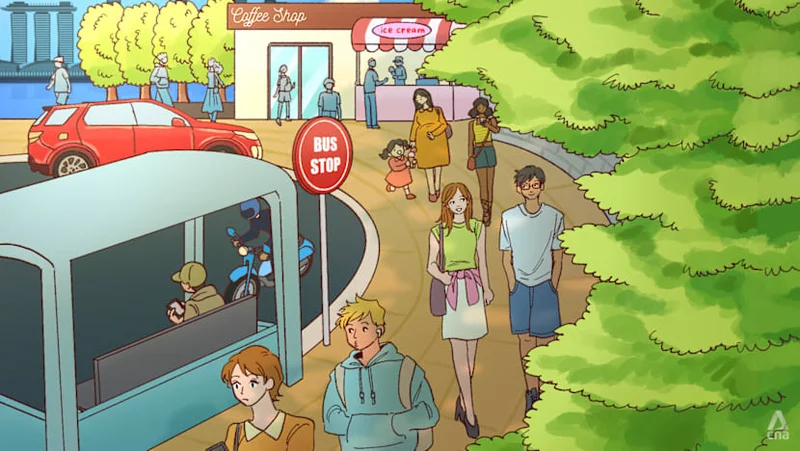
Why Singaporeans should walk more – it's not just for the health benefits
Singaporeans still choose convenience over walking, even for short trips, and getting more people to walk will require more than better infrastructure.
About eight years ago, Ms Clara Lim decided to walk the three-hour journey every morning from her home in Punggol to her workplace in Tai Seng near Upper Paya Lebar.
The ambitious attempt to save money lasted only two weeks due to sheer exhaustion, so she scaled back her plan. She started walking from her home to the nearest MRT station every morning, rather than take a four-stop bus ride.
Outside of work, too, Ms Lim walked "almost everywhere". After a day out with friends, she would walk home from as far away as Dhoby Ghaut in town, because she hated feeling like a sardine in a can while on the train. The journey was roughly 15km long and would take her about four hours.
And two years ago, to earn a badge on her Garmin watch that is also a fitness tracker, she once clocked 50,000 steps in eight hours without a break.
"I just decided the day before that I wanted to achieve the badge, so I walked along the coast from Punggol towards Tanah Merah," said Ms Lim, now 28 and a user experience (UX) researcher.
"It was fun; I just love walking and wanted to, so I did."
Today, her walking habits have changed. A new mother of a three-month-old daughter, she now takes fewer impromptu walks.
Instead, Ms Lim spends about two hours each morning strolling with her baby along the park connector near her home to hit 20,000 steps each day.
"While I used to walk alone and listen to a podcast, now I walk with my daughter in her stroller, sometimes staring at her and just clearing my mind. It's enjoyable doing so every day," she said.
Another avid walker, Mr Hong Chou Hui, 49, enjoys walking for about two hours daily, before 9.30am or after 5pm, when temperatures are much cooler and the humidity is bearable.
These walks are largely in the Ubi and Kaki Bukit area, where he lives. Since he began walking in 2022, he has made a couple of discoveries: an old secondary schoolmate’s bike shop nearby and the favourite resting spots of his neighbourhood's community cats.
"These small things are what you would not notice if you didn't walk. If you're riding in a car or on public transport, you're likely glued to your phone screen," the self-employed content strategist told CNA TODAY.
Aside from his daily walks, Mr Hong prefers to alight a few MRT stops away from his destination. He walks the extra distance to explore neighbourhoods, clear his mind and get some extra movement in his day.
"Before I walk ... I do some research and plan a route with more shelter and shade, or perhaps with aircon as well as a water point at the end," he said.
"If I have to meet clients (for work), I'll take a towel and extra clothes to freshen up at the toilet."
Mr Hong and Ms Lim's experiences illustrate what urban planners describe as the essence of a walkable city – one that prioritises pedestrians. This means being able to reach daily destinations – such as a supermarket, park and the nearest public transit – comfortably on foot.
Indeed, Singapore has long integrated walkability into its "car-lite" vision, rolling out various initiatives to improve connectivity via walking.
For example, the Walk2Ride programme by the Land Transport Authority (LTA), launched in 2013, aims to build 200km of sheltered walkways, linking commuters from MRT stations to residences and amenities within a 400m radius, and from bus interchanges, bus stops and LRT stations within a 200m radius.
However, most Singaporeans who spoke to CNA TODAY said that walking is not their preferred way to get around due to the heat and humidity, what more with the convenience of driving and easy access to public transport.
Dr Belinda Yuen, a research director with the Lee Kuan Yew Centre for Innovative Cities at the Singapore University of Technology and Design (SUTD), said: "Singapore is walkable by design, though it remains a work in progress rather than a finished achievement."
Neither is walkability a "one-off attainment", the senior professorial research fellow added.
This means that walkability is never a finished product, because building a pavement or shelter, for instance, is only the start. Despite Singapore's progressive urban design, creating a walkable city requires continual upgrades and refinements as people's needs evolve and some hurdles remain.
These include dangerous crossroads, uneven footpaths and conflicts with cyclists on shared paths – all of which are pain points during walks that were raised by pedestrians who spoke to CNA TODAY.
So, what will it take for a city designed for walking to get more people on their feet?
WALKING INTO WALLS
Along most roads in Singapore's heartlands, trees line the pavements, providing some shade from the sweltering heat. Nearer to bus stops and MRT stations, sheltered walkways protect commuters rain or shine.
Mr Chintan Raveshia, who leads Arup's cities, planning and design business across Asia Pacific at the global design and engineering consultancy, said: "Compared to other neighbouring cities like Kuala Lumpur and Jakarta, Singapore is far more walkable.
"But there are other cities like Rotterdam in the Netherlands and Copenhagen in Denmark where walking is prioritised over other modes of transport, which makes them more walkable than Singapore."
He also said that in non-walkable cities, residents would naturally use their personal vehicles even for short trips, due to the convenience or the lack of walking infrastructure such as pavements.
Ms Lena Tan, head of communications at The Food Bank Singapore, recalled how hard it was for her to take walks when she lived overseas.
"Walkability in Singapore is taken for granted," the 50-year-old said. About 10 years ago, when she lived in Thailand, in a town that was a two-hour drive from Bangkok, she would always lament how it was not practical to walk to the other side of town even though it was just 1km away, because "there were no pavements and it would get very dark at night".
"Or like in Batam, Indonesia, where there are few traffic lights and heavy traffic – your only option as a tourist is to book a Grab ride even if it's just to cross the road," she added.
Singapore's walkable infrastructure certainly encourages people to stay active and exercise, but a key signal of a walkable city's impact on its residents is what they choose when they need to get to their destination, Associate Professor Sheila Maria Arcuino Conejos said.
The urban planner who teaches built environment and facilities management at the School of Science and Technology at the Singapore University of Social Sciences (SUSS) added: "For public health and society, walkable cities encourage routine physical activity as part of everyday life rather than requiring people to schedule exercise."
On this point, some Singaporeans told CNA TODAY that they do walk as a form of exercise, but avoid travelling on foot to get to planned destinations.
One reason they gave was the tropical weather. The searing heat combined with high humidity make being outdoors uncomfortable.
Another common complaint was the design of pathways for pedestrians and cyclists. Although there are cycling paths, several people noted that not everyone follows the demarcated routes.
And due to existing infrastructure such as lamp posts and shelters, the cycling and pedestrian paths sometimes merge.
One such example is along Upper Serangoon Road, next to Block 103, Potong Pasir Avenue 1.
Pedestrians walking towards Woodleigh Park are directed to a pedestrian-only path on the left, which involves walking by an elevator to use an overhead bridge, and then taking three steps down onto a shared path.
Cyclists can choose to use a cyclist path on the right, which is only 1.5m wide, is along the road and is blocked by several plants and the overhead bridge's support pillars.
When CNA TODAY visited the area on Friday, seniors who chose not to use the steps to get to the pedestrian crossing were seen walking on the cycling lane instead for convenience.
The alternative would have been to use a ramp down to the void deck of Block 103, walking through the void deck and up another ramp – though it involves a detour that one 76-year-old retiree said was extremely inconvenient.
Similarly, the addition of shelters to certain walkways around Singapore has shrunk the amount of space for pedestrians to walk, making the tight squeeze an uncomfortable experience, some Singaporeans said.
Mr Hong, the self-employed content strategist, pointed to a stretch along Kaki Bukit Avenue 1 where a 1.4m-wide path shared by pedestrians and cyclists narrowed to about 1.2m due to the support pillar for the sheltered walkway.
With the stairs of an overhead bridge also eating into part of the pavement, CNA TODAY noticed a bottleneck where pedestrians were nearly shoulder-to-shoulder as they walked past each other.
During the 8.30am rush hour, the congestion forced office workers to squeeze past one another while also giving way to cyclists zooming down the pavement.
Residents also pointed to a taxi stand near Kaki Bukit MRT station's exit B, where some pedestrians and cyclists are forced to use the road because the pathway is too narrow for the morning crowd.
A similar bottleneck exists along Yishun Avenue 6, where a walkway shelter narrows the shared path for pedestrians and cyclists. On a recent Wednesday morning, pedestrians were seen stepping aside behind a pillar to avoid an oncoming personal mobility device.
Ms Tan from The Food Bank Singapore, whose office is located in the West Coast, said that for people who work in industrial estates, getting around on foot is "near impossible".
"Most pavements are not sheltered, and there isn't much to see besides industrial buildings and warehouses," she observed, adding that she has to drive to work since such industrial estates are often less connected through public transport.
And for some Singaporeans, there is little reason to walk, especially when working from home.
For 32-year-old consultant Benjamin Lim, for example, on days when he works from home, he clocks roughly 1,000 steps – far too little to reap the health benefits of walking.
"The lines blur when you're working at home," he said. "I can just order food delivery so I don't need to go out. By the time I'm done with work, I'm too tired to leave, so at most, I'll just go downstairs to the nearby coffee shop at the next block."
Even if he needs to head to the office, Mr Lim would rather hop onto a bus to the train station just one stop away instead of walking the distance, since it is a cooler and much more convenient option that does not involve perspiring in his stuffy buttoned shirt.
Mr Lim's routine illustrates what Assoc Prof Conejos calls Singapore's "convenience paradox", where transportation is so convenient that residents would choose it even for trips that are easily walkable.
"The issue is not convenience itself – convenience is generally a good thing. The problem arises when the most convenient option is always the one that requires the least physical movement," she said.
"This is why Singapore presents an interesting case, because it is both highly walkable and highly convenient. The challenge is not that walking is impossible; it is that public transport, air-conditioned spaces, and other convenient options are often so good that they compete with walking for relatively short trips."
STEPS TOWARDS WALKABILITY
Since the Land Transport Authority (LTA) launched the Walk2Ride programme in 2013, 186km of covered linkway has been built.
The authority has announced plans to expand covered linkways, with the aim of adding 50km of covered linkways by 2029.
Under the Land Transport Masterplan 2040, the government hopes to ensure that residents can walk, cycle or ride to their nearest neighbourhood centre within 20 minutes, and between home and workplace within 45 minutes during most peak periods.
Beyond that, the upcoming Marina South town is designed to be a "10-minute town", where residents may reach amenities within a 10-minute walk. The Bishan-to-City Links project – a 10km pedestrian and cycling route connecting Bishan to the city – is also set to be completed in the second half of 2027.
The Urban Redevelopment Authority (URA) said: "As the foundation of a liveable and well-connected city, walkability has long been a key priority in Singapore’s planning and urban design."
Beyond building new infrastructure, URA added that it also continues enhancing the walkability of existing built-up areas.
This includes Funan mall's underpass in town, which allows commuters to walk in sheltered comfort between the mall and City Hall MRT station, as well as to Esplanade and Promenade MRT stations and Suntec City mall.
It also has plans to expand the pedestrian network around Marina Bay, such as building a "seamless underground connection from Raffles Place to Gardens by the Bay in the longer term".
LTA has also embarked on road repurposing projects to reclaim roads for pavements and cycling paths.
Along Zion Road, LTA will repurpose up to two out of five to six road lanes. This is around 700m between River Valley Road and Ganges Avenue.
The repurposed space will have a widened footpath and a new cycling path to connect Zion Road to the Alexandra Park Connector. It will also allow LTA to expand the existing bus shelter opposite Great World mall, and provide sheltered connectivity to Zion Riverside Food Centre.
LTA is also repurposing two of the four lanes along a 300m road stretch fronting Sims Vista Market and Food Centre. This will improve safety and convenience for people crossing Sims Place between Block 53 and Sims Vista Market and Food Centre.
There will be space for a widened footpath and new cycling path, and sheltered connectivity across Sims Place as well.
In response to CNA TODAY's queries, LTA said that works are set to be completed in the second quarter of 2027.
THE RIPPLE EFFECTS OF WALKABILITY
Beyond helping people get around, walking can have far-reaching benefits for health and well-being.
Dr Jade Chee, an associate consultant at the department of orthopaedic surgery in National University Hospital (NUH), said that walking improves cardiovascular health by raising aerobic capacity, improving blood flow and lowering blood pressure.
"With regards to mental health, walking has been linked to reduced incidence of depression, anxiety, and stress," she added.
"Walking also plays a part in longevity, with significantly lower rates of early death seen in individuals who met minimum activity guidelines."
However, what is crucial is the pace of walking and the time spent doing it.
Those aged 21 to 30 could aim for a pace of roughly 120 steps a minute, while those aged 61 to 85 can aim for a slower pace of about 105 steps a minute.
"One way to gauge if you are at this pace is by using the talk test – you should be able to talk but not sing while walking," Dr Chee said.
These benefits underscore why creating a more walkable city matters.
For example, one study found that people who relocated from a less walkable to a more walkable area increased their daily step count by 1,100 on average.
Dr Chee said: "Beyond direct activity, walkable neighbourhoods are associated with lower rates of obesity and diabetes, improved mental health via easier access to transit and cultural or green space, and reduced loneliness through casual social interaction."
And if there are fewer cars on the road as people choose to walk instead, this would lead to better air quality and reduce environmental harms.
Urban planning experts highlighted that designing cities around walking can yield socio-economic benefits.
Walkable cities help households lower their transportation costs by reducing spending on buying and maintaining a vehicle, Assoc Prof Conejos said.
"Walkable streets tend to generate more foot traffic than car-oriented areas. Pedestrians are more likely to stop at cafes, shops, restaurants and markets, which helps businesses thrive," she added.
Beyond that, Mr Raveshia from Arup consultancy said that people are more likely to foster a sense of connection when they walk around their neighbourhood.
"When you walk through a city, you connect with all the things and shops and all the people and neighbours. You meet the regular people who are normally sitting down at the coffee shop, hear the birds chirping – and that makes you feel like a part of the neighbourhood.
"(When) you travel in a car or taxi, your experience is simply getting from point A to point B. And during the ride, you're most likely to disconnect from reality by scrolling through your phone or simply seeing your neighbourhood through a glass window," Mr Raveshia added.
Property developers told CNA TODAY that walkability has benefited shops and the flow of people through their buildings and malls.
Ms Soon Su Lin, the chief executive officer of Frasers Property Singapore, said: "Conveniently connected retail, dining and community amenities encourage visitors to spend more time, engage deeper and enjoy a richer overall experience, which directly drives vibrancy and tenant business activity.
"Ultimately, walkability is not just about building physical infrastructure. It is about creating active, connected environments that drive long-term social and economic value for our residents, tenants and neighbourhoods."
Assoc Prof Conejos said that the groups who benefit the most from walkable neighbourhoods are children, the youth, seniors, people with disabilities, low-income households and people who cannot or prefer not to drive.
"These groups are most affected by transportation barriers and gain the greatest increase in independence, access and quality of life when daily destinations are within a safe 10 to 15 minute walk."
STEP BY STEP
Noting the benefits of walkability, URA said in response to CNA TODAY’s queries that it plans "comprehensive and seamless pedestrian networks of different levels and forms" together with its partner agencies.
"Depending on the location of key transport nodes and surrounding developments, these networks could be at street level, underground and, where appropriate, at elevated levels."
On this point, it said that all new commercial and mixed-use developments along major roads and key pedestrian routes must include covered walkways.
"This allows pedestrians to continue their journey without being affected by changes in weather conditions," it added.
"Where feasible, urban design elements such as through-block links, courtyards and pedestrian malls are also introduced to create more direct walking routes and add variety and interest to the street-level experience."
URA also said that planning and designing good infrastructure makes getting around on foot safer and more convenient, but commuting patterns are shaped by several factors, as described by the experts who spoke to CNA TODAY.
URA said: "We will continue to work with relevant agencies to strengthen pedestrian networks, close missing links and improve the comfort and accessibility of walking routes across Singapore, to ensure that walking remains a practical and attractive commuting option, especially between developments and public transport nodes."
Apart from these efforts, several Singaporeans called for more facilities to enhance the walking experience, such as increasing natural shade and tree cover, making void decks in newer estates easier to navigate, and installing more water points and shower facilities.
Mr Hong, the avid walker who lives around the Ubi and Kaki Bukit area, said: "When I walk through the public housing blocks and paths that are surrounded by trees, I can feel an obvious change in temperature. There's no heat radiating from the roads and the sound of cars zooming by is blocked … it's definitely more enjoyable to walk these paths."
Others wanted a better wayfinding map to suggest routes that can navigate through public housing estates.
Ms Lim the UX researcher said: "If I use Google Maps, it tells me to take the pavements along the road and go one round around an estate, when I could just cut through a housing block and get there in half the time."
Experts said that the void decks below public housing blocks are unique features that make Singapore walkable, but these are under-utilised.
"Singapore is largely fenceless, and you can walk and cut through these estates and community streets that have its different unique charms," Mr Raveshia from Arup said.
Enhancing the vibrancy of neighbourhoods can make walks more enjoyable, he suggested, such as through art installations and increasing shop fronts along pedestrian routes, including void decks.
"And as more people enjoy walking, the presence of other people adds to the liveliness and vibrancy of a neighbourhood."
Dr Yuen from SUTD said that Singapore could take a leaf out of other cities' books, by introducing pedestrian-friendly features such as woonerven, for instance, which is Dutch for "living streets".
These are public spaces in the Netherlands where pedestrians, cyclists and slow-moving vehicles share the roads, and pedestrians are given priority.
In Singapore, based on a 2024 study she did on walkability among older residents in Tampines, Dr Yuen proposed that Singapore may adopt a "stepping stones" strategy by placing frequently visited destinations such as shopping and food places at variable intervals to encourage people to walk more. This is alongside more greenery, sheltered paths, good lighting, wider walkways and safer crossings.
"In short, make walking safe, pleasant and fun," she said.
On this, real estate developer CapitaLand Development told CNA TODAY that a more walkable city requires close collaboration among the authorities, developers and communities.
"Walkability is most successful when it is built into a precinct from the outset rather than treated as a standalone feature," the developer said.
"By making the journey intuitive and enjoyable, people naturally spend more time there, which in turn supports business activity and adds vibrancy to the area."
It pointed to Geneo, its mall at Singapore Science Park, as an example. It features food and retail services, as well as more community spaces and direct MRT access for people working in the area and those living nearby.
Ultimately, though, the experts said that the biggest hurdle lies in changing Singaporeans’ mindset towards walking.
Assoc Prof Conejos said: "Singapore is exceptionally convenient ... The challenge is not removing convenience but helping people recognise that a short walk can be part of a convenient lifestyle rather than an inconvenience."
For a start, walking should be reframed as a mode of transport, rather than just for exercise or recreation.
"Singaporeans are accustomed to efficiency. Sometimes, a bus ride saves only three to five minutes compared with walking, yet many people will choose the bus," Assoc Prof Conejos added.
"A mindset shift would encourage asking, 'Is this trip short enough that walking is the better option?' Not because of guilt or obligation, but because it's healthier, it costs nothing and it may be equally fast door-to-door."
Behavioural shifts and infrastructural upgrades take time, but Singaporeans do not have to wait to start taking more steps.
That is what 16-year-old Yvette Tan does. The Secondary 4 student began walking three years ago for her health, but has since made it part of her daily commute.
Be it going to school, tuition or even the mall, the teenager prefers to get there step by step.
"There's no one bothering me on my walks ... the alone time helps me relieve stress and also reflect (on) what I need to do or study," she said, adding that she roughly walks 20,000 steps a day over roughly two hours.
"I'd love more sheltered walkways, but I'm used to the Singapore heat. I just deal with it and walk. After a while, you'll get used to it and it isn't a hurdle to walk."