I’m writing this from the 59th floor of a hotel in Las Vegas, on what our American friends would call ‘vacation’, having already been in San Francisco and LA.
Don’t be alarmed, you’re not reading Annabel Grossman’s Travel Insider email newsletter (do subscribe if you haven’t already – it’s brilliant!), there is a car angle to all this – and it’s about the cars I haven’t been driving over the past week or so.
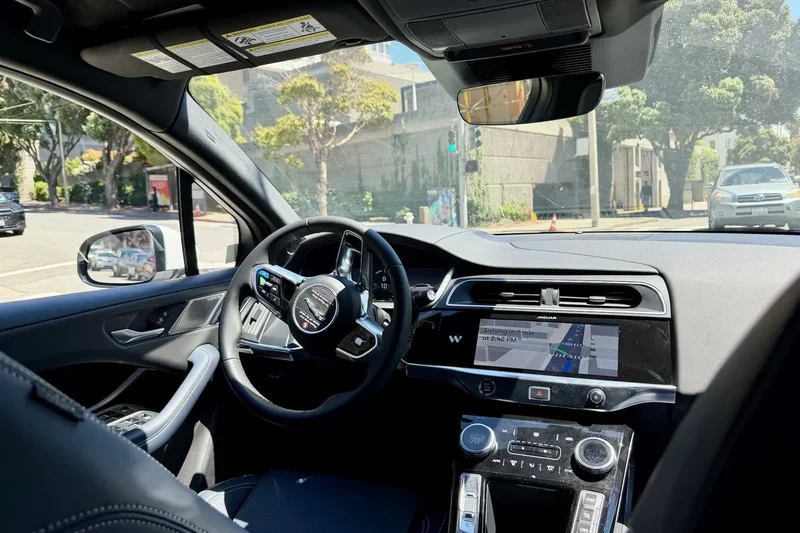
My normal default setting is to hire a car when in the US – when in Rome, etc… However, I resisted the temptation in San Francisco, instead choosing to download the Waymo app. Okay, full disclosure, I used Uber for the 30 minute journey from the airport to our Union Square hotel, but after that it was Waymo.
For those who don’t know Waymo, it’s another American tech startup – a subsidiary of Alphabet, Google’s parent company. Waymo describes itself as the world’s first autonomous ride hailing service – the company is currently carrying out trials on the streets of London with its fleet of white Jaguar I-Paces complete with weird bodywork additions that sense everything that’s going on around it.
Waymos are ten-a-penny in San Francisco, so I thought I’d give it a go. Having experienced plenty of self-driving cars in the past, including being one of the first in Europe to experience Tesla’s Full Self Driving (Supervised), I’m used to sitting in the driver’s seat ready to take over if needed. But sitting in the passenger seat – or the back seat – with nobody in the driver’s seat, well that’s a whole new experience.
The Waymo app is very user friendly and, as with Uber, you get an idea of when a car will turn up, how long the journey will take and how much it will cost all in advance. But unlike Uber, there’s no awkward small talk with a driver and – one thing I loved – no need (or even opportunity) to tip at the end of the ride.
As for the ride itself, four of us squeezed into the Jaguar I-Pace (and being in that car reminded me just how good this former World Car of the Year winner still is) and once the squeals of excitement and nervousness from my fellow passengers had died down, the car was on its way. You just get in, wait until everyone’s buckled up, hit the start button and off you go.
Oh, and for anyone who’s sat silently in the back of an Uber just wishing the driver would turn the radio down, you can choose your own music in a Waymo. It even greets you by name.
Navigating the tricky streets of San Francisco, the Waymo took everything in its stride. It gave way to pedestrians, gently pushed into a busy, but slow-moving, line of traffic and drove smoothly and safely.
Let’s deal with that safety issue, shall we? There have been plenty of social media videos of Waymo cabs finding themselves in awkward situations on no-through roads, but when it comes to incidents, Waymo says that “the Waymo Driver is better than humans at avoiding crashes that result in injuries — both of any severity and specifically serious ones – as well as those that lead to airbag deployments.”
When it comes to stats, Waymos have covered over 67 million miles in the San Francisco Bay area alone, while over comparable human benchmarks using the same distances and timescales, Waymo says it has seen 94 per cent fewer serious injury or worse crashes, 82 per cent fewer airbag deployments in crashes and 82 per cent fewer injury-causing crashes.
And I have to say, I – and arguably my friends who are less experienced in autonomous cars – all felt entirely safe in a Waymo. In fact, when I gave them the option to choose a piloted Uber or driverless Waymo, they unanimously chose the Waymo option. And then proceeded to argue about who chose the music!
Tesla provides similarly impressive stats about its collision rates in cars operating under Full Self Driving (FSD) with over 12 billion miles driven using FSD so far. It says you’re seven times less likely to have a major or minor collision in a car with FSD and five times less likely to have an off-highway collision. And remember that FSD allows you to go further than just the restricted city streets that Waymo covers.
Here in Las Vegas, Amazon’s Zoox robotaxi service is running with boxy vehicles that don’t even have a steering wheel. They look cool, comfortable and – importantly for users – will even charge your smartphone for you on a journey.
So, I’m all in on autonomous vehicles and can see the benefits in places where you don’t want to drive – and for people who can’t drive whether that’s down to age or a disability. And one thing I always remind people who don’t like the idea of driverless cars is that many are happy to get on a plane, where all the pilot will do is take off and then monitor the auto pilot system. Many landings are even autonomous these days.
Of course, there are plenty of cars and plenty of times when I do want to drive – I’m still a car and driving fan after all. But for driving around San Francisco, Las Vegas or even London, when I can just sit back, relax, enjoy what’s around me and know that I’ll be driven safely and comfortably around the city, then for me it makes absolute sense.
To get the latest motoring insights from EV editor Steve Fowler delivered straight to your inbox, simply enter your email address in the box at the top of this page.
Each edition of DriveSmart offers clear, expert guidance on the fast-moving world of electric vehicles and modern motoring, from trusted reviews and practical tips to the biggest industry news of the week.
You can also head to our newsletter preference centre to sign up for the email.