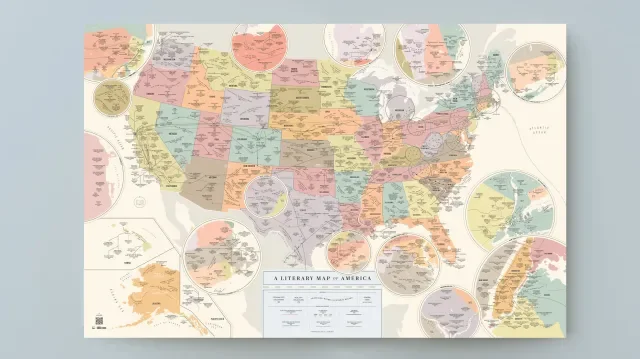
The second map ever featured on Strange Maps — back in 2006, when it was still a fledgling WordPress blog — was a literary take on Maine. It showed the real and imagined places that tether Stephen King’s horror stories to the rugged landscape of his home state. On the map, fictional towns like Derry, Castle Rock, and Lake Kashwakamak jostle for space with the real ones that inspired them, including Bangor, Skowhegan, and Portland. I was mesmerized by both that duality — the tension between actual and made-up locations — and another: the friction between literature as the projector and landscape as the screen upon which its narratives play out. That tension — that friction — is the weird interzone where our imagination lives. It is where literary fiction comes alive and hooks us, where we walk for miles in the shoes of its protagonists, where they take us on emotional rollercoasters. The impact of some books long outlasts the final page. Drive through any quaint small town in Maine, and if you’ve read King, you can’t help but feel a nameless dread lurking behind the picturesque, all-too-familiar facades. Or perhaps in the storm drains underneath. Have the author’s stories grafted a now-endemic eeriness onto the Pine Tree State, or have they merely brought a pre-existing spookiness to our attention? Either way, the phenomenon reveals the powerful effect of literature on our understanding of geography. “A Literary Map of the United States,” a poster created by Ben Gibson, a design director at Big Think, charts that fascinating relationship between the word and the land on a nationwide level. Stephen King is still there — not just up in Maine (with It, Carrie, and ‘Salem’s Lot), but also in Colorado (The Shining, Misery) and Florida (Duma Key). But so are hundreds of other writers, their works anchored in various ways to other parts of the country. There are many ways to read this map: as a peculiar road map of the United States, a potted history of the same, a metatext of American literature, a guide to American literary genres and their centers of gravity, and more. I will get to at least some of them later, but for now, I want to examine the effect that scholars call broadly “imaginative geography,” more precisely “toponymic capture,” and more elegantly “authorial inscription.” It is the process by which a writer’s vision of a place becomes so dominant that it effectively overwrites that place’s prior identity in the public imagination. We could say other parts of America have been “colonized” by other texts the same way King’s horror stories have influenced our perception of Maine. A gentler metaphor, from Rebecca Solnit’s Infinite City, is of cultural and literary memory as an “overlay.” It resides above physical geography like a transparency on an overhead projector, a slightly shifting but persistent presence. In Landmarks, the English nature writer Robert Macfarlane develops the idea that a sufficiently powerful text doesn’t just describe a landscape, but alters the mind that subsequently encounters it. He uses the verb phrase “to see through” to define it: you see the Suffolk coast through W.G. Sebald, the Mississippi through Mark Twain, the South (as a particularly “Gothic” place) through Faulkner. Several such places — literary locations, real and imagined, that have lodged themselves firmly in the mind — stand out on Gibson’s map. The places below have been toponymically captured (or authorially inscribed) to such a degree that it has become all but impossible to think of them in any way except through the works of fiction that brought them to our attention. Sleepy Hollow, New York Washington Irving’s The Legend of Sleepy Hollow (1820) gave a Hudson Valley hamlet one of American literature’s most durable gifts: its very own monster, the Headless Horseman. Sleepy Hollow is ground zero for America’s love affair with the uncanny. It’s the place where Old World superstition met New World darkness. As Irving wrote, “A drowsy, dreamy influence seems to hang over the land, and to pervade the very atmosphere.” Here, he invented a distinctly American ghost story and gave birth to the idea that the new republic should have its own legends, hauntings, and monsters. They’ve been roaming the land ever since. Salem, Massachusetts Nathaniel Hawthorne was born in Salem in 1804, the great-great-grandson of John Hathorne, an official involved in the 1692 witch trials. That fact haunted him so much that some believe he changed the spelling of his last name as a way to distance himself from his ancestor. In The Scarlet Letter (1850), he transformed his hometown into the locus delicti of Puritan guilt: a place where the past does not release its grip and where the sins of the great-great-grandfathers are visited upon the living with compound interest. “No man, for any considerable period, can wear one face to himself, and another to the multitude, without finally getting bewildered as to which may be the true,” Hawthorne wrote. No American writer has mapped the mental cost of religious intolerance more precisely or more permanently affixed it to a physical address. East Egg and West Egg, New York For The Great Gatsby (1925), F. Scott Fitzgerald invented two villages on the North Shore of Long Island: East Egg is old money, settled and beautiful; West Egg is new money, striving and vulgar. They are separated by the narrow water of the bay and by the rather wider chasm of class. Gatsby stares across the gap at a green light, the symbol of his desire. “So we beat on, boats against the current, borne back ceaselessly into the past,” Fitzgerald writes. He understood and expressed as few novelists have that geography is destiny in America: The side of the tracks — or, in Gatsby’s case, water — on which you are born largely decides your fate. Yoknapatawpha County, Mississippi With Yoknapatawpha, William Faulkner created the most richly realized invented geography in American literature, a fictional county of 2,400 square miles, complete with census figures and a hand-drawn map signed “William Faulkner, Sole Owner & Proprietor.” Yoknapatawpha became the laboratory in which Faulkner conducted his great experiment: the South as a place outside time, where the land remembers what the people try to forget. As he put it in his most famous quote, “The past is never dead. It’s not even past.” In the decades since Faulkner helped define the Gothic South, his version has cast its shadow across the imagination of many readers and arguably every Southern writer. Maycomb, Alabama Harper Lee’s To Kill a Mockingbird (1960) invented American fiction’s most morally charged small town and one of its most unforgettable moral witnesses. Jean Louise “Scout” Finch, just six years old, observes her father defending a Black man wrongly accused of rape in a town that’s already decided he’s guilty. Maycomb — modeled on Monroeville, Alabama — is the South at its most seductive and repulsive: a community bound by manners, whose civility is the elegant surface covering a base of organized injustice. Lee located evil not in monsters, but in neighbors; not in extravagant wickedness, but in ordinary cowardice. No American novel has made a stronger case that a small town can be an efficient machine for enforcing conformity, or that a single conscience can stand against it: “You never really understand a person until you consider things from his point of view … until you climb into his skin and walk around in it.” Gopher Prairie, Minnesota In Main Street (1920), Sinclair Lewis returns to his hometown of Sauk Centre, Minnesota (disguised as Gopher Prairie), and commits one of American literature’s most thorough acts of demolition. Gopher Prairie is the emblematic provincial town, conformist and suffocating, where the absence of ideas is taken for the presence of virtue. Carol Kennicott, Lewis’s protagonist, arrives in town with ideals and is ground down over the years by a community that sees her intellectual curiosity as an affront. Gopher Prairie is everywhere that culture is regarded with suspicion and ambition with distrust. That is to say, it can be anywhere. As Lewis himself put it, “It’s one of our favorite American myths that broad plains necessarily make broad minds, and high mountains make high purpose.” Lake Wobegon, Minnesota Garrison Keillor’s radio program A Prairie Home Companion (1974–2016) so lovingly and consistently conjured up a fictional town that it acquired a solidity of its own, both in the American imagination and in a series of books. Lake Wobegon is the small-town Midwest reimagined with gentle comedy and quiet elegy. Its famous tagline — “Where all the women are strong, all the men are good-looking, and all the children are above average” — is both the joke and the thesis: This is America’s dream of itself as a community of modest sufficiency, with the small town a haven rather than a trap, as it was for Sinclair Lewis. That these opposing versions of small-town America sprang from the same Minnesota landscape says something about the directive power of our imagination, literary and otherwise. Winesburg, Ohio Sherwood Anderson’s Winesburg, Ohio (1919) is less a novel than an anatomy of despair. The book presents a cycle of linked stories about the inhabitants of a small Midwestern town (modeled on Clyde, Ohio, and not the actual Winesburg, Ohio), many of them wrapped up in some private obsession that ultimately warps them. Though Anderson describes them as “grotesques,” his characters are not monsters. They are simply what happens when a partial truth hardens inside someone. Winesburg is a stand-in for any town where the gap between inner life and outer expression is too wide to cross, a place where the things that matter most are precisely the things that can’t be said. What remains is the image of a town as a collection of sealed containers, each under pressure and none able to open. Holcomb, Kansas The 1959 murders of the Clutter family of Holcomb, Kansas, by two ex-convicts gave Truman Capote the canvas for what he called a “nonfiction novel,” a work that uses the full apparatus of literary fiction to document an actual crime. The novel put Holcomb — a village “on the high wheat plains of western Kansas, a lonesome area that other Kansans call ‘out there'” — on the map. This nondescript place in one of America’s most visually anonymous landscapes was seared into the national imagination as the site of a specific kind of horror: the violence that intrudes from the boundless outside, the darkness that finds its way to even the most ordinary doorstep. The flat Kansas landscape, with its grain elevators, vast sky, and howling winds, was permanently altered in the American mind, made sinister by its proximity to the four deaths documented by Capote. Brokeback Mountain, Wyoming Annie Proulx’s short story “Brokeback Mountain” (1997) uses a fictional peak inspired by Wyoming’s real mountains to map a corner of the heart that American fiction had rarely dared to visit. Two young ranch hands spend a summer above the treeline in the high grazing country of Wyoming, fall in love, and spend the next 20 years unable to admit it to the world — or to let it go. “There was some open space between what he knew and what he tried to believe, but nothing could be done about it, and if you can’t fix it you’ve got to stand it,” Proulx wrote. The mountain itself contains everything the two men can’t have in the world below: It’s a place where the ordinary rules do not apply. Proulx’s Wyoming landscape is pitiless: cold, windswept, indifferent to human feeling. It is precisely that indifference that makes the men’s love, set against it, feel so consequential. Cannery Row, California In Cannery Row (1945), John Steinbeck describes a world that’s already disappearing. Within a few years of its publication, Monterey’s sardine-canning industry would be barely hanging on, following the familiar pattern of overfishing, population collapse, and commercial decline. The book describes Ocean View Avenue, a street of corrugated iron buildings and marine smells, of cheap lodgings and manual labor. In Steinbeck’s words, “Cannery Row in Monterey in California is a poem, a stink, a grating noise, a quality of light, a tone, a habit, a nostalgia, a dream.” The operating word here is “nostalgia,” thanks to Steinbeck’s own book. In 1958, the Monterey City Council renamed Ocean View Avenue after the book that had become its memorial. Cannery Row is now a tourist destination, complete with restaurants, gift shops, and an aquarium — the most American homage possible for a literary classic. + + + “A Literary Map of the United States” is now available in Big Think’s online store on Pop Chart, where you can also find our first poster, “A Visual History of the Universe,” and other Big Think merch. This article American literature, charted in one monumental map is featured on Big Think.
American literature, charted in one monumental map