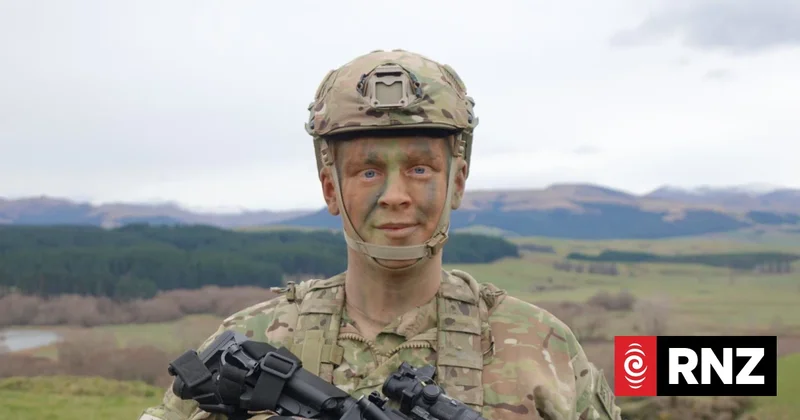
On the hills near the small Southland town of Waikaia, a battle is underway.
Trenches are set into the hilltop and soldiers have spent days climbing the grassy slope to prepare for the big offensive, often in the cold and mud.
Explosions and soldiers are not usually a common sight in the town of just over 100 residents, but Waikaia has been hosting Exercise Tauwharenīkau.
It is the largest Reserve Force-led warfighting exercise conducted in the South Island in decades, with close to 500 New Zealand Army and Australian Army Reserve personnel joining forces.
Legs burn as soldiers each haul at least 30 kilograms of kit up and down the surrounding hills, trying to scout for the enemy.
That enemy has included Lance Corporal Stephen Potter, an Invercargill-based doctor and a medic in the Reserve Force.
For the last week, he has been disrupting, delaying and harassing the opposing side.
"We had a good fight in a quarry where we had actually fortified up with rocks and they had to come up quite difficult terrain and they actually came up with quite an intelligent way to come up one of our blindspots," he said.
"It's about trying to make it so it's realistic enemy. We were trying to counter that by putting patrols in to try and spot them so trying to adapt."
They train regularly, but he said the terrain was rough.
"Certainly seeing a lot of people pretty tired with the hills. I think the North Islanders find it a wee bit cold, being a local I don't find it too bad," he said.
"But it has been pretty rough ... having to have the warm kit ready, making sure our Australian comrades are wrapped up well.
"I think Southland gives a really good training ground to actually build a good amount of resilience and I think that it's nice to be in my own backyard."
Speaking the day before the battle, he was looking forward to seeing how the other force would try to claim the hills they were based on, which overlook Waikaia.
Opposition Force Commander Major Dion Becker said the hills were prime territory.
"It dominates the air in front of us. It's sighted to stop enemy forces coming up this valley so a lot of it is, as you can see, is laid out with interlocking arcs just to deny that bit of real estate," Becker said.
But their kit did not make it an easy climb.
"Some of our specialists units, they could be carrying up to 60 kilograms and this is a great environment to really build that resilience of carrying that weight over really undulating terrain, sorting out our lower limbs and things like that so that we can get to the high ground and fight when we're there," he said.
Among the kit was an assault rifle that fired blanks - no live ammunition was used in the exercise
"We've also got attached lasers that connects to sensors that people wear so that we can, in real time [say], 'that was a close shot' or 'that was a good shot'," he said.
"They get feedback with a verbal tone and our umpires can then download a lot of that information and just see trends and do some analysis on that "
Soldiers would be positioned in trenches, including ones that were camouflaged under mounds of grass.
1 Field Squadron Captain Dean Burke said engineers would also be working in the final assault by helping the infantry to break in and removing the obstacles.
"Survivability is about hardening the defensive position as we've done here and so for the opposing forces, [they're] given a greater chance of survival in this structures [sic] that [we've] provided them," he said.
Further south, at the Waimumu Forward Operating Base, Catering Sergeant Katie Emmett and eight others help to put out roughly 1000 meals a day.
There were two transportable kitchens decked out with ovens, kettles, grill plates and a deep fryer.
"It's really good to have in mind what they're going to be doing, and that's running as fast as they can, getting into position as fast as they can, medicating as fast as they can and communicating as fast as they can," she said.
"Ideally it's going to be hearty. It's going to make sure they have enough carbs."
The menu was varied.
"Spaghetti, baked beans in the morning. An egg option and they'll have a protein, whether it be bacon, sausages, and a specialty item, just create that morale.
"You've got your pancakes, maple syrup, squirt of cream, and hash browns."
Supply company IC Corporal Daniel Dunn said 100 people could use their diesel-fuelled showers over two hours.
The cubicles were a bit cramped, but they put out 40 degree water, he said.
"Basically soldiers can come in, put all their uniform and stuff in here, pull the handle and then they've got water for a 20 second period and they can do that multiple times."
Back at the front-line, Reserve Force Executive Officer Lieutenant Colonel Darren Young said the Southland terrain was putting soldiers through their paces.
"The size and scale of the areas that we're training in is a really good opportunity," he said.
The exercise was a great chance to build foundational skills, build their confidence and work as a team, he said.
Saturday's battle would put the skills they had honed to the test, he said.
"They've been practicing their assaulting skills, navigation, all the basic soldiering skills to get them to a point where they can work together as two companies, assaulting an objective which is where we are standing," he said.
Young said the training meant it would be easier to integrate the reserves into the main force if needed.