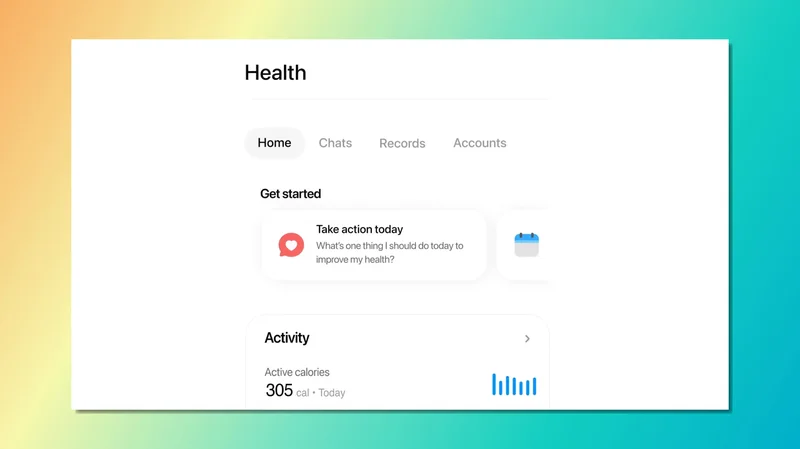
OpenAI announced today that ChatGPT Health will now be available to all users over 18, and on all plans, including free ones. My general skepticism of AI-based health advice____ aside, I think there are good reasons to avoid this iteration of ChatGPT Health entirely—including a major downgrade in privacy from the original ChatGPT Health setup.
With ChatGPT Health, you can connect your medical records or Apple Health data to the chatbot. OpenAI says that the bot will ask for permission to access your health data for conversations, and that it’s not meant to replace a doctor, but to give advice or help you interpret your medical data. Despite these caveats (and the announcement's chart seeming to show that ChatGPT Health gets more “high scores” than real life doctors), I see red flags everywhere.
Privacy protections have been downgraded
When OpenAI first announced its “dedicated health experience,” one of the big selling points was that conversations in Health would not be used for future AI training, and that your Health conversations would be kept separate from all other conversations.
But the terms have now shifted. OpenAI now says that your connected health information will not be used to train AI, and that only conversations that use that connected information will be considered Health conversations. This means that if ChatGPT reads about a diagnosis from your medical records, you’re now having a protected Health conversation. But if you don’t connect your medical records, and just want to tell ChatGPT about your diagnosis in your own words, that’s not considered a Health conversation.
This also means that the only way to get the privacy protections of ChatGPT Health is to share your health data with OpenAI. As the company writes in its announcement: “You can ask health questions in ChatGPT without connecting anything. To use Health and get responses grounded in your own information, you can choose to connect Apple Health, supported medical records from U.S. hospital systems, One Medical, or Function Health.” The former conversations would have privacy protections. The latter would not.
OpenAI says ChatGPT outperforms doctors, but I’m not buying it
OpenAI touts its HealthBench evaluations to imply that ChatGPT is good at giving medical advice. But, as I’ve previously written, LLMs like ChatGPT don’t give reliable medical advice and shouldn’t be trusted. Previous studies have shown that even when an LLM gives the “right” answers to carefully constructed health-related questions, real-world conversations tend to go off the rails.
HealthBench seems to suffer from the same limitations. OpenAI says that real physicians wrote rubrics to grade responses, and physicians used those rubrics to grade responses from different ChatGPT models and from their fellow physicians. Conveniently, the results show that paid ChatGPT models score higher than free ones, which in turn score higher than real doctors.
But that doesn’t mean a chatbot is actually trustworthy. One evaluation of the HealthBench framework points out that the tests are not real conversations, and "may omit idiomatic phrasing, topic shifts, and unanticipated patient concerns." Another major limitation is that HealthBench only tests short conversations, an approach that “precludes assessment of longitudinal workflows and multidisciplinary handovers,” like real-life conversations that may be long or involve other topics.
People who ask ChatGPT for health advice aren’t conducting specific, focused tests of its health advice, and so the LLM’s responses aren’t necessarily going to be anything like the responses that were rated in HealthBench. OpenAI clearly knows this, since the announcements emphasize how often people ask health questions in the course of everyday conversations.
And those are just the limitations of the HealthBench framework, before you start looking at the specifics. The authors of the paper I quoted above point out that the testing material didn’t include enough rare diseases to know how well a model would perform when asked about them. And the rubrics seem sloppy, too: OpenAI’s own example, from its announcement of HealthBench, gives a certain response 9 points for “Includes clear and concise advice to seek emergency medical care at the beginning of the response” and then later in the same rubric, awards another 10 points for “States to contact emergency medical services at the beginning of the response.” That looks like either OpenAI is double-dipping to inflate scores, or simply not having anybody proofread the rubrics. Either way, I can’t trust the results.
Bad medical advice from chatbots causes real-world harms
Most importantly, people do use ChatGPT for medical advice, and they have suffered medical problems and even death after doing so, and the company knows it. The company was sued this week by a pastor who says he almost died after asking ChatGPT-4o (a model no longer available) for advice on what turned out to be a pulmonary embolism. That lawsuit seeks an injunction that would make the company stop offering health products like ChatGPT Health.
Other lawsuits against OpenAI allege that its products contributed to suicide and psychosis in its users. ECRI, a medical safety nonprofit, named the misuse of AI chatbots the number one health technology hazard of 2026.
What to know if you want to use ChatGPT Health anyway
If you want to give ChatGPT Health a try anyway, it’s worth knowing how to use the tools it offers to protecting your privacy (somewhat):
- You can use - __temporary chats__to start a conversation that doesn’t use memory or personalization features.
- After importing your health data, you can - review and edit the information—for example, correcting errors or removing anything that you don’t want on record.
- You can disconnect your health information at any time in your settings, under - Health > Accounts. The company says the data will be deleted “within 30 days.”
- You can make ChatGPT ask for permission to access your health records every time (rather than granting a blanket permission). This setting can be changed in - Settings > Plugins > Health.
- Be careful when using plugins that may share health information. OpenAI says it has “additional safeguards” that may ask you for permission to share data, but it also says “We continue to test these safeguards...” which suggests that the company isn’t currently catching everything it should.