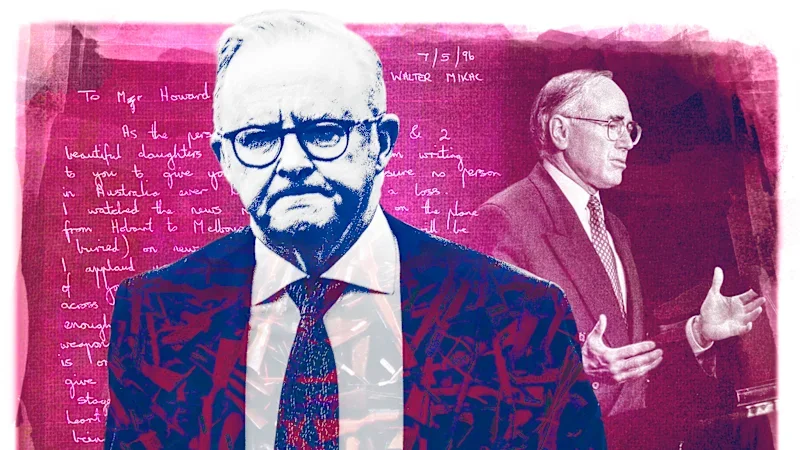
A little over a week after his wife Nanette and six-year-old daughters Alannah and Madeline were gunned down in Australia’s deadliest mass shooting, Walter Mikac sat down to write a letter to John Howard.
“As the person who lost his wife and two beautiful daughters at Port Arthur, I am writing to you to give you the strength to ensure no person in Australia ever has to suffer such a loss,” he pleaded with the then-prime minister.
Spurred on by the note, which is now held at the National Museum of Australia, Howard announced his legacy-defining national gun buyback scheme. Some 644,000 newly prohibited semi-automatic and pump-action firearms – one-third of all privately owned guns in Australia – were eventually handed over and destroyed.
Mikac had hoped to witness a similar national moment following December’s Bondi terror attack, in which 15 people were killed and many more physically and mentally scarred. But a potential repeat of Howard’s 1996 triumph has collapsed under the weight of shifting politics, absent leadership, and disagreement over who foots the bill.
Of Australia’s eight states and major territories, just two are proceeding with a post-Bondi buyback: NSW and the ACT.
Under the terms initially laid out by Prime Minister Anthony Albanese, states and territories were meant to agree to reforms by March, and legislate the changes no later than July 1. Both deadlines have come and gone, and a mooted September start date in NSW is looking unlikely.
Victorian Premier Jacinta Allan rejected a key recommendation by her own independent expert, Ken Lay, to place a cap on how many guns a person can have, fearful of regional voters angrily handing back firearms at the same time as her beleaguered Labor government heads to the polls in November. Victoria Police also wanted a cap and was ignored.
Queensland is also out, as is South Australia. Tasmania won’t have a cap and Western Australia has just had 83,000 guns returned under a voluntary return program and feels no need to tie itself to Albanese’s proposal.
It took Howard just five months to announce, negotiate and begin his national gun buyback scheme following the Port Arthur massacre. By contrast, more than seven months have passed since the Bondi Beach antisemitic attack with no agreement.
Howard told this masthead this week: “Although the circumstances do vary, I am very disappointed that Anthony Albanese hasn’t got everybody on side.”
To make matters worse, the small number of jurisdictions that do want to take part in Albanese’s scheme still haven’t been able to finish the design of the scheme and strike a funding deal with Canberra.
In the Jewish community, patience is wearing thin. Farmers and recreational shooters who will be caught up in the fallout are also in a state of limbo.
The failure to land a new national gun buyback scheme – one of the key policy responses to flow from the Bondi atrocity – offers an insight into the state of politics in 2026 and the profound power of self-interest.
The rot set in the day Albanese announced his plan for a national buyback nearly a week after father and son duo Naveed and Sajid Akram allegedly opened fire on Jewish families at Bondi Beach.
Billed as “the largest since the Howard government in 1996”, Albanese said the buyback was critical and argued there were now 4 million firearms in Australia – more than at the time of the Port Arthur massacre.
But there were three problems with the prime minister’s commitment that meant the idea was fatally flawed from the start.
The first was who would pay. Unlike Howard’s buyback, which was federally funded via a temporary increase to the Medicare levy from 1.5 to 1.7 per cent, Albanese’s model called for a 50:50 cost sharing with the states.
Would the deal have got up had Albanese stumped up 100 per cent of the funding? “I’m not so sure,” Australian Gun Safety Alliance convenor Stephen Bendle said this week. “What we’ve seen is that there has been political hesitation more than financial.”
Either way, an argument over costs gave leaders an easy way to sidestep the scheme. Northern Territory Chief Minister Lia Finocchiaro was the first leader to baulk at forking out. “We welcome the federal government to have a gun buyback scheme, but Territorians won’t be the ones footing the bill,” she said. “I’ve been very upfront and honest about that from day one.”
Albanese’s second failure was his initial refusal to announce other strong measures. His stubborn resistance to calling a royal commission into the deadly attack meant the measures outlined in his early response – however well-intentioned or needed – suffered by association.
Ironically, Howard – who supports the principle of a fresh buyback – damaged its chances of success in the days after Bondi. Savaging what he said was a failure of Albanese to combat antisemitism, Howard dubbed the prime minister’s proposed buyback a “diversion”.
“I do not want this debate post this horrible event to be used, the focus on guns be used, as a pretext to avoid the broader debate about the spread of hatred of Jewish people and antisemitism,” Howard said in December.
Albanese eventually relented and agreed to a royal commission – but the father of gun reform speaking in such negative terms offered conservatives cover to shirk bipartisan support.
The third setback was Albanese’s apparent unwillingness to use his prime ministerial authority to campaign for the changes. Whereas Howard travelled around the country making the case for a buyback, Albanese has been nowhere to be seen. He has spoken of the scheme publicly just a handful of times since February, according to an analysis of Hansard and his own transcripts.
But there is much blame to go around. The majority of states have refused to take part even though Virginia Bell explicitly recommended a national buyback in her interim report from the Royal Commission on Antisemitism and Social Cohesion.
Costs are one factor. However, the rise of One Nation and its leader Pauline Hanson has seriously spooked state leaders and oppositions. One Nation, which is vehemently opposed to a buyback and has pledged to repeal it, poses a real threat in Labor and Coalition-held electorates with high rates of gun ownership.
Federal Labor MP Dan Repacholi, who represents the NSW seat of Hunter, supports a buyback scheme but has criticised the four-weapon cap for recreational shooters proposed by NSW Premier Chris Minns. Allan, the Victorian premier, holds the regional seat of Bendigo East but denies her political survival was a factor in not following the lead of her NSW Labor counterpart.
Critics don’t buy it. The leader of the Victorian Greens, Ellen Sandell, said Allan’s refusal to support a cap was a “total capitulation to One Nation, the gun lobby, or probably both”.
Estimates based on current Victorian firearms ownership data have revealed that less than 20 per cent of the state’s firearms users would be impacted by the cap rejected by Allan.
Despite that proportionately small number, 287,000 firearms could have been disposed of had she agreed to the limit and participated in the national buyback.
“Any leader worth their weight would do what’s necessary to keep the community safe after such a horrific massacre as Bondi,” Sandell said in an interview this week. “People expect leaders to stand up and do what is right, even if that might be difficult and requires you to show some guts.
“And that’s why this is so disappointing with what Jacinta Allan has done here – she just does not have the guts to do what must be done.”
One senior Labor figure defended Albanese’s handling of the matter and said weak state leaders like Allan were really to blame for the scheme’s collapse. “They all need to explain why they are ignoring the recommendation of a royal commission that everyone was demanding,” the source, who declined to be named, said.
The department of Home Affairs, the domestic spy agency ASIO and the Australian Criminal Intelligence Commission have also endorsed a buyback, arguing it would help manage individuals with violent extremist ideologies, and frustrate serious and organised crime from obtaining lawful access.
Stolen or missing registered firearms account for nearly 10 per cent of illicit longarms and around 31 per cent of illicit handguns in Australia. Authorities estimate there are at least 250,000 illegal longarms and handguns in Australia, and potentially as many as 500,000.
Bendle also said limiting access would have other benefits, noting the “No.1 cause of firearm deaths is still by suicide”.
Shooting Industry Foundation of Australia chief executive officer James Walsh argued a cap in NSW and other states would not target the right gun owners. “These policies are not going to take a single firearm off a terrorist or a criminal – you’re just taking guns out of a safe,” he said.
“Taking those guns doesn’t increase public safety. Go out and go hard in south-western Sydney and take all the illegal pistols, illegal firearms, and the semi-automatic firearms that are being used. That will actually have tangible public-safety benefits.”
The argument that law-abiding owners saddle the biggest burden in any buyback was given short shrift by Howard in 1996. In his response to Mikac’s emotional letter of early 1996, the then-prime minister replied, saying: “I regret that many people who have never done anything wrong in their lives will be inconvenienced by the new laws, but this is ultimately a small price to pay for a community that feels, and is, more secure.”
Of course, Howard could rely on the crucial support of his deputy, Nationals leader Tim Fischer, who was instrumental in persuading rural Australia of the need for change.
Walsh said claims his industry and its lobbying arm had too much influence over the failed buyback were wrong. He claimed his organisation had to do little if any campaigning before most states pledged to not take part, and said the Minns government had “refused to speak to us”.
“We have his backbenchers calling, going, ‘there’s nothing that we can do. We know it’s going to cost us our jobs. We know we’re going to lose votes over this, but it’s a captain’s call. He won’t change his mind’.”
An analysis commissioned by his association recently found the cost of buying back weapons in NSW would be about $415 million before other costs such as compensation and administration were added. The government has not publicly disputed the findings of that study.
The delay in securing an agreement between Macquarie Street and Canberra has caused legitimate angst among recreational shooters and primary producers in NSW, who still have no idea whether the government will pay market value for a firearm, rather than a lower set price.
Walsh was scathing of Albanese’s handling of the issue, and his absence from the debate over recent months. “The prime minister seems to say a lot and then change his mind, doesn’t he?
“He came out in an emotion-fuelled speech saying he was going to do this and going to do that. But he hadn’t come to the industry. He hadn’t gone to the states. He didn’t know how many firearms are out there.
“There were questions he should have asked before he came out with this.”
The Herald and The Age asked the prime minister a series of questions, including why he had not been more forceful in his public advocacy for the scheme and whether promising to fully fund the program might have delivered more participation by the states.
In a statement, he said: “We’re continuing to work on the buyback scheme. We’re confident it will lead to a significant reduction in the number of firearms in our community, and that’s a good thing.
“I want fewer guns on our streets.
“The states and territories will make their own decisions about how they choose to participate – but all governments have a responsibility to do all they can to keep Australians safe.”
Chris Minns, whose premiership was redefined by the horror of Bondi, remains 100 per cent behind the gun buyback and has been overheard telling colleagues he thinks it’s an issue worth losing an election over.
Laws that passed parliament in December restrict firearms licences to Australian citizens, reduce the standard term for firearm licences from five years to two years, cap the number of firearms an individual may possess at four, with a higher limit of 10 for primary producers, and restrict access to pump-action, button or lever-release, or straight-pull firearms – such as those used in the Bondi attack – to primary producers.
However, progress on making those laws reality has been painfully slow. Some of the yet-to-be-resolved issues include whether the state can afford to offer market value for guns, which will increase the cost of the scheme, how much should be paid for ammunition and other soon-to-be redundant firearm paraphernalia, potential compensation for gun clubs and stores, and what other exemptions may need to be written into the regulation. There is also a huge amount of work being done on the mechanics of how guns would be collected and destroyed, which NSW Police have had to play a central role in navigating.
One senior member of the Minns government, who declined to be named due to cabinet confidentiality, said the work had been frustrating, “but I am sure there will be a deal and this will go ahead”.
Minns and Albanese have been under little political pressure to hurry up because oppositions state and federally do not see a political dividend in supporting the buyback.
NSW Opposition Leader Kellie Sloane told a NSW Farmers’ conference in Sydney this week that while the NSW Liberals supported Minns’ gun laws in December, they wanted changes.
Bondi is personal for Sloane – she was one of the first on the scene to render assistance to the dead and wounded – but like her Victorian counterparts she is being squeezed by One Nation ahead of the March election.
“There were two terrorists that caused that attack,” Sloane told the crowd. “It was not farmers. I know you feel like you’re being punished. I know that those 10-gun caps in your communities feel unworkable. So I want to say that we are working with the government, with stakeholders, to make amends.”
Privately, the state government is angry at other states for capitulating to the threat of a backlash and does not blame Albanese.
Minns told this masthead on Friday: “There is goodwill from both the NSW and federal governments on this, and we’ll get it done. We remain absolutely committed to the buyback scheme.”
Minns has previously argued NSW will end up with the “strongest gun laws in Australia”. That may be true, but it would be easy for someone to cross a border and more easily obtain weapons in states with a higher supply.
Perhaps aware of the potential for states to go their own ways, the royal commission’s interim report warned against patchy laws. “There is a public interest in national consistency in firearms regulation in Australia, where extensive and largely unmonitored state and territory borders make it possible for people and firearms to move between jurisdictions with relative ease,” the report noted.
Bendle from the Gun Safety Alliance agreed things had not landed where he had hoped. “There was some hope among public health experts that there might be some light come out of the shadow of a Bondi,” he said.
He said while some states won’t sign up to a full national gun buyback, many may still alter their gun laws, and that would be a good thing. “But it won’t be the same as 1996.”