In the 19th century, Melbourne’s shopping arcades were the height of the city’s social scene.
Young women would stroll through the walkways, looking for opportunities to socialise. Businesses were crammed into the smallest of storefronts. Uniformed beadle officers would be constantly on the lookout, dispersing people who loitered for too long.
More than a century later, Melbourne’s streets look remarkably different. But the arcades remain a celebrated and timeless part of the CBD.
Heritage consultant Kristine Slawinski will be running free guided tours through these historic precincts this weekend, as part of Open House Melbourne. She hopes that the opportunity will put a spotlight on the institutions.
“People might go through them on a daily basis, or quite regularly when they visit the city,” Slawinski said. “[The tours aim] to help people open their eyes and to see what’s around them.”
Melbourne’s two best known arcades sit side by side, between Collins Street and Bourke Street Mall. The Block Arcade is known for its domed roof and impressive tiled floors, while visitors remember Royal Arcade for its chequered floors or curious Gog and Magog clock.
Block Arcade managing director Grant Cohen said the city’s enclosed shopping strips paid homage to their European counterparts. The design of the Block was heavily inspired by the Galleria Vittorio Emanuele in Milan.
“When [the Block] was built and finished in 1892, it was the place to be seen. And we say it still is,” Cohen said. “We’ve spent many years … maintaining and looking after it, and it presents today as it did when it first opened.”
Cohen emphasised the importance of protecting the city’s ageing buildings. He said that foot traffic in the arcade remained high, and that the spaces would remain a significant part of the city.
“Arcades are really such an important piece of Melbourne history. Because it allows people to [enter a] time machine … places like this are becoming fewer,” he said.
Securing a tenancy in a Melbourne arcade was the aspiration of many entrepreneurs in previous centuries. Although running a modern shopfront is a different experience, owners still recognise the importance of maintaining their memory and legacy.
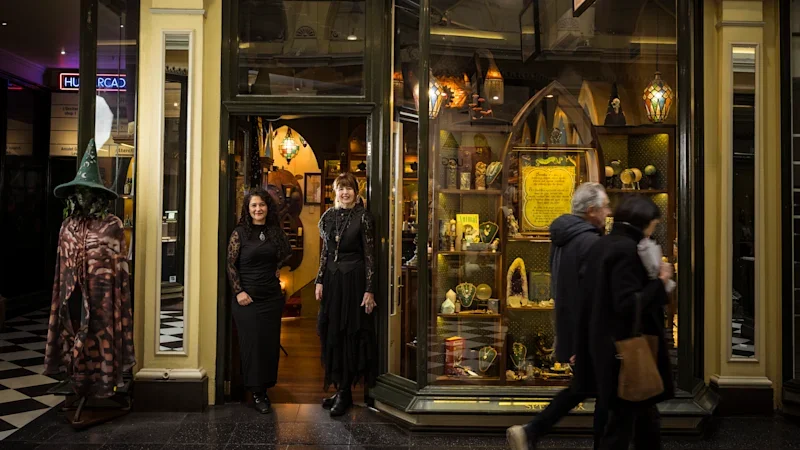
Spellbox has occupied a storefront in the famous Royal Arcade for almost three decades. Owner Danae Moon and manager Jasmine Sun said they couldn’t imagine a better place for the unique business – which is centred on the practice of witchcraft.
“[Royal Arcade] has got that … magical, quaint quality. Sort of otherworldly … Spellbox could never be in a shopping centre,” Moon said.
“It is beautiful to come in and see the old and beautiful semicircular windows. It’s [part of] the history of Melbourne, which I think is really important to maintain.”
Around the corner, antique and vintage boutique The French Jewel Box occupies a prime storefront underneath The Block’s domed roof. Co-owner Lachlan Burnet said the heritage arcade was a special place to run a business.
“It’s a very beautiful space. So we feel very fortunate … It’s such a fabulous heritage building … I think that’s what people want to see,” Burnet said.
“There’s a lot of great, fantastic contemporary buildings in Melbourne, but the Block Arcade is probably the standout arcade in Australia.”
Even away from the hallways of the city’s more famous arcades, some lesser-known corners of the city offer their own important slice of history.
The art deco Manchester Unity Arcade was built in 1932 on the ground floor of the Collins Street building of the same name. The site was initially known for housing the state’s first escalator, and later grew infamous after a 1978 diamond heist, in which three salesmen were killed.
Today, modern visitors will still be impressed by the foyer, which was mainly built using Australian materials and has bronze finishes.
The Cathedral Arcade in the Nicholas Building on Swanston Street is now home to a popular coffee shop and bar, along with vintage clothing stores. On the levels above, boutique traders remain open for business and are accessible via the building’s vintage elevators.
Both of these arcades are included in Slawinski’s guided tour. She stressed how important it was for the public to keep visiting some of the city’s smaller shopping arcades, which can struggle with low customer numbers.
“If people don’t frequent and patronise all the little businesses that are in these arcades, they’re just going to disappear and [fill with] tumbleweeds,” she said.
“See if there’s an alternative route. Just go for a wander and see what you can see.”