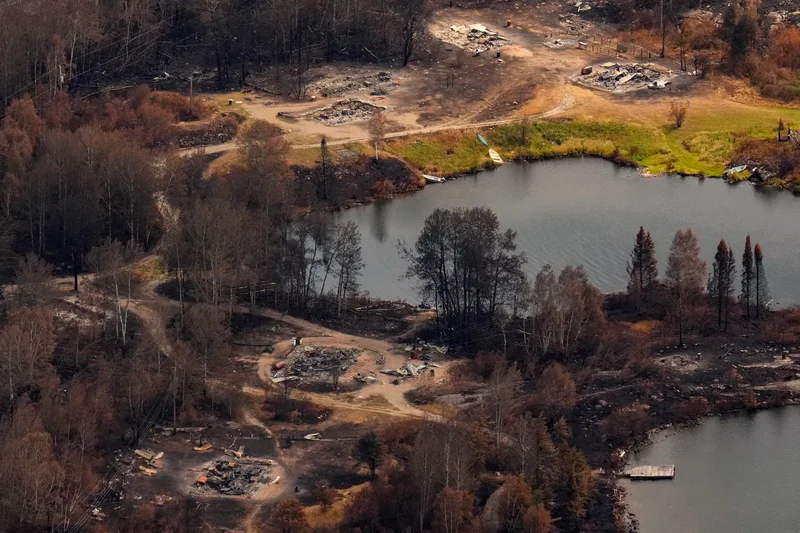
The rampaging wildfires in Northern Ontario that forced several First Nations communities to flee and blanketed the province and beyond in ominous orange smoke have reignited debate on whether the province is doing enough to address the threat.
First Nations chiefs and Opposition NDP Leader Marit Stiles have called for a public inquiry into Ontario’s wildfire response, once the smoke clears. (The Ontario government counters that it does an internal review every year.) Ms. Stiles says the provincial government has long failed to spend enough. Liberal MPP Adil Shamji, in an open letter this week to Mr. Ford, has called for a $100-million boost to the wildfire budget.
Officials with the Ontario Public Service Employees Union, which represents wildland firefighters, say they remain underpaid, understaffed and underequipped – despite years of warnings about the need to ramp up efforts in the face of the drier and hotter conditions resulting from climate change.
Mr. Ford has called the criticism “despicable and disgusting,” while vowing that he would spend whatever it takes to combat the flames.
Ontario’s base budget for wildfire has increased
Opposition leaders and union officials say Ontario’s 2025-26 base budget of $150-million for wildland firefighting, which is up from $135-million the year before, is still inadequate. They point to the actual amount spent fighting the province’s forest fires in 2025-26, which was much higher at $271-million.
But this practice of starting with a base budget and allocating more money ad hoc, depending on the severity of fire seasons, is not new, or unique to Ontario.
Mr. Ford has pointed out that his government has increased that base budget significantly from the $70-million a year set in 2018 by the preceding Liberal government. But it has done so gradually, after holding the budget at that level after taking office in 2019.
Union says Ontario is short wildland firefighters
While Mr. Ford recently has said the province had close to 800 or 900 wildland firefighters, Dave Bradley, a spokesman for Natural Resources Minister Mike Harris, said Friday the actual figure fluctuates but is at least 700 currently, with personnel slotted into 156 crews. Mr. Harris was not made available for an interview.
The union representing these workers is adamant that this number is too low.
Noah Freedman, vice-president of the Ontario Public Service Employees Union local 703 and a 10-year veteran of the province’s wildland fire service, said the government’s current provision of around 150 crews, which he said have four-to-six firefighters each, is far below the 200 the province used to have in decades past.
He points out that these teams, stationed at regional fire headquarters spread across Northern Ontario, are tasked with protecting an area twice the size of France. (As of Thursday, the province said it had 139 active forest fires – down from the nearly 200 that were burning two weeks ago.)
Ontario’s fire plan is centred on rapidly deploying these small crews to put out blazes when they are still relatively small, as soon as possible after they are first spotted, Mr. Freedman said. With more crews, more of the massive blazes that erupted this month could have been contained earlier, he argues.
“These fires should have never been allowed to get to where they did,” Mr. Freedman said. “We could have put them out.”
He also says a larger base budget would allow for more permanent staff, both to retain more veteran firefighters and to do more preventative work in the off-season.
He points to internal government warnings dating back more than a decade about poor pay and a crisis in retention. The workforce is mostly seasonal, often made up of students. Mr. Freedman said the increasing use of six-person crews is a reaction to a shortage of veterans, who must be spread among less experienced firefighters.
In an e-mail, Mr. Bradley said the government does not agree with the union that it needs 200 crews, adding that additional firefighters can be brought in from other jurisdictions: “Ontario does not have a target number of crews, to suggest otherwise is false. If needed, additional capacity can be supplemented through established mutual aid and contracts as operational needs evolve.”
The province can call on private contractors to provide 80 additional crews made up of 320 personnel, Mr. Bradley said.
He also said the government has taken action to boost pay and attract and retain its own wildland firefighter staff, adding more than 170 permanent positions since 2024, including an unspecified number of full-time crew leaders. And Ontario has also increased compensation “for our heroic frontline firefighters and pilots,” he said.
It’s not enough, Mr. Freedman argues, noting that OPSEU had been pushing for changes for years. He said he made $31 an hour as a crew leader last year, after 10 years on the job: “They essentially gave everybody a couple-of-dollars-an-hour raise, patted themselves on the back and said they fixed the problem.”
Questions about number of helicopters, waterbombers
It’s not just a shortage of personnel, Mr. Freedman says. He warns that Ontario also suffers from a shortage of the medium-sized helicopters big enough to deposit a four-to-six-person crew and their 1,000 pounds of gear at a remote fire site. Mr. Freedman says the province failed to sign a new long-term deal with a private contractor for standby helicopters of this size for this season.
This means, Mr. Freedman charges, that Ontario must rely on shorter-term rental contracts that he expects will be more expensive. Plus, he said, the province may more often have to use smaller “intermediate” helicopters, which require two trips to transport a full crew of firefighters and their gear. This can cause delays that allow small fires to grow, he says.
Mr. Bradley said Ontario had more than 120 aircraft available, including 63 helicopters and 18 waterbombers – numbers that include the province’s own fleet plus vehicles from private contractors and those on loan from other governments.
He did not directly address the helicopter contract issue. But the government’s tally includes seven privately contracted medium-sized helicopters, with a contract for another one still to be finalized. Five more such aircraft are on loan from Alberta and the federal government. Mr. Freedman argues this is still not enough.
The union leader also said that as many as three of Ontario’s own nine large waterbomber planes have been grounded for repairs. An internal Ministry of Natural Resources report from June 28, obtained by the union, lists just five of a total of six Canadair CL-415 waterbombers, known as “super scoopers,” as available that day.
However, the aircraft totals that the government initially provided through e-mail cite Ontario’s entire fleet of nine CL-415 heavy water bombers.
Asked to clarify the discrepancy, Mr. Bradley said on Friday that seven of the planes were active, but that two were indeed grounded for “urgent repairs.” He said all nine had pilots assigned and that the government hoped the two sidelined aircraft would be up and running “as soon as possible.”
His e-mail also pointed to the province’s previous announcement of $650-million to add six new waterbombers and five new helicopters to the province’s fleet. The new waterbombers are not expected to be ready for years.
Experts say more prevention is needed
The union and opposition critics say a higher base budget could allow for more staff for preventative measures outside of fire season, such as the practice of “prescribed burns.”
Experts say these fires, deliberately set in a controlled way to reduce the amount of deadwood and fuel in a forest that could ignite, can indeed help protect communities and reduce the severity of fires.
But most acknowledge that despite the recent admonition of U.S. President Donald Trump, this kind of forest management is not practical deep inside much of the vast remote wilderness in Ontario’s north.
U.S. President Donald Trump has threatened to tariff Canada over the wildfire smoke that has 'invaded' major cities like New York and Chicago, saying we aren't doing enough to manage the fires. The Globe’s Jesse Winter, who has covered wildfires for years, explains what Trump’s claims overlook.
Alex Migdal/The Globe and Mail
Brigitte Leblon, dean of natural resources management at Lakehead University in Thunder Bay, said Ontario needs to do more prescribed burns, especially as climate change worsens fire season and pushes past the province’s ability to fight fires after they start.
“The best thing is doing more prevention, and prevention creates fire-resilient forests,” Dr. Leblon said in an interview.
The B.C. government, in an annual report on prescribed and “cultural” burns done in partnership with First Nations, said it burned more than 6,300 hectares in 2025.
Mr. Bradley said Ontario spends $2-million a year on its FireSmart prevention program, which includes prescribed burns, but he did not provide a figure in hectares.
According to Ontario’s website, it had 13 prescribed burn projects inside its fire-prone northern areas scheduled for 2026, some in partnership with First Nations. While many listed do not include the number of hectares targeted, those for which numbers are provided range from a handful to 544.