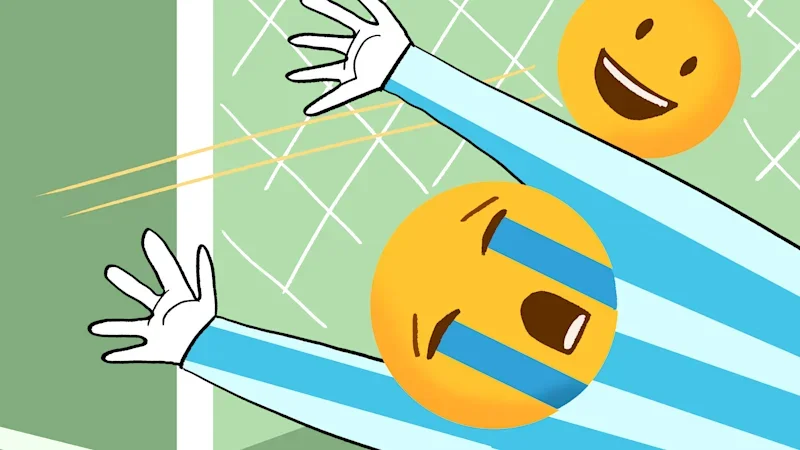
“So it’s over – the few weeks every four years when you pretend you know something about football.”
Cutting words to hear, at the end of an all-absorbing FIFA World Cup. My son spoke with his hand over his mouth, so I appealed to the referee (his mother) to get him sent off, but she was busy watching video replays.
Having lost the point, I went down screaming in agony, ankle in one hand, eye socket in the other, rolling downhill on a flat floor. This earnt a red card for “blatant simulation”, so I called the President of the United States to get it overturned. But he was busy taking a call from Bryson DeChambeau whining at him to impose Mar-a-Lago rules on the British Open. Under the Mar-a-Lago rules of golf, it’s OK for a “winner” to stomp down the grass around your ball. Hell, it’s OK to throw your ball back onto the fairway. Mar-a-Lago rules had already been invoked to rig the World Cup, so why not the Open?
But the President couldn’t take my call. As the final loser, I claimed there was a conspiracy against me. Don’t tell me I don’t know something about soccer. Soccer unites the world in sore-loserism.
The chaotic scenes after the World Cup final – Argentine players trying to punch on and earning posthumous red cards, doddering US Presidents trying to muscle into the winner’s celebration, the eruption of conspiracy theories about the game being rigged – turned out to be completely consistent with the philosophy now embedded into global professional sport. Throughout the tournament, nobody got beaten by a better opponent. There had to be corruption or malfeasance or dark political fishiness. This great compelling carnival of sport, as it escalated to its conclusion, became more and more anti-sport.
“Show me a good loser, and I’ll show you a loser,” was one of the famous lines from football coach Vince Lombardi. It is a most American idea, and for the five weeks of the World Cup this American allergy to being a good loser infused the peak event of global sport.
Australia was not immune, just a small-scale example. When the Socceroos lost in the round of 32 to Egypt, it was difficult to hear any credit given to the opposition or any good grace, any acknowledgement that Egypt, a soccer-mad country of 120 million, might just have a better team than Australia. Instead, commentators attacked coach Tony Popovic for his selections, the tactics of being overly defensive, and the “mentality” of lacking a killer instinct.
This reaction did not show Australia to be a small soccer nation. To the contrary, it showed us to be a small version of the big soccer nations.
When England fell to Argentina, commentators attacked coach Thomas Tuchel for his selections, the tactics of being overly defensive, and the “mentality” of lacking a killer instinct. When France fell to Spain, ditto. When Argentina finally lost the decider, same again: coach’s selections, tactics, mentality, with the requisite addition of conspiracy theories. (Curiously, after four years of the global conspiracy theory that the World Cup was rigged for Argentina to win, the new conspiracy theory is that it was rigged for them to lose. Conspiracy theories themselves turn out to be sore losers.)
Whether the sport is a billion-dollar industrial complex, a national obsessive-compulsive disorder or a third-tier, underfunded winter code, the response to defeat replicates itself: blame your own, hint at off-field shenanigans, and never, on any account, pay due credit to the other team for just being better than you on the day.
Never admit that your team was forced to be “too defensive” because the other team would not let them get the ball. Never admit that the better team won. Or, if you’re Argentina, turn your backs and never even acknowledge that the other team exists. To do so might risk making you a good loser: that is, a loser.
Under the hyper-magnification of the current American cultural climate, the World Cup produced this jarring, compelling mix of the very best and the very worst that sport has to offer: sublime skills and atrocious chicanery; passion so unbearable that it found its final expression in violence; the sweet purity of a 30-metre shot into the top corner against a backdrop of the filth and rot of phone calls between Donnie and Gianni. The higher the stakes, the sharper the juxtaposition.
If there was a game after the final, on the trajectory the World Cup was going, it would have been settled by gunfire.
Maybe that’s where we’re headed in 2030, unless FIFA can break the circuit it has constructed during the past half-century.
We journalists get criticised for paying too much attention to sports administrators, but the World Cup shows how administrators set the tone for the diseases that infect games. Only because of FIFA’s work over the decades does a World Cup become such fertile ground for sore-loserism: for accusations of cheating and corruption, for refusal to accept defeat, for everything that denies that a fair contest has taken place.
FIFA’s naked and, under president Gianni Infantino, proud transactionalism – from ticket prices to “hydration breaks” to political favours – lays the ground for the ultimate dissatisfaction, the casting of doubt on results, the suspicion that this was not a game, it was just another transaction.
And yet … and yet ...
Just as the de facto world championship of golf, the British Open, emerged from the DeChambeau muck to give us a winner in Ryan Fox – the most likeable and homespun individual and a deserved champion golfer of the year – the World Cup gave us Spain.
What had Spain done? They’d overcome the embarrassment of their first match, when they were unable to put a goal past Cabo Verde. (Which ended up not such an embarrassment, with superhuman Cabo Verde goalkeeper Vozinha being named in the official team of the tournament despite playing just four games.) Spain had overcome the dreadful luck of a deranged draw that forced them to beat Portugal, Belgium and France before they even made it to the final. Spain had developed a brand of soccer that asphyxiated their opponents and was coldly systematic, and yet also hypnotic and, in its way, utterly pure.
Spain played the best football, and then they shoved the silly old man out of their way. Football really was the winner in the end, in spite of everything FIFA could throw at it.
What a dizzying month. I might not know much about football, but I know when the good guys and the best team win.