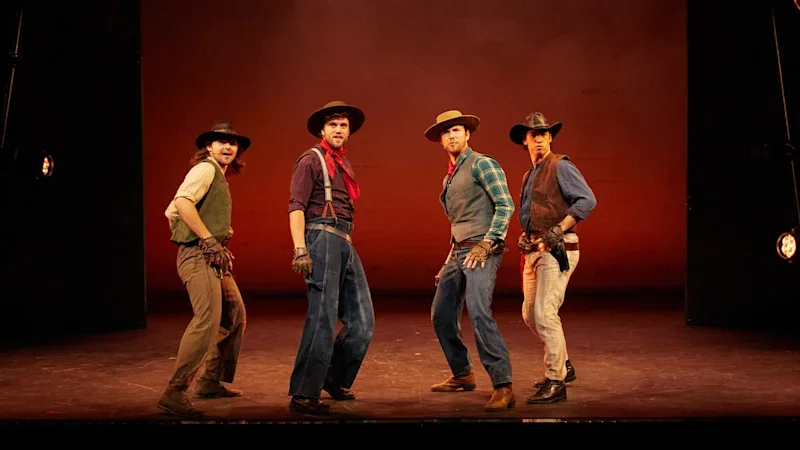
MUSICALSReg Livermore’s Ned Kelly: The Musical ★★★★★Victorian Opera, Union Theatre, until July 25
Reg Livermore’s Ned Kelly: The Musical sets itself a challenge from the outset. First of all, which version of the much disputed Kelly story do you tell? Do you portray the famous outlaw as a folk hero or a villain? Then, once that is sorted, what tone should the whole thing have? After all, there are very real deaths and tragedies scattered throughout this story – and we all know how badly things turn out for the Kelly gang.
This new production by Victorian Opera navigates all of this deftly. The story firmly has its flag planted in the folk hero camp, but does not gloss over the harsher realities of the story. The crimes are grounded in their context and the scenes slip from high-energy numbers to heart-wrenching grief with deceptive ease. It’s fun without ever being glib and serious without seeming insincere.
There are many times you’ll watch a musical, have a great time, then not be able to hum a single bar the moment you get home. That’s not the case here. In Ned Kelly the music is exceptional: memorable, eclectic and highly accomplished. Conductor Simon Holt – who also provided additional music and orchestration, necessary because there was no complete score of the original – conducts the Victorian Opera Chamber Orchestra with verve.
Maria Mercedes as Ma Kelly uses her powerful voice to infuse every scene she is in with fierce love, rage and pride. Ethan Jones as Ned Kelly is a star on the rise; he is just as confident in a solo ballad as he is leading show highlight Gonna Rob a Bank. His Kelly is puckish while unwavering when it comes to fighting for what he feels is right.
Melbourne’s opening night of Ned Kelly: The Musical was originally supposed to take place in 1978, but after premiering in Adelaide and then touring to Sydney, its season was cut short and the rest of the tour cancelled. With the recent cancellations of Waitress, Beetlejuice and Dear Evan Hansen, it’s an all-too-familiar scenario.
Second chances don’t come around often, but it’s fortunate in this case that it did. It’s a very specific joy to watch a show and have it be familiar in a way so many are not; that it is built around stories you’ve heard your whole life, with settings that in some cases are almost just a stone’s throw away.
This isn’t a production that should languish in obscurity; this is a revamped homegrown musical that should be celebrated and seen widely – and far more frequently than every 48 years.Reviewed by Elizabeth Flux
DANCEVista ★★Stephanie Lake Company, Malthouse, until August 1
The first half of Stephanie Lake’s Vista is a glib imitation of dance theatre, a succession of predictable shapes and transitions and opaque fragments of drama, each section falling away to reveal another just the same – like slices of a grey sausage.
Or perhaps, more poetically, like the fluttering of an empty sleeve. Movement without bodied substance. Profluent sameness. An impersonal exercise composed for a camera-like gaze rather than the shared space of live performance.
And what is our reward for all this smoothness? A colourful burlesque. In part two, the first half is reperformed as a hectic carousel: scenes run backwards and dancers mock their former reserve with extravagant weeping, while others loudly commentate on the movements.
There are two problems with this device. First, the opening really is a bore: plausible convolutions ornamented with undulations; affectless attitudinising amounting to a necropolitan chic. It’s the choreographic equivalent of a monotone recitation.
Second, part two is actually not much better. Yes, the constant swapping of partners and the increased energy and messiness create the impression of spontaneity, but it’s the same drab material. The improvement is largely a matter of speed and effort. There is more colour and more dash and more enthusiasm. But beneath the structural gimmickry, the choreographic language remains unchanged, mechanical and lacking any strong organising subjectivity.
Lake has inherited the miscellaneous contemporary dance legacy of those choreographers with whom she once danced. Yet, sometimes, her work can seem curtailed by that inheritance, neither tracing it to its sources nor looking elsewhere.
It is, in other words, oddly featureless.
Of course, I should resist such sweeping statements but, really, I wish this piece had a third part: another turn of the carousel, carrying us into a genuinely new and improbable vista, introducing more than a clever replay of something that we’ve seen before.Reviewed by Andrew Fuhrmann
THEATREMackenzie ★★★★★Bell Shakespeare, Arts Centre Melbourne, until August 9
Bring me a bucket of water, would you? I’m writing a five-star review of a Bell Shakespeare show, and my hair might catch fire. (Five stars! Bell Shakespeare?)
Australia’s most prominent Shakespeare company has been, for significant stretches of its history, bedevilled by incestuousness and mediocrity. No point denying it. I’ve followed Bell for decades now and its most reliable fare, oddly enough, tends to lie outside the Shakespearean canon.
Over the years, it has done everything from Molière to Eugene O’Neill, and it usually rises to the occasion. But there’s never been anything half so funny and alive as Mackenzie.
Yve Blake’s original, freewheeling adaptation of Macbeth relocates the action from the blasted heaths of medieval Scotland to a cutthroat realm behind the scenes of a children’s TV show.
It’s comedic and dramatic genius – a pop girl transformation of the Scottish play that does for Shakespeare what SIX did for the wives of Henry VIII.
In this version, King Duncan becomes tween TV star Dahlia (Anusha Thomas) – think Hannah Montana or a young Britney Spears, and you’ll get the idea – and the Macbeth-figure, Mackenzie (Kimberley Hodgson), is an overlooked child actor with a horrific bowl cut who plays Dahlia’s ugly duckling sidekick.
Lady Macbeth is converted into Mackenzie’s manipulative stage mum, Ruth (Nikki Britton), while Banquo is Mackenzie’s best friend and fellow child star Beau (Ryan González).
The witches? An eccentric make-up artist (Jane Watt) prone to strange prophetic “episodes”. Macduff? A butch lesbian and head of catering at the studio (Billie Palin) with more than enough reason for vengeance.
Even telling you this much feels like a slight spoiler, given how much delight Shakespeare lovers will take in Blake’s inspired tweaks to the Bard’s dramatic architecture, and the hilarious Easter eggs and in-jokes sprinkled throughout the show.
Director Virginia Gay is one of the funniest women in Australian theatre, and the acting is brilliant across the board. Every single member of the cast achieves an exquisite level of clowning, and the energy and commitment and berserk stylisation of the performances take Mackenzie to another level as a satire of both showbiz and adolescence.
Credibly reversing gender in relation to Macbeth’s violence and paranoia is a masterstroke, and a deeply feminist one, that mocks misogyny and exploitation in the entertainment industry, while giving a broad licence to comedy that’s just plain wrong – and a springboard from which to vault into Mackenzie’s nihilistic acceptance of her fate.
Genuine pathos attends Hodgson’s marvellous metamorphosis from an awkward 13-year-old to the beautiful child tyrant Mackenzie becomes, and even Britton’s overwhelming caricature of a stage mother wrenches tragedy from its opposite.
The play isn’t a fully fledged musical, but – between all the intrigue and silliness that erupts the moment the cameras stop rolling – it is buoyed by slick street choreography and catchy pop songs. It’s also flamboyantly costumed and lit, with all the glam outfits and faddish accessories a teen pop princess could want.
Mackenzie should prove a winner with almost everyone, though particularly younger audiences. It reminded me that Bell Shakespeare was the company that first gave me the theatre bug as a kid, and it’s a joy to watch a show guaranteed to spread the passion to a new generation.Reviewed by Cameron Woodhead
MUSICJeane ★★★★
The Tote, July 24
Melbourne institution The Tote has seen it all over the years, but crowd-surfing nuns might be a first. Two songs into Jeane’s launch for debut EP Sicko, a pair of the religious rebels appear on stage in prayer, before launching themselves into the sold-out crowd.
It’s the kind of irreverence that the Melbourne four-piece thrives on. Led by fiery frontwoman Jazz Johnston, Jeane is a shape-shifting musical enigma. Their music showcases a range of styles and moods, flitting from soft, piano-led songs – what Johnston describes on the night as “medicine” music – to short, sharp blasts with a punk rock heart.
Johnston’s magnetic presence seals the deal live: her vocals are soulful one minute, an ear-splitting yelp the next. There’s a cheeky smirk on her face as she sings, as if she’s letting the audience in on a secret. A shaky start to the male vocal harmonies irons out as the set continues; the camaraderie and synergy between the band members is palpable as they work in tandem to build to gorgeous, glorious climaxes, then simmer down again. These songs are good on record, but live, they explode.
Under Johnston’s spell, the small venue feels both intimate and like a stadium. She commands the space, making use of every corner – from sitting on the edge of the stage and singing directly to punters in the front, to literally bouncing off the walls towards the end of the set, when she climbs onto tables and speaker stacks, slick with sweat as she screams into the microphone. The audience yells back, particularly during the chorus of propulsive single Cash, and it’s an ecstatic mess of noise and movement.
Unusually for a local act and this stage in particular, the band return for an encore and the place is fizzing with the energy of it all. Sickos, the lot of us.Reviewed by Giselle Au-Nhien Nguyen
THEATRESteel Magnolias ★★★★
Athenaeum Theatre, until August 16
Most people would have heard of the 1989 American movie starring a swath of Hollywood luminaries (Dolly Parton, Sally Field, Shirley MacLaine, Daryl Hannah, Olympia Dukakis, Julia Roberts), but it’s likely that not many would have realised that Steel Magnolias was a theatrical piece before it was successfully translated to screen. This production, on tour around the country, is based on the original play by Robert Harling and follows the same beats as the movie.
Director Lee Lewis eschews any drastic reinterpretation; the Southern American accents are retained (kudos to Jennifer White, dialect coach), and there are no attempts to modernise or change its location. Once again Steel Magnolias is set inside Truvy’s (Mandy Bishop) home salon in Louisiana (where the motto is: “There’s no such thing as natural beauty”). To the delight of nostalgics of the era, 1980s fashion and styles are in abundant display thanks to designer Simone Romaniuk – think stiff bouffant hair and soft pastel tones in the set dressing and wardrobe, with pink as the accent colour.
It’s a busy thoroughfare: a site of information exchange, barbs, advice and laughter amid the hooded hair dryers, nail polish and hair rollers. There’s Annelle (Lotte Beckett), a newcomer to the town and recently hired hair stylist; M’Lynn (Lisa McCune) and her daughter Shelby (Jessica Redmayne), a young bride; Clairee (Tracy Mann), a widow rediscovering independence; and Ouiser (Belinda Giblin) the neighbourhood grouch.
All the big moments are dramatised in this cosy salon that spans a couple of years, including births, marriages, heartbreak, divorce, disease, sacrifice, and illness. The salon acts as a safe space for confession and solace, and in between the divulging of secrets and gossip, the play explores the bond between mother and daughter and the support of community.
The collective’s emotional strength is to be sorely tested because these steel magnolias, with their metaphorical mix of floral charms and gritty centres, must rally around when death eventually comes for one in their fold.
It’s a character-driven narrative that focuses on the personal stories and interrelationships between the six women; the men – their partners and sons – are referred to but never seen, relegated offstage.
As an ensemble, the actors work well together – the wisecracks and hard-won wisdom that bounce off each other feel authentic. It’s impossible to single out any for individual praise, as they all acquit themselves with the ease and professionalism that can only exist after decades in the business.
The play teeters between comedy and tragedy; every time it veers toward melodrama or is at risk of appearing too mawkish, a snappy quip manages to bring some light relief.
Steel Magnolias is ultimately a paean to the camaraderie between women, and this production sizzles with the energy of a megawatt hairdryer as it navigates life’s big and small moments. Go see it with your posse of girl friends.Reviewed by Thuy On
The Booklist is a weekly newsletter for book lovers from Jason Steger. Get it delivered every Friday.
More: