Bus number 44 stands out: it’s half-embedded in the wall of a building in the Zacamil neighborhood. This is one of the most densely populated neighborhoods in the Meijicanos district, located in the metropolitan area of San Salvador, the capital of El Salvador.
For 57-year-old Esmeralda Quintanilla, the bus is her favorite piece in the open-air museum. The artwork has given new meaning to the place where she has lived for the past 27 years.
“It was the only bus that came into this neighborhood, [which used to be] controlled by the Barrio 18 gang. All the other buses didn’t even dare,” she sighs.
Zacamil is a vast concrete expanse of 40 public housing buildings. They started going up in the 1960s, constructed by the state, in order to accommodate the influx of workers arriving from the countryside.
The apartment blocks — lined up one after the other and numbered sequentially — have a vaguely Soviet aesthetic. The superblock alone provides shelter to around 4,000 people. However, the neighborhood’s fame is due to the massacres and violence it suffered, first during the armed conflict of the 1980s (Zacamil was where the largest rebel offensive took place, in 1989) and, later, during the Barrio 18 gang’s battle to take control. The transnational criminal organization eventually split into two factions: Revolucionarios (“revolutionaries”) and Sureños (“southerners”).
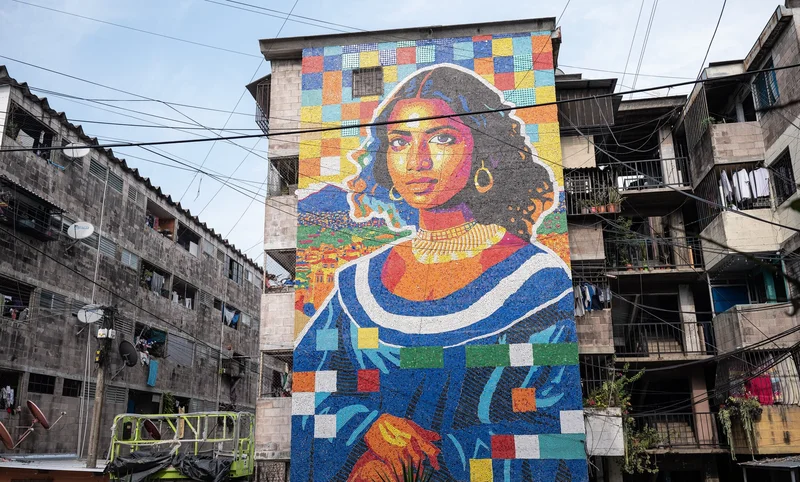
Today, the neighborhood has a different face. Since 2024, dozens of Salvadoran and international artists have been covering the facades with murals, light installations, and mosaics. The project, promoted by Custom Made Stories, a Salvadoran art foundation, restores aesthetic dignity and lays the groundwork for urban renewal. It seeks to repair the social fabric of the community, which is much more than a scene of war and gangs.
But fear still lingers in the architecture. The doors have a second layer of iron. The balconies are enclosed with wire mesh. And the windows are covered with bars. “When the gangs were here, people tried to stay inside as much as possible,” Quintanilla says. “Nobody went out. There was silence.”
See, hear, and say nothing
The two main Salvadoran gangs — Barrio 18 and Mara Salvatrucha (MS-13) — emerged in Los Angeles. They eventually spread to El Salvador and the rest of Central America, after the first mass deportations in the late 1990s.
Since then, they have sown terror for more than two decades, by forcibly recruiting young people and committing thousands of murders and extortion. Today, however, the gangs have practically been dismantled by Nayib Bukele’s state of emergency, which, since March 27, 2022, has imprisoned more than 92,000 people en masse. El Salvador is now safe, but at a high human cost.
Various international organizations, including Amnesty International, have criticized the Salvadoran government for the arbitrary detentions of adults and minors, enforced disappearances, and the deaths of people in state custody. “The government cannot trample on fair trial rights in the name of public safety,” United Nations experts declared, in a statement released in 2023. Furthermore, 36% of those arrested have no connection to the gangs, according to a leaked Salvadoran police report, which is supported by a Human Rights Watch investigation.
The memory of living surrounded by gangs cannot be erased from the collective memory. For 20 years, Esmeralda Quintanilla’s family life was marked by the gangs. Even visiting her sister was a challenge. One lived in Zacamil — a Barrio 18 stronghold — and the other in Mariona, a territory dominated by Mara Salvatrucha. Crossing the border between the two areas could cost you your life.
“To celebrate birthdays or Christmas,” Quintanilla recalls, “we would meet at a restaurant in a commercial area.”
Luis Luna, 36, has lived on the superblock since he was born. He feels a bit like a survivor. “I didn’t get involved with the gangs; soccer saved me,” he recalls. “But it was easy to fall into that stuff here: it’s a working-class neighborhood where [it’s hard to meet your] basic needs. Accepting expensive shoes, food, or money was enough to get you indebted to the gang members. And then, you had to return the favor.”
During those years, when Esmeralda Quintanilla came home from work, the first thing she did was check her two daughters’ backpacks and rooms. She would even turn over the mattress. If she found a pencil she didn’t recognize, she would make them return it. “Back then, the gangs also recruited young girls,” she remembers. Over time, this nagging fear hardened into mutual distrust. “‘See no evil, hear no evil, speak no evil’” — this was the gang members’ motto. And that’s what we did. Silence was the way to survive,” Quintanilla concludes.
An open-air museum for Zacamil
“When we came here to present the idea of supporting the reconstruction of the social fabric through art, we realized that, before anything else, we had to rebuild the trust that had been broken during all those years,” Ethel Colato explains. She’s with Custom Made Stories, promoting the foundation’s social and visual arts project.
“At first, we thought it was just typical propaganda from some political party, the kind that talks a lot but doesn’t do very much,” says Thelma Chávez, 27, a resident of Zacamil. Like Luna and Quintanilla, she’s also a community leader. “But when we saw that they wanted to do something for us — and for Zacamil — we changed our minds.” In addition to art, the project aims to renovate public spaces, reclaim social areas like the sports field and make improvements to buildings that have deteriorated after years of government neglect.
“We’re creating an open-air museum in Zacamil,” Colato continues. “We need to change the way things are done and create a beautiful, healthy and dignified environment, where the small shops that have been plagued by extortion for so long can flourish again.”
“I had never been to Zacamil before, because it didn’t have a very good reputation,” says Gerardo Gómez, a Salvadoran artist. “I painted everyday life, the shops, the old movie theater, the buses… and I even included the criminals in one corner, because memory can’t be erased.” Through his work, the artist wants to help the community process a painful past that, he hopes, will never be repeated.
In another alley, the work of Salvadoran artist Roque Espinoza touches on the rural roots of the first inhabitants of the superblock. “It’s beautiful to see Zacamil free of gangs, just like it was when I was a child,” he recalls. Espinoza lives in the countryside, in the state of Sonsonate. He’s very excited about the Zacamil project, because it proposes urban renewal for and with the people. “I’m a humble farmer. It has been a gift to be able to paint there. I think Zacamil should be an example, to show how other areas should also be renewed,” the artist affirms.
The residents of the neighborhood are enjoying a newfound peace, accompanied by the art that they themselves have helped create. “We know that murals aren’t the only thing people need; there’s still much to be done,” Colato concludes. “We want to create events and give the community [members] opportunities to leave their homes and truly reclaim a space that has always been theirs, but which they couldn’t use for so long.”
Esmeralda Quintanilla is finally happy to live in Zacamil. She can invite her family over for meals. She can sit and chat with friends on the street and walk freely. “After so many years when nobody wanted to set foot on the streets of Zacamil, seeing artists and people from all over the world come to visit our neighborhood today is a great source of pride.”