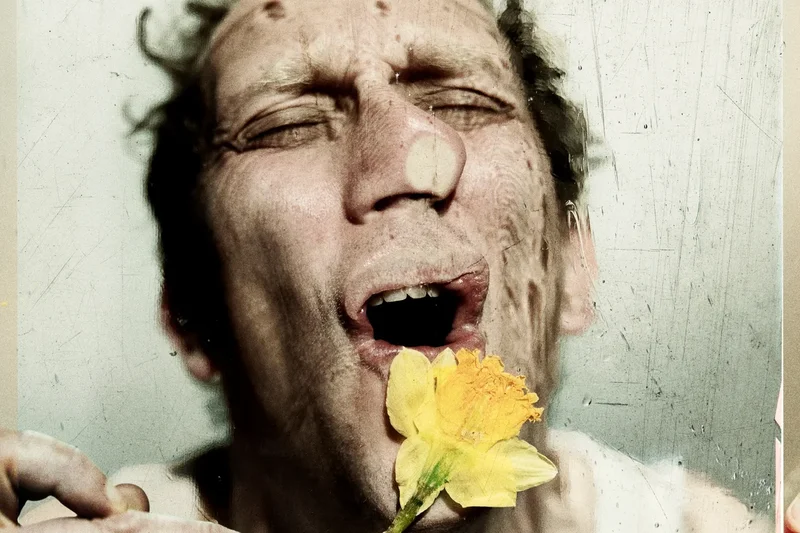
It’s nearly three decades since the British playwright Sarah Kane took her own life, at the age of just 28 – but directors are still in thrall to the five shocking plays she left behind. In her lifetime, she was a celebrated but deeply polarising figure in the world of theatre: her debut, Blasted (1995), and her third play, Cleansed (1998) were particularly incendiary, thanks in part to their violence and willingness to explore humanity’s deepest depravity – even as they exposed its most fundamental tenderness.
Now it’s 2026, and the world has (to some extent) caught up with Kane’s brilliance. The latest director to wrestle with her writing is Rebecca Frecknall, spearheading a new staging of Cleansed at north London’s Almeida Theatre. Frecknall is the outgoing associate director at the Almeida, and Cleansed is her last in a run of shows there that included A Streetcar Named Desire (with Paul Mescal), Romeo & Juliet, and The Duchess of Malfi. “It’s interesting,” she tells me, over Zoom. “Cleansed doesn’t have the performance history that a lot of other plays I’ve directed do, and there’s something freeing in that. People have this idea around it, that it’s a brutal play, with a lot of violence in it. There’s a harshness to it. And that’s valid, but it’s a play that’s very much about love, and exploring the limits, possibilities and transcendent capabilities of love and connection.”
She’s sitting next to the actor Leo Bill (Taboo; The White Queen). Bill, who previously acted in Frecknall’s Malfi in 2019, fronts the cast as Tinker – a sadistic puppetmaster at a hellish, lawless university campus. His subjects, or victims, include a gay couple whose love is tested with extreme violence, and a woman grieving the loss of her brother, with whom she had an incestuous relationship. “It’s hard work, unusual work,” remarks Bill, when I ask how rehearsals are going. The play, he says, felt “hardcore, in a very supreme way. In a way that I hadn't really experienced before – and in a very British way as well. In terms of what was put on in theatre a lot of the time, it felt radical and dangerous.”
“Hardcore” is surely a fair enough adjective. A trigger warning for the production suggests a sort of “I’ll have everything on the menu” approach to transgression – it warns that Cleansed includes “prolonged nudity, torture, mutilation, sexual violence and incest, suicide, and drug abuse” – and I’ve abridged that list by half. It’s par for the course, I suppose: this is after all a play that features rats eating limbs and tongues being severed.
It’s the fourth major production of Cleansed to be staged in London, and the first in a decade. During the previous outing, directed by Katie Mitchell at the National Theatre in 2016, the shock factor made its way into headlines: the BBC reported that five audience members fainted during previews of the show, with dozens walking out. Frecknall says that she would be “really surprised” if the phenomenon repeats itself here. “It’s certainly not the aim,” she says, “but I don’t think it was Katie’s aim when she did it at the National. People have physical reactions to all types of works; it’s just some get reported more than others.”
At the time, Mitchell claimed that her cast had suffered “strange” and “extreme” nightmares during the show’s run. “I thought I would [be the same],” admits Frecknall, “but I’ve actually slept better at night. Just because it’s so tiring – the level of concentration required, but also the creative energy, and the physical demands. You’re trying to stage the unstageable multiple times over.”
Bill credits the strong support system among his collaborators with helping to mitigate the gloom of the material. “We talked a lot about not taking it home with you,” he says. “It’s not the violence so much – it’s the intense state you’re in throughout. But at the weekend, I did have these waves of sadness that would just sort of hit me. So you try and do nice things… I went to the zoo.”
The beauty in ‘Cleansed’
is so much more important than whether somebody faints or not
Bill brings up a quote from Kane, from an interview with The Independent she did back in 1995. Asked how she’s able to “get up every morning” when her vision of the world is so bleak, she responded: “Once you have perceived that life is very cruel, the only response is to live with as much humanity, humour and freedom as you can.”
“There’s something in that,” says the actor. “We do live in a cruel world. And I sort of question how conservative we have become. We should be challenged. And theatre should challenge people. And theatres have been funded… it’s not like we’re illegally doing some heinous crimes down an alleyway and charging some cash.”
He has, he says, had “quite a lot” of friends and acquaintances tell him that they want to come and see the play, but are “scared” about the play’s content. “It’s like, ‘Well, we could all go and watch a Noël Coward play’,” says Bill, “And that’s fine – but what world are we in, where we are afraid to be challenged? It all becomes about that, about, like, ‘oh, some hands get chopped off’. Whereas actually, it’s so beautiful. And the beauty in [Cleansed] is so much more important than whether somebody faints or not.”
There are other problems, too, with staging Cleansed. Kane’s work was known for probing the translation from page to stage, often leaving substantial room for directors to interpret her instructions idiosyncratically. (Her last two plays, for instance – 1998’s Crave and the posthumously staged 4:48 Psychosis – did not specify which lines of dialogue were to be spoken by whom.) In Cleansed, these challenges manifest most in the stage directions, which are often literal but supposedly “impossible” to stage. Like a where a sunflower grows up from the floor, or, um, the aforementioned rats. Every scene, says Frecknall, contains a “theatrical problem to solve”.
There are struggles with the content too – the lack of conventional narrative information provided to either the audience or those staging it. “It's unusual work to be in the room with a play that gives you so little information,” she says. “And it doesn’t have a naturalistic, linear structure. It’s challenging for everyone to work out how to play the scenes, when you don’t have the information about what happens directly before and after.”
“It's not a play where, you know, you start at the beginning and two people are having a chat over a coffee and then slowly everything goes to s***,” says Bill. ”It just starts at an extreme and carries on. There’s no respite – it’s relentless.”
After Cleansed, Frecknall is moving to the Old Vic (alongside the Almeida’s artistic director Rupert Goold) to serve as associate director there. She could hardly have picked a bolder swansong. All these years later, Kane’s play seems to be just as provocative, just as unusual – and just as challenging – as it was when it first debuted. “You don’t really see that type of work very often,” admits Bill. “Even sitting in the rehearsal room, you start reading the play, and there are things in it that I still don't get.
“But it’s not just intellectual. You don't have to completely get it. Cleansed does something to you on an emotional level – if you let it.”
‘Cleansed’ is at the Almeida Theatre until 29 August