Sign in. It’s quick, free and it’s up to you.
An account is an optional way to support the work we do. Find out more.
THIS WEEK I have been driving a birthday present, although sadly not mine.
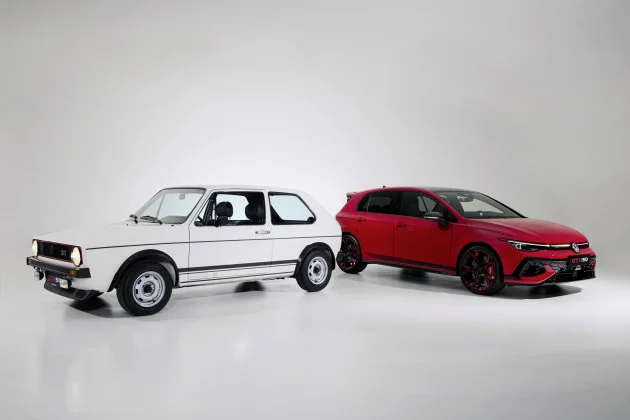
The Volkswagen Golf GTI Edition 50 is the car Wolfsburg has built to celebrate half a century of the GTI, and since the badge and I were both born in 1976, spending our shared 50th together on Irish roads felt like the decent thing to do.
One of us has 325 horsepower and a Nürburgring lap record. The other one has dodgy hips.
The Edition 50 is, in short, a weapon.
The exhaust snarls in a way no Golf has quite managed before, the grip is limpet-like, and you sit in brilliant bucket seats holding a steering wheel trimmed in what Volkswagen calls ArtVelours microfleece and what everyone else calls Alcantara.
It is the most powerful and fastest production Golf GTI there has ever been.
And yet, when you have had your fun, it will pootle home quietly and swallow the groceries, because it is still a Golf, and that has always been the entire point.
Fifty years on, the trick still works: a car that behaves itself all week and misbehaves beautifully on request.
The only thing that has stopped behaving is the price.
The Edition 50 starts at €74,795 on the road in Ireland, and the car I have been driving, with its optional extras, lands north of €84,000.
You can blame the tax system for a chunk of that. At 173g/km of CO2, the anniversary car tips into the 35% VRT band, a full five points more than the standard GTI, which itself now starts at €62,760.
The founding promise of the GTI, dreamed up in a Wolfsburg flat, was pure dynamics at a cool price. Fifty years of CO2-based taxation have quietly strangled the second half of that sentence in Ireland, and it is worth pausing on the fact that the people’s hot hatch now costs more than a very nice three-bed did when the Mk2 was on sale.
The strange thing about the GTI, and the bit I love most, is that it was never supposed to exist. In the mid-1970s, while Led Zeppelin and Pink Floyd filled the stadiums, five Volkswagen employees began meeting in a private flat in Wolfsburg to plot something the company had never asked for.
An engineer, a chassis expert, a marketing man, the head of development Hermann Hablitzel and, brilliantly, the head of press Anton Konrad. Their plan was a properly quick Golf that ordinary people could afford. The code name was Sport Golf, and when they showed their first prototype, Scirocco-based and infernally loud, to Volkswagen’s head of development, Professor Ernst Fiala, his verdict was two words: “You’re crazy.”
They carried on anyway, undercover, until the board finally relented in May 1975 with the Frankfurt Motor Show just months away. That summer, a prototype ran as a pace car at the Nürburgring with GOLF written on the doors and the GTI name still secret, leaving spectators wondering why an ordinary family hatchback was lapping so indecently fast.
Even the name was a near thing.
TS was considered, and GTS, until someone remembered Porsche had already claimed those letters with the 904 GTS. So GTI it was. The finishing touch came from chief designer Herbert Schäfer, a keen golfer, who topped the gear lever with a golf ball. Fifty years later it remains one of the most recognisable interior details in motoring, and it started as a pun.
The car went on sale in June 1976 at 13,850 Deutschmarks.
The plan was to build 5,000 to recoup the development money. They built 461,700 of the first generation alone. The formula was almost embarrassingly simple: a practical family hatchback weighing 780kg, a fuel-injected 110 horsepower engine, tartan seats, a red stripe around the grille.
It never asked you to compromise. It carried the shopping all week and then, on the right road on a Sunday, it made you feel like a rally driver. The phrase “hot hatch” exists because of this car, and everything from the Peugeot 205 GTI to the Honda Civic Type R has been chasing the same trick since.
Fifty years of chasing, and the old master still has the last word. Last summer, with the optional Performance Pack fitted, the Edition 50 lapped the Nürburgring in 7 minutes 44.523 seconds — the fastest front-wheel-drive production car ever around the place, a record it took, rather pointedly, off the Civic Type R.
The interior, meanwhile, nods to 1976 everywhere you look: a modern descendant of the original tartan on the seats, red seat belts, red rubber pads on the pedals.
Volkswagen notes that maximum torque has more than tripled in 50 years. So has the weight, near enough. The original was 780kg with 110 horsepower; this one is 1,470kg with 325. Triple the muscle, nearly double the mass. That, roughly speaking, is also my own story since 1976.
The generations in between each added their own line to the family story — the Mk2 cocking an inside rear wheel in tight corners like a terrier at a lamppost, the Mk5 staging the great comeback, the Mk7 going record-hunting — and there is a full generation-by-generation tour at the end of this piece for those who want it. Half a century, one idea, steadily turned up.
In Ireland, of course, the GTI tale has its own particular flavour. For those of us who came of driving age in the 1990s, a GTI was the dream and the insurance quote was the nightmare.
A 19-year-old with a provisional licence asking to insure a Mk2 GTI in 1995 would have been quoted a figure resembling the GDP of a small island nation. So we lusted from afar, bought the 1.4 CL instead, and told ourselves the tartan seats were a bit much anyway.
That lust never went away, it just matured into something more expensive.
I had a look on DoneDeal Cars this week, as I do, and there are more than 340 Golf GTIs for sale in Ireland right now, spanning nearly the entire half-century.
At one end, a 1983 Mk1 project in Sligo for €4,500 and a 1990 Mk2 in Dublin for €17,500, the cars the men of my vintage couldn’t insure at 19 and are now buying at 50 to right the wrong.
In the middle, honest Mk5s and Mk7s, including manual cars for those who feel as I do about gear levers. And at the other end, the Edition 50 itself: at least four already listed by Irish dealers, from €74,795 to €84,465, a near ten grand spread on a limited edition that has barely landed. Fifty years of the same idea, all on one website, from pocket-money project to birthday flagship.
I know the trick works because I fell for it myself.
I had a Mk7 GTI, a basic spec car by 2026 standards, with a manual gearbox and not much else, and it remains one of the best cars I have ever spent time in. It did not need options or drama. It had exactly enough power, a chassis that flattered you, and a gearshift that made the daily commute feel like an occasion. That is the GTI thesis in a single ownership experience.
Which brings me to the one melancholy note in the birthday car.
The Edition 50 is DSG only. Seven speeds and unquestionably faster than any human hand. Volkswagen’s own anniversary literature notes, with a straight face, that the modern gearbox works quicker than any hand could ever manage on a golf ball. True. But it means the 50th birthday GTI has no gear lever, and therefore nowhere for a golf ball to sit, and I would be lying if I said my left hand didn’t occasionally reach for something that is no longer there.
And the idea is not finished. This summer Volkswagen will unveil the ID. Polo GTI, the first fully electric car to wear those three letters, with 226 horsepower and front-wheel drive, just like the original.
Plenty will call an electric GTI sacrilege. I am not so sure. The original GTI was itself a heresy, a secret project cooked up in a flat by people the head of development called crazy, built on the belief that an ordinary car could be extraordinary. If the badge stands for anything, it stands for that idea rather than any particular engine.
Turning 50 invites a certain amount of reflection, and I have been doing plenty of it, some of it at speed.
Careers change, hairlines retreat, knees file formal complaints. But it is oddly comforting to share a birth year with a machine that has spent five decades proving the same cheerful point: you do not need to be exotic to be brilliant, and you can be practical and joyful at the same time.
Happy birthday to us both. One of us is getting a cake. The other got 325 horsepower, red seat belts and a lap record.
I know which of us is doing better.
1976 — Mk1.
The heretics win. 110 horsepower, 780kg, fuel injection, tartan seats, red stripe around the grille, golf ball on the gear lever. Volkswagen plans 5,000 to recoup its money; it builds 461,700 of the first generation alone. The hot hatch is invented.
1984 — Mk2.
Grows up without calming down. Keeps the original’s balance — famously lifting an inside rear wheel in tight corners — and adds serious muscle with 16-valve engines and the supercharged G60.
1991 — Mk3.
The quiet one. Aerodynamics and safety take priority, but in 1996 the “20 Years of GTI” edition starts the tradition of birthday flagships that leads directly to the car on this page.
1997 — Mk4.
A leap in build and interior quality, and the turning point: turbocharging becomes the GTI standard, cemented by the 180hp “25 Years” edition in 2001.
2004 — Mk5.
The great comeback. Red-framed honeycomb grille, tartan seats, a punchy 2.0-litre turbo — the core DNA restored. The Edition 30 follows in 2006 with 30 extra horsepower, one for each year.
2009 — Mk6.
Precision over drama, with the XDS electronic differential lock standard for the first time. The 235hp Edition 35 of 2011 pushes the GTI towards 250km/h.
2013 — Mk7.
Track credibility. A Performance version with a proper mechanical diff, then the Clubsport, then the Clubsport S — which reclaims the front-wheel-drive lap record at the Nürburgring. Also the author’s favourite, with a manual gearbox and not much else.
2020 — Mk8.
The current car, crowned in 2026 by the Edition 50: 325 horsepower, 1,470kg, and a 7:44.523 Nürburgring lap that makes it the fastest front-wheel-drive production car ever around the place.
2026 — ID. Polo GTI.
The next heresy. The first fully electric GTI: 226 horsepower, front-wheel drive, just like the original. The idea, not the engine, carries on.
Paddy Comyn is the head of automotive content and communications with DoneDeal Cars. He has been involved in the Irish motor industry for more than 25 years.
Journal Media Ltd has shareholders in common with DoneDeal Ltd
To embed this post, copy the code below on your site