I am not at the World Cup. I’m going to play the odds here and say that neither are you. Despite the fact that this is apparently the biggest World Cup of all time — more countries represented, more matches played, more fans paying more money for tickets than ever before — almost none of us have been at the World Cup, at least not physically. Like almost everyone who’s been watching (whether casually and fitfully, as in my case, since my country, Ireland, didn’t even qualify for the competition, or with the steadfast commitment and maniacal fervor of so many millions of dedicated spectators), I have been watching it on television.
The number of people who attend the World Cup, large and growing though it may be, is nothing compared with the sheer world-buckling biomass of those who experience it on a screen. According to FIFA’s figures, some 1.5 billion people, nearly a fifth of the population of the planet, watched the last World Cup final, in 2022, and the tournament this year seems on track to exceed that number. So much attention is paid to the business of physically being at the World Cup — the teams that make it there, the fans who travel to support them, the wild and joyful spectacle of multifarious soccer-loving humanity converging on a given place at a given time — that it is easy to overlook the extent to which it is a televised spectacle, perhaps even primarily a televised spectacle.
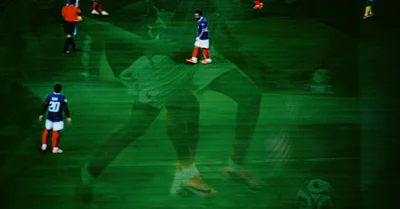
In this spirit, some of the most interesting images to emerge from this World Cup have been created by photographers who are not, in fact, at the World Cup. These photographers are not, that is, standing by the touchline recording the action with their telephoto lenses in the traditional manner, but rather sitting hundreds or even thousands of miles away capturing the flow of images on their television screens. In doing so, they’ve made of those images something new and visually singular — whether it’s by photographing the screen through a bag of water (as the Paris-based photographer Bilal Aouffen has done) or rendering the pixelated image of a player as a dreamy smear that seems to capture more a fleeting and indistinct impression of the goal than the goal itself.
Take, for instance, the photographs posted to Instagram by the Brazilian artist Gabriel Rolim, whose images are wittily mediated: He uses a modified camera made for the Game Boy to take shots of his television, which he converts into animations that are strange, and strangely delightful, like a pixelated thermographic image of a memory of watching the World Cup. Or the Moroccan photographer Karim Ouakkaha’s beautifully textured shot of the Egyptian goalkeeper Mostafa Shobeir, sitting crestfallen in defeat, the melancholy digital blear of the image making it seem as though he himself is dissolving along with his team’s hopes of progressing.
Jared Soares, a Washington-based artist, snaps photographs of the matches playing on his television, prints them out in monochrome on printer paper and then crumples and flattens the paper before scanning it. The creases give a startling tactile form to his black and white images of players and, especially, fans in moments of public agony and ecstasy.
We are having trouble retrieving the article content.
Please enable JavaScript in your browser settings.
Thank you for your patience while we verify access. If you are in Reader mode please exit and log into your Times account, or subscribe for all of The Times.
Thank you for your patience while we verify access.
Already a subscriber? Log in.
Want all of The Times? Subscribe.