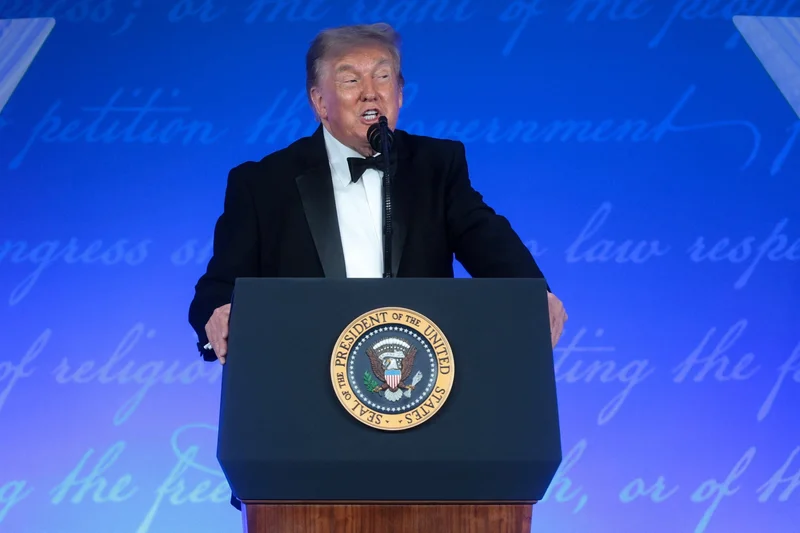
President Donald Trump returned to the rescheduled White House Correspondents' Association dinner Friday night with a wide-ranging hour-long speech that blended praise for some journalists with pointed criticism of others, jokes targeting the weight and intelligence of public figures, and fresh remarks about the prospect of a third presidential term.
Trump also said he had softened his address, telling the audience he had discarded the more aggressive version he had prepared for the original April dinner, which was postponed after a gunman opened fire outside the venue.
"That was going to be a doozy," Trump said of the earlier speech.
Opening his remarks, Trump recalled the canceled April event, saying, "As I said three months ago, the show must go on," and praised organizers for rescheduling the dinner. He briefly referenced what he described as "the attempted mass murder" that could have occurred that night before shifting to a speech dominated by humor, political barbs and personal insults.
Trump's appearance, along with his pledge to return for next year's dinner, marked a notable chapter in his often combative relationship with the news media. Since beginning his second term early last year, he has repeatedly criticized news organizations, filed lawsuits against media outlets and taken administrative action affecting journalists. The audience included reporters whom Trump had previously publicly criticized and barred from official events.
Trump's sometimes off-color speech, which lasted just over an hour, was filled with vague potshots directed at people he dislikes, from Jane Fonda to Bruce Springsteen to "Barack Hussein Obama." The audience, reacting at first with friendly laughter, gradually grew quieter as the insults piled up.
Among other targets of Trump's humor were late-night hosts Jimmy Fallon and Jimmy Kimmel, Rep. Ilhan Omar, D-Minn., California Gov. Gavin Newsom, former New Jersey Gov. Chris Christie and Trump's own speechwriters, whose jokes he sometimes criticized even as he delivered them. Some of the comments flirted with racism.
The president also spent time expressing pride in the ballroom at the Waldorf Astoria hotel, formerly the Trump International Hotel.
"It's great to be back at a place that I know very well, because I built it," Trump said.
He also referred to the journalism awards presented earlier in the evening, most of them recognizing reporting that challenged him and his administration.
"Do I have a say in those awards?" he asked with a grimace.
Trump briefly mentioned the Iran war and made several remarks about the ballroom being built at the White House. He also joked about the possibility of serving a third term, despite the U.S. Constitution's 22nd Amendment barring presidents from being elected to a third term.
"Just like my presidency, the second time is always better," the president quipped. "And the third time will be better yet."
He then added, "I'm only kidding."
At the end of his remarks, Trump put on a red cap reading "Trump 2028" and jokingly announced the "scoop" that he was running again.
Earlier, Trump entered the ballroom to polite applause and was thanked for his support by outgoing White House Correspondents' Association President Weijia Jiang of CBS News. After dinner, he remained for more than an hour of awards presentations.
One of the winners, Tyler Pager of The New York Times, was among the reporters subpoenaed by Trump's Justice Department over his reporting on Trump's Qatari-gifted Air Force One jet. Those subpoenas were withdrawn Thursday in a New York courtroom, just one example of the administration's efforts during Trump's second term to challenge media coverage it viewed unfavorably.
The rescheduled dinner was held at a smaller venue that accommodated about 700 people. Security was significantly tighter. Guests entered through a single entrance, passed two ID checkpoints and a detection dog, and were screened by armed officers and security guards. There was no red carpet or separate cocktail receptions before the dinner.
"Let's try this again," Jiang quipped while welcoming the crowd.
"The White House press corps," she noted, "always have a follow-up."
Turning serious, she reflected on the trauma and confusion surrounding the canceled April dinner.
"Tonight our message is this: We are back," she said. "We will not be intimidated. We refuse to let an act of violence have the final word."
Early in his speech, Trump signaled that he had decided to tone down his remarks, though he still delivered several sharp jokes.
"This is really the largest group of 'Trump Derangement Syndrome' people put together at one time," he told the media-heavy audience.
Besides the pared-down speech, Friday's dinner featured two additional awards. One honored Victor Gonzales, the Secret Service agent staffing a security checkpoint in April who was struck in his protective vest.
Gonzales "placed himself directly in harm's way and engaged the armed suspect," Jiang said. "He stayed in the fight and the attacker was stopped."
A second award recognized the staff of the Washington Hilton, the site of the original dinner, for their professionalism under pressure.
The dress code was relaxed to "black tie optional," and dinner included grilled peach and burrata salad, lobster and beef Wellington. As planned for the original event, the evening also featured entertainment by mentalist Oz Pearlman, who this time got to perform his act.
Jiang and her fellow board members worked to ensure the rescheduled dinner took place, determined not to let the violent attack, or images of journalists sheltering under tables, define the event. Announcing the new date, she emphasized the dinner's stated purpose: "A celebration of a free press and the vital role of journalism in our democracy for over a century."
Still, some argued the dinner should not have been rescheduled.
Critics have long questioned the optics of journalists in formal attire socializing with the officials they cover.
"It undermines the public faith in how the press does its work, and it makes it look like we are pals with the people we cover," Kelly McBride, an ethics expert at the Poynter Institute, said while organizers were debating whether to reschedule the event.
The dinner came amid rapidly increasing tensions between the media and a president who has sought to pressure news organizations through sanctions against members of the White House press corps, regulatory actions by the Federal Communications Commission and lawsuits. Those tensions have only intensified since April.
Trump, however, ended on a somewhat conciliatory note.
"I have a lot of respect for your profession," he told the assembled journalists.
He also touted his own success before adding, "When I'm not around, you're all gonna be broke."
He concluded with one final joke about the evening.
"I didn't know what to expect. It's far worse than I originally thought."