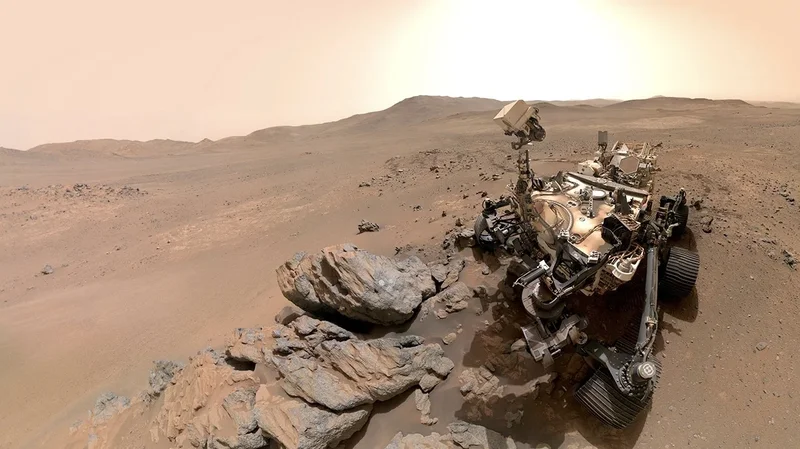
If a chatbot can insist it's right while being totally wrong, imagine the stakes when NASA starts leaning on artificial intelligence to help with life detection.
Could the rovers suddenly hallucinate aliens?
Michigan State University researchers wanted to know, so they trained an AI system to spot the difference between digital "organisms" that can copy themselves and others that can't, using a computer program called Avida. In test runs, the algorithm nailed the distinction, getting it right 99.97 percent of the time.
You May Also Like
Then, the team tried to fool it. They took nonliving chunks of code and made small changes over and over, nudging the AI to feel more confident that it was looking at something alive. Eventually, the system became almost 100 percent certain that many of the fakers were alive, even though they never exhibited the one behavior defined as "alive" in that virtual world: replication.
The work shows how AI can latch onto patterns in its training data without fundamentally understanding what makes something alive, said Ankit Gupta, a doctoral student in computer science and engineering. Gupta and his coauthor, Christoph Adami, a professor of microbiology and molecular genetics, physics, and astronomy, warn that this weakness could foil space missions that send smart instruments to Mars, icy moons, or other extraterrestrial environments to hunt for signs of life.
The team will present their findings in August at the 2026 Conference on Artificial Life in Waterloo, Canada.
"AI is highly accurate at classifying things that are 'usual,'" Gupta told Mashable. "The problem occurs when it is presented with examples that are unlike the common things, which AI will misclassify with confidence. This is much more likely with extraterrestrial life, for obvious reasons."
At the same time, NASA and its partners are pouring money into AI‑driven life‑detection projects, betting that machine learning can sift through huge, complex data sets that scientists could never fully analyze on their own. It's setting the stage for a future in which AI helps flag promising clues, with humans making the final call.
In one NASA‑funded effort, a large team led by Carnegie Science's Michael L. Wong and NASA's Caleb Scharf is building machine‑learning tools to pick out patterns of life in complex chemical data. Their project, supported by a $5 million grant, aims to train AI on at least 1,000 samples — from meteorites and rocks to fossils and living organisms.
Some of the data comes from real instruments, including mass spectrometers like those already flying on NASA missions. The algorithm learns how a mix of molecules shifts when life has shaped that material versus when simple physics and chemistry have done the job.
While Wong welcomes the fresh scrutiny, he isn't sure the experiments exposed a serious vulnerability in AI approaches. In his view, the way the study actually created its fake life matters. The authors used a kind of selection process that kept refining the code until it looked increasingly lifelike.
"I don't think it's that bad, to be honest," he told Mashable. "To generate their life mimics — their spoofs — they actually had to perform natural selection, which is a living process. I don't know of any actual physical environment that performs that kind of selection, where it says, 'I will prefer entities that just look like life, but don't actually do lifelike things.'"
But the research did push Wong to think more about what kinds of examples he feeds into life‑detection models. His group wants to continue training AI not just on things that are alive, but also on the remains and byproducts of life — the fossils, goo, and waste.
After all, if the models are only taught to identify living things, they won't be able to recognize the dead ones, he said. That could create a massive blind spot if Mars or another world hosts only the chemical leftovers of a long‑extinct biosphere.
"A fossil is evidence of life. So is the chair that I'm sitting on because those don't just magically pop into existence thanks to geology," he said. "A fossil and my chair are not alive, but I think they're part of life. They are a product of life."
Wong's team also spends a lot of time trying to deceive its models. In some cases, the algorithm has surprised the scientists by picking up on patterns the humans initially missed. In one test, the system kept insisting that a sea squirt sample looked photosynthetic, even though sea squirts don't make their own food from sunlight. What initially looked like an error was anything but, Wong said: Those creatures often host algae that do use sunlight, and the AI had spotted the chemical fingerprints.
Despite the advances in technology, the Michigan State team is not convinced the tools are ready for spacecraft. The team's lab is also working on its own machine-learning methods to defend against this kind of trickery.
"We can wait," Gupta said. "Clearly, we are not there yet."