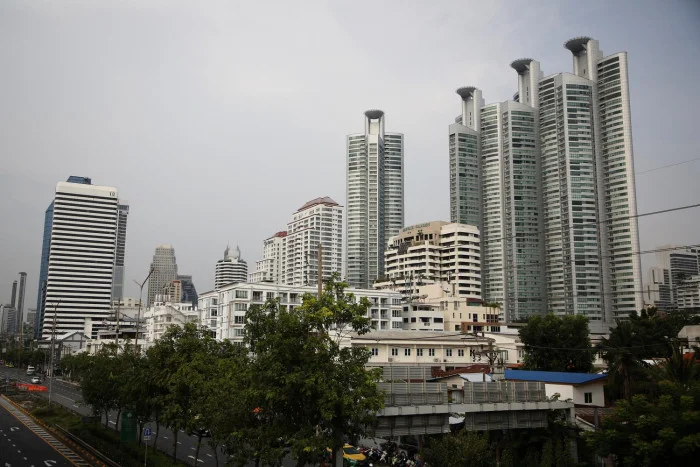
Bangkok office landlords are offering a range of incentives, including barter deals, as competition for tenants intensifies. (Bangkok Post file photo)
Despite no new office completions in the second quarter of 2026, Bangkok's office market remained highly competitive as landlords of new buildings increasingly offered barter deals and matched incentives provided by owners of older properties.
Aukit Pronpattanapairoj, head of office leasing at property consultancy Cushman \& Wakefield Thailand, said competition in Bangkok's office market has remained intense as landlords focus on filling vacant space.
"Competition has shifted beyond traditional pricing incentives, such as deeper discounts and rent-free periods, partnerships and business barter arrangements," he said.
For example, some office landlords have attracted insurance companies by purchasing insurance policies from them, while others have invited computer brands to bid for office fit-out and IT supply contracts, he said.
To accelerate occupancy, some landlords of new office buildings completed in recent years have matched the incentives offered by those of renovated older properties, including fully or partially fitted office space.
"Newly completed office buildings are generally better positioned to attract large tenants, as companies requiring several floors typically prefer contiguous floor plates," said Mr Aukit.
Late last month, property consultancy JLL Thailand reported that the online travel booking service Agoda leased a 26,000-square-metre office spanning seven contiguous floors at One Bangkok Tower 5, underscoring major occupiers' preference for large, connected office space.
According to Cushman \& Wakefield Thailand's office market research, Bangkok's total office supply remained unchanged at roughly 9.15 million square metres in the second quarter from the previous quarter.
Of the total, around 5.03 million sq m was located in the central business district (CBD), followed by 2.41 million sq m in city fringe areas and 1.71 million sq m in outer-city locations.
Grade A offices accounted for 38% of total supply, while Grade B and Grade C buildings represented roughly 58% and 4%, respectively.
"Grade B buildings account for the largest share of Bangkok's office stock, with more than half of them more than 10 years old," said Mr Aukit. "In contrast, Grade A buildings represented 78% of new office supply completed over the past decade."
Bangkok's office market is gradually moving towards a more balanced position as new supply slows, easing competition among landlords for tenants, he said.
Competition through aggressive rental pricing and tenant incentives has also moderated, as most office buildings completed during the past 1-2 years have achieved high occupancy, with some nearing full occupancy.
Older Grade A and Grade B office buildings are increasingly losing tenants because of ageing facilities and rents that have risen steadily over many years.
In response, many landlords have upgraded their buildings or renovated parts of their properties to improve competitiveness and retain existing tenants.
Around 616,130 sq m of office space is scheduled for completion between the second half of 2026 and 2031, with additional projects or redevelopment schemes likely to be announced.
"More office developments are under construction in outer-city locations such as eastern Sukhumvit, Bang Na-Trat Road and Phahon Yothin than in the past," Mr Aukit said.
"Although these areas still trail the CBD in new supply, they now have more office developments than city fringe locations, partly because land prices in middle-city areas have become less suitable for office projects."
The CBD continues to record the largest pipeline despite high land prices, as many developments are built on long-term leasehold land or form part of large mixed-use projects.
The vacancy rate for Grade A offices in the CBD declined to 21.9% in the second quarter from 23.3% in the first quarter, the lowest level since the first quarter of 2023.
The improvement reflected slower additions of new Grade A supply, alongside sustained demand from tenants relocating to newer buildings or expanding into larger office premises.
Average Grade A office rents remained unchanged at 943 baht per square metre per month in the second quarter.
Rather than cutting headline rents, landlords increasingly relied on leasing incentives to attract occupiers.
These included rent-free periods, fit-out allowances and more flexible lease terms, helping reduce tenants' overall occupancy costs while allowing landlords to maintain rental levels.
"Leasing activity continues to be driven by the flight-to-quality trend, with occupiers relocating from older, less competitive buildings to newer offices offering better facilities, building systems and more attractive leasing packages," Mr Aukit said.
"For the remainder of 2026, the market is expected to remain tenant-led as vacancy rates stay elevated, forcing landlords to compete through various leasing strategies and giving occupiers greater bargaining power."