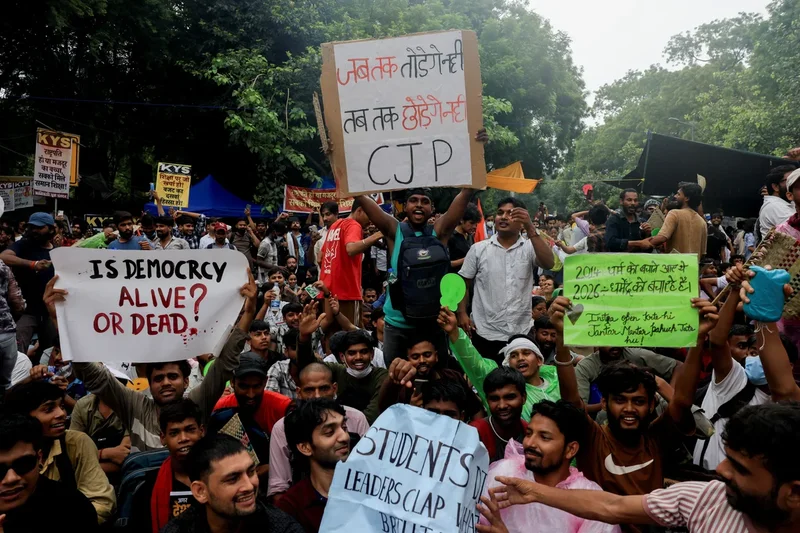
India’s education minister Dharmendra Pradhan stepped down on Saturday after millions of protesters took to the streets across the country demanding accountability over examination paper leaks.
It is a rare victory for the mainly Gen Z-led protest movement after a government known for not bending to public pressure was forced to give in to one of the major demands of the protestors – Mr Pradhan’s resignation.
But the success didn’t come overnight.
When the Cockroach Janta Party (CJP) – a satirical, youth-led movement – called for a protest in the Indian capital in the blazing heat of June to demand Mr Pradhan's resignation after exam paper leaks in May, only a few hundred showed up, mostly to make content for their social media platform.
When I asked Abhijeet Dipke, the founder of CJP, whether he was ready to take the protest to the streets, he replied: “Ma’am, we are already on the streets. Where else should we take this?”
It was easy to write off the agitation, largely because it lacked the organisation needed to sustain the original demands.
Over the past month, during my multiple visits to the protest site, I saw the agitation grow little in number as a few hundred people walked in and out of the Jantar Mantar protest site, documenting the agitation and raising anti-Modi slogans.
Despite educator Sonam Wangchuk’s weeks-long hunger strike alongside students from left-leaning groups, the party failed to translate its social media following in millions into numbers on the ground.
However, a month later, the "cockroaches", or the Gen Z protesters, were swarming the streets of Delhi and other major cities across India and have become one of the biggest challenges to prime minister Narendra Modi's government in recent years.
The groundswell of support was almost overnight, in response to the brutal crackdown on protesters, including Delhi Police’s forceful removal of Wangchuk from the venue. It gave the movement the momentum it lacked.
So when Dipke called for a protest march to Indian parliament on the first day of its monsoon session on a Monday, thousands responded.
Students and youth activists frustrated with rising unemployment, the paper leaks, and poor state of the economy, began arriving at the protest site on the eve of the march. By 1 am, there was barely any place to stand.
Protesters told me they had come from Uttar Pradesh, Maharashtra, Haryana, Gujarat, and someone was even there from remote Nicobar island chain in the eastern Indian Ocean. Political activists and students – many of them attending a protest for the first time in their lives – braved a brutal police crackdown on 20 July but stood their ground.
According to several reports, the police and paramilitary forces charged with batons, fired tear gas, and used excess force. Journalists on the field were struck with batons. Students were seen in footage from the site begging with folded hands. Women accused male police officials of harassment, while allegations of unprecedented pellet gun use surfaced.
By the evening of 20 July, bruised and beaten, protesters returned to the Jantar Mantar armed with their mobile phones, posters, and memes.
In the next few days, the protest had become bigger with people organising in states and cities across India.
“I have had to run away from my house to take part in this movement. I am not going anywhere till Dharmendra Pradhan resigns,” a 23-year-old student from the western state of Uttar Pradesh told me.
The leadership of the cockroach party remained unwavering in their demands. "Dharmendra Pradhan must resign," said Dipke. He said: "It was non-negotiable."
Delhi police has turned central parts of the capital into a fortress, closed 16 metro rail stations, shut down mobile internet, and arbitrarily detained students heading to the protest.
An 18-year-old woman, who travelled 18km to reach Jantar Mantar each day, repeatedly checked whether I was hydrated or needed food. Everyone was looking out for each other.
A nine-year-old boy with bandages on his foot was looking for any shoe his size in a collection of footwear, gathered from the scene where protesters fled during the crackdown. “I was here with my mother and elder sister [on Monday],” the boy said. “Every one of us got beaten up.
“The doctor has asked me not to get the bandage wet and not to walk barefoot,” he adds, though his search for footwear his size is unsuccessful.
He, like others at the protest site, struggles to make sense of why the police resorted to baton-charging demonstrators.
Solidarity arrived in the form of food delivery orders. As thousands camped overnight, strangers across the country sent food, water and essentials through delivery apps. Doctors and lawyers were at the venue to offer their services.
In eight years of covering protests across India, I have rarely seen a public response of this scale, perhaps because it remains bereft of political colour and religious dogma. The opposition lawmakers currently in Delhi for parliament session made a beeline to show their support to the youth.
Rahul Gandhi, the leader of the opposition, was quick to demand the prime minister’s resignation for “destroying the future of India’s youth”. The youth movement in India have stopped short of being a anti-government agitation as witnessed in neighbouring Sri Lanka, Nepal and Bangladesh in recent years.
Modi broke his silence after a month with a statement on X, announcing fast-track courts to handle the paper leak cases. When that failed to pacify the protesters, he shared a bizarre midnight selfie video assuring strict action against the perpetrators of the leak.
The backlash against the 75-year-old leader was swift and came in the form of memes. “Never trust a man who reaches out after midnight,” read one edited reel on Instagram.
Modi’s ministers met with a delegation of cockroach party spokespersons for the second round of talks. After nightfall on Friday, an ominous air surrounded the protest site, while police issued measures preventing movement towards the site of agitation.
On Saturday morning, Pradhan cited threat to national security as one of the reasons for his decision.
But even if Delhi erupted in joy, the “cockroaches” stood firm and refused to end the protests till the government met their remaining demands.
Dipke warned: “Remember, don’t mess with the cockroach.”