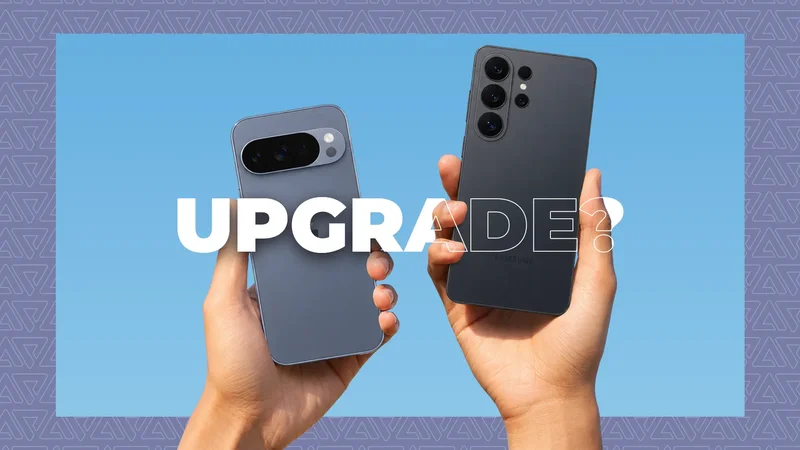
I love phone upgrades.
In no way is that a controversial opinion. Most of us love the spectacle and pageantry that comes with a new phone launch, not to mention the speculation and rumors that come months in advance of an actual launch.
My journey following new phones hasn't always been blissful. Any time there's a new S Ultra, I wonder . Then I see .
But recently, something has changed. Rumors are no longer exciting. Instead, they weave tales of desperation, of cost-cutting, and of rising prices.
In short, it means bad things for anyone who wants to buy a new phone.
Which is why I won't be buying a new phone for the foreseeable future — unless Samsung, Google, and other phone companies finally make the big update we've all been waiting for.
Upgrades had already been slowing down
Your phone is probably closer to the newer models than you think
Outside circumstances may have exacerbated it, but the problem of unexciting upgrades has been coming for a while now.
Processors have been getting quicker every year, but the days when any flagship phone felt slow are behind us.
Even Google's Tensor chip, well known as being , doesn't feel like a slow chip by any means.
The same is true of other traditional upgrade areas.
Displays are largely all gorgeous now, with sharp resolutions and high refresh rates, even on budget phones.
Cameras can still be a bit hit-and-miss for some phone brands, but we rarely have to deal with rubbish light capture and muddy textures anymore.
On the whole, we're largely looking at broadly competent devices that are being tweaked to be a little bit better. Yes, they're being improved, but it's not by much.
Does that mean there's no room for improvement? No, not at all. There are areas where smartphones can continue to progress and push onwards.
Unfortunately, that may not be a good way forward.
The best areas to develop are being squeezed
The stuff we need is the stuff that's in demand
All credit to smartphone manufacturers, they seem to have noticed the relative lack of hardware innovation and have responded by doubling down on software.
Recent years have seen the rise of artificial intelligence, such as it is, and we've seen more and more new phones debuted using AI as the reason to buy.
Some are terrible, some are okay, and some are genuinely useful — this is very much still a developing area for a lot of manufacturers, but it's really starting to find its feet.
Since AI and new software features are often available on older phones, this may seem like a bad way to sell new phones.
This is true to an extent, but it's easy to leverage hardware upgrades in a way that benefits the software.
The processor is the traditional way to do this, but given those have largely reached a plateau, it's not worth focusing on.
Instead, look at what AI needs. More RAM allows RAM to work more easily in the background without impinging on the user's performance, while more physical storage means the ever-increasing size of local AI models isn't a problem.
These are two very easy ways to slap a "built for AI" sticker onto a device without needing to do very much.
But the problem is obvious here for anyone who's been paying attention. Because these components benefit AI enormously, the prices for them have shot up, and it's these price rises that are such a problem for all electronics right now.
Everyone's chasing the same magical dragon, and that means the obvious and easy routes to better devices are closed off.
Except, they're not fully closed off. And that could be an even worse problem, because it could make phones worse in the short term.
Phones may get worse before they get better
The next few years may get a bit rocky
None of the routes forward feel particularly positive.
The first route involves pure price rises. Everything continues as it used to, but now everyone pays more than they used to. Higher part costs mean a higher end price for the consumer.
Nobody likes this option.
The second is to curb price rises by making strategic cuts to other areas of devices. So, while the price will stay the same, the general quality will drop.
This avoids more expensive phones, but may have big knock-on effects for durability and longevity.
The third way, and the most likely of the bunch, is a mixture of the previous two. This generally means making small cuts in areas where they can be made, and taking smaller price rises as a result.
Physical upgrades will be largely slowed down, and the ship will be kept afloat.
We're already seeing manufacturers taking this route.
Samsung tried to devices, and you can be sure other companies are doing the same thing.
Speaking plainly, I don't like any of these options.
But this is the world we're currently living in. As long as the AI bubble continues to inflate, this is the reality we'll be living in.
There's one more option though. An area that's worth exploring and expanding that major US manufacturers have ignored for too long.
There's light at the end of the tunnel
A vital spec has been neglected for years
It's batteries. Batteries are the light at the end of the tunnel.
Normally, batteries creating light is not a good thing, as it usually means they're on fire. But not in this case!
Battery tech in most US phones has stagnated hard.
Samsung's Galaxy S Ultra phone has used the same 5,000mAh cell since it was introduced in 2020. That's six years without real change, and that's a very long time in smartphones.
Yes, there's wisdom in being careful where potentially explosive materials are concerned, and given its history, Samsung has reason to be more careful than most.
But it's time now. There are only so many places manufacturers can make big strides now, and battery tech is one of them.
We need bigger and better batteries.
Chinese companies have led the charge on this, and if you'd bought a OnePlus phone , then this is something you understand very well.
Samsung has finally started to make moves in this area. The , and it's likely this is being used as a test before rolling out the tech to more models.
I'm keeping my current phone until battery tech improves
Until there's a reason to upgrade, I won't
Battery life has been one of my most important specs for a long time, and that's why it's been so frustrating to see so many of the biggest brands in the business ignoring the very real advances being made elsewhere.
But now, when it's clear so many of the usual avenues are closed, with AI pushing up prices of other components, this has to be where Google, Samsung, Motorola, and other US brands go with their newest phones.
Frankly, I can't see how I would be able to justify buying any new phone now until new battery tech is being used. Because what's the point?
While I could be surprised, it's very likely that all the upcoming devices will be slightly tweaked versions of devices we already have — but more expensive.
The Z Flip 8 is essentially , but now it costs more.
If getting me to spend more on the same tech is all you have left, then I certainly won't be putting my hand in my pocket for anything "new."
But if new, larger batteries start becoming the norm? You can be sure I'll be giving my credit card a bit of exercise.