Author's note: This essay is adapted from Dreaming Systems, my ongoing memoir about blockchain, technological optimism, and the futures we imagined before they existed.
--
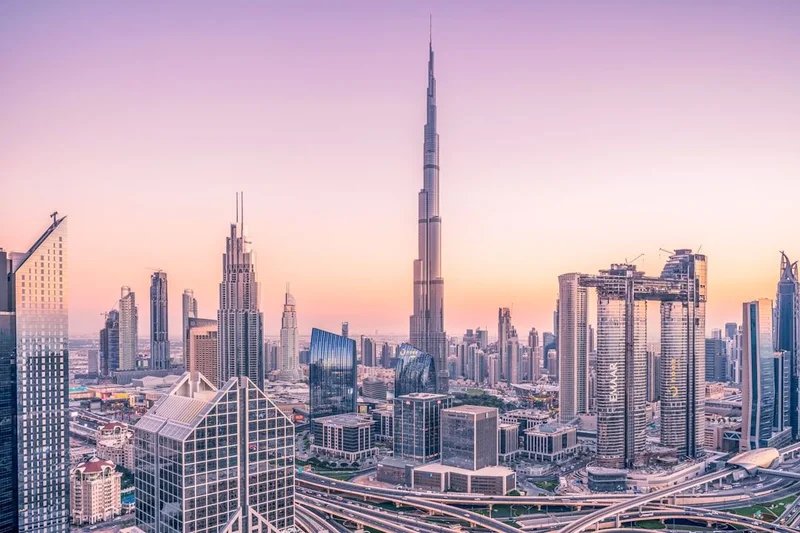
I am standing at the floor-to-ceiling tinted window of a hotel room in Dubai, looking out over a sea of lights.
Behind me: a queen-size bed, a large flat-screen television, a small desk, discreetly patterned carpet, muted lighting. The room could be anywhere in the world. Only the view gives it away, and the fact that in the bathroom, next to the large freestanding bathtub, there is a hose installed beside the toilet. I know bidets around the Mediterranean and high-tech toilets in Japan, but this is my first time in a country with a hose.
On the bedside table stands a trophy.
Its base is a transparent block of plexiglass. On top of it is a flame-shaped disk, also made of plexiglass, partly clear, partly covered in blue foil. The name of the project that brought me here is printed on the flame.
To protect the identities of the people involved, I need another name for the project. The real one ended in “coin.” That much is true.
But in the blockchain boom of 2017 and 2018, so many coins were born that people were running out of names. Almost every possible coin I could invent either existed, had existed, or had at least been claimed by someone with a landing page and a dream. I cannot call it Globecoin or Worldcoin or Mycoin or Yourcoin. Not Centercoin, not Edgecoin, and certainly not Bitcoin or Litecoin. Not Onecoin, not Twocoin, and not Nonecoin. Not Hundredcoin or Billioncoin. Not Lovecoin. Not Dreamcoin. Not Suncoin, Mooncoin, or Earthcoin.
Oldcoin would be available, perhaps, but misleading.
Losecoin might not be factually wrong, but it would not match the mood of the undertaking.
Let’s call it Maybecoin.
So there it is on my bedside table: a blue plexiglass flame bearing the name Maybecoin.
It had been handed to me earlier that evening in a formal ceremony.
Let’s rewind.
A taxi picks me up from Dubai International Airport. The driver is from Pakistan, and on the way into the city he talks to me about the rainy forests of his home while I watch the world outside the window go by. He is actually a software developer, he tells me. He used to work online as a freelancer from Pakistan, but the fees were too low and the competition too high. He is in Dubai to make contacts, to find opportunities. Once he has earned enough money, his younger brother will be able to study abroad.
“In Dubai?” I ask, not even knowing whether there is a university here.
He shakes his head.
Not in Dubai. People like him and his brother, he says, are treated like servants here. People like him meaning: people from Pakistan. He did not come here to drive a taxi, but nothing else had worked out.
London would be better, he believes.
That is where his brother should go.
Outside, the roads are broad and straight and hostile to pedestrians in the way I imagine some American cities to be, somewhere away from the supposedly civilized East Coast. Maybe Las Vegas. I have never been there either. The desert air pushes in through the half-open taxi window and competes with the cold stream from the air-conditioning. Neon signs glow in the night, in Arabic letters.
Finally, the driver stops in front of a hotel. Behind the glass facade stretches a wide lobby, where huge signs point the way to the “Maybecoin Convention.” He opens the door, hands me my small suitcase, and wishes me a successful stay.
My suitcase and I roll uncertainly into the lobby and follow the signs. Through a pair of broad double doors, I enter a convention hall. Large round tables are arranged inside, ten or twelve seats at each. At the far end of the room stands a stage.
Near the entrance, on the other side, there is an enormous buffet.
Steaming platters of meat, vegetables, colorful rice dishes. Everything labeled in English and Arabic, with additional signs for halal and Hindu dietary requirements. The desserts impress me most. Desserts always impress me most. Small works of art: cream-white flans on violet fruit mirrors, little cakes with glossy chocolate coating and shavings of gold leaf.
I hand in my suitcase and coat at the cloakroom and wander between the tables, unsure what to do.
Suddenly, a young Indian man approaches me with purpose, greets me by name, and shakes my hand enthusiastically.
“So glad you could make it! Please, please, have a drink, take a seat, the show will commence shortly!”
This is Adesh, as it turns out, my contact at Maybecoin. He booked my flight here. The tickets arrived only hours before departure. Information about the schedule was supposed to follow, but somehow never did.
I take a glass of orange juice from a waiter’s tray and sit down at one of the large tables.
A young woman and a young man are already sitting there. The woman has a complicated braided hairstyle and wears an emerald-green sheath dress. The man is in a black suit. They smile politely. From their slightly halting conversation, I gather that they have only just met each other, too.
The man, I learn, is from Nigeria. The woman is from Kenya.
Nathan and Lucy.
Both are working on the Maybecoin website, they tell me.
And me?
“The whitepaper and the press releases,” I say.
When I look around the hall, I seem to be almost the only European woman in the room. Apart from a woman near the stage: very tall, very blonde, very short skirt, very closed expression. On the stage itself, a short, sturdy woman in an expensive-looking sari is moving people into their correct positions. I cannot hear her instructions, but everyone she addresses nods eagerly.
A man with a moustache tests the microphone and immediately produces feedback.
The lights go out.
The spotlight comes on.
A presentation is projected onto the large screen. In front of it stand the people the woman in the sari had carefully lined up, all of them unsure where to look.
The presentation shows aerial shots of global cities, their skyscrapers glittering in sunlight. Heavy bass music. Videos of fast cars. Men shaking hands. Women smiling while walking purposefully somewhere. Between them, animations of currency symbols.
Also moving purposefully somewhere.
A group of three or four men hurry past the front of the stage with lowered heads and distribute themselves among the empty seats at our table. Whispering, then silence.
On the screen: abstract green and blue hexagons on a dark background, forming chains. As the music builds toward its climax, the Maybecoin logo appears like a final chord.
Applause.
The lights come back on.
The moustached man has now tamed the microphone and gives a speech peppered with statistics about the global economy and the trading volume of cryptocurrencies.
Then, one by one, the people lined up on stage are called to the microphone. Handshake. Maybecoin trophy. Thank-you speech. Next, please.
Adesh comes to our table and herds us onto the stage as well, friendly but firm.
The same procedure: handshake, trophy, camera flashes.
Back at the table, I look at the trophy in surprise and then at the others.
Do they know what is planned for tomorrow?
General shaking of heads.
But first, the buffet.
We can all agree on that.
That is how I eventually end up standing by the window in my hotel room many floors above Dubai, replaying the day in my mind like a video someone has edited together while leaving out important context.
The next morning, there are already familiar faces at breakfast in the hotel.
At first Lucy and Nathan, Adesh and his Indian friends all seem slightly dazed. But sleep deprivation soon gives way to contagious enthusiasm. Adesh explains the plans for the day while the others bounce almost like rubber balls in their seats:
A trip to the desert.
Quad biking.
Camel riding.
Falcons.
Belly dancing.
After breakfast, we gather in front of the hotel. The Jeep that will take us into the desert arrives. The mood is exuberant. Loud music. Everyone takes selfies with my sun hat, which someone has playfully snatched from my head.
And with every improbable turn the day takes - because we really do arrive in the desert, really do ride quads, really do sit on camels, really do hold falcons on our arms, really do eat on carpets in a tent camp while belly dancers play with fire - my skepticism weakens a little more.
I still do not know why I am here.
The announced work meeting is obviously not a work meeting.
But we are having fun, so why not accept things as they come?
The others celebrate with the dedication of people who know that every opportunity comes only once. I decide to celebrate along with them with the somewhat perforated dedication of a person who actually always wants to understand what is happening and why.
We visit the tallest building in the world, the Burj Khalifa. In the souvenir shop I buy a small stuffed camel and name it Sahin, after the camel I rode the day before.
We eat in an Indian restaurant surrounded by large families, and the others compete to suggest which dishes on the serving platters I might be able to eat without setting my European tongue on fire.
After dark, we take a boat tour and watch a dervish dance on deck.
Slowly, I begin to enjoy spending money that does not exist.
Before going to bed, I ask Adesh whether I could perhaps visit the hotel hammam for a massage and manicure. He pulls a bundle of dirhams from the pocket of his jeans and hands me part of it without even counting. It turns out to be more than enough, including a generous tip for the women working there.
The massage is given by a quiet woman who serves me peach-scented tea afterward and then disappears without a trace.
The manicure is done by two Filipina women who show me photos of their children on their smartphones and chat constantly with me and with each other while a television runs in the background.
I correct myself: The money I am spending here exists very much.
And some of it, I hope, will reach the children whose faces I have just seen on those phones.
This is the part that made the blockchain boom difficult to dismiss, even later, even after so much of it collapsed into absurdity.
Yes, the projects were often vague.
Yes, the pitch decks and whitepapers sometimes described worlds that would never come into being.
Yes, people discovered that putting “decentralized” in front of an existing business model did not magically make it more viable.
But the people around those projects were real.
The Pakistani developer driving a taxi in Dubai so his brother might study abroad.
The Kenyan and Nigerian freelancers building the website.
The Indian coordinator trying to make the whole shimmering performance hold together for one more day.
The Filipina women in the hammam, whose children were present only as images on small glowing screens.
And me, the unlikely author of a whitepaper that had helped describe this thing into temporary existence.
There is a temptation, when looking back at a hype cycle, to divide everyone neatly into believers and scammers, victims and opportunists, insiders and outsiders. That is emotionally satisfying. It is also too simple.
In that hotel, in that convention hall, in that Jeep driving into the desert, the categories blurred.
Everyone was, in some way, working on the dream.
Some were doing it for money.
Some for status.
Some for escape.
Some for their families.
Some because technological systems had begun to look like doors in walls that had previously seemed solid.
The last afternoon, I take a taxi to neighboring Sharjah and meet my Indian pen pal for the first time in my life.
We have been writing to each other since we were thirteen years old, but we have never met. She became an engineer and now works here, like so many of her compatriots. We drink tea and wander through the bazaar.
Under other circumstances, I would find this completely unreal.
But inside this weekend, it fits like a puzzle piece.
My sense of probability has shifted so much within two days that my mind can barely keep up. The tea tastes good. The air-conditioning blows cool air over our skin. The fabrics in the bazaar shine temptingly.
Then, I have a flight to catch.
Back to the land of cause and effect.
Maybecoin disappears shortly afterward.
My final invoice remains unpaid.
But Sahin, the little stuffed camel, is still with me.
I once photographed him on an unnaturally green lawn outside an Indian restaurant in a city that, in a certain sense, did not exist.
Looking back, I do not think the strangest thing about that weekend was the trophy, or the desert trip, or the fact that I was flown to Dubai for a work meeting that never became a work meeting.
The strangest thing was how briefly and completely the whole imagined world became tangible.
The whitepaper had described a future.
The convention staged it.
The buffet fed it.
The trophy certified it.
The desert excursion made it feel like a reward that had arrived before the thing itself.
For a few days, Maybecoin behaved like something real because enough people acted as if it were.
And what if most systems begin that way?
Someone writes them down.
Someone believes the document.
Someone builds a website.
Someone books a hotel ballroom.
Someone steps onto a stage.
Someone claps.
And for a moment, the future seems to have arrived early, wearing a badge on a lanyard, standing under artificial light, holding a blue plexiglass flame.