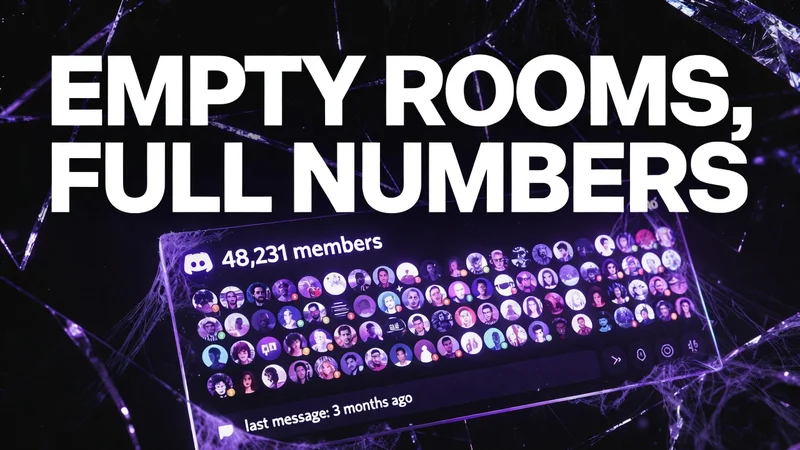
Nothing happened. The growth was never real to begin with. The uncomfortable thesis: most Web3 “communities” aren’t communities. They’re temporary crowds of people extracting value, and the moment the extraction stops, so does the crowd.
The industry has built an entire growth playbook (quests, points, airdrops, engage-to-earn), that manufactures the appearance of belonging without ever creating the thing itself. Everyone uses this because it is the business model. Below are four mechanisms that make this collapse structural.
Task Farming
Paying People to Pretend to Care “Quest platforms” like Galxe, Layer3, and Zealy turned community participation into piecework: follow this account, retweet this post, join this Discord, and get points redeemable for a future airdrop. What it actually built was a mercenary labor market.
An 0xScope Labs analysis found Galxe logged more than 100,000 daily active wallets on multiple occasions over a recent 12-month period, before that number fell to below 20,000 just days after each peak. It is happening because a task queue emptying out the moment the reward is claimed. Airdrops make the incentive explicit, and people respond exactly as incentivized.
When Arbitrum ran its $1 billion ARB airdrop in March 2023, independent researchers at X, ran a clustering analysis on the eligible wallets and identified more than 279,328 addresses belonging to the same underlying entities, and 148,595 addresses classified as high-confidence Sybil accounts, together accounting for ~47.96% and 21.8% of the airdropped tokens respectively. In other words, a fifth of the “community” that supposedly earned Arbitrum’s governance token wasn’t a community, and Arbitrum’s own anti-Sybil model reportedly missed a huge share of it.
Task farming succeeds perfectly at what it’s designed to do: generate metrics. It just was never designed to generate an active web3 community.
Vanity Engagement
Discord member counts, X (Twitter) followers, unique active wallets, these are the KPIs projects report to investors and use to justify valuations. None of them measure whether anyone actually cares about the project.
friend.tech is the cleanest case study of vanity engagement collapsing on contact with reality. It launched in August 2023 and became, briefly, one of the highest-revenue apps in crypto. According to TechCrunch’s analysis of Dune Analytics data, activity declined 95% from a peak of almost 39,000 daily transactions on August 21 to about 1,400 within a week.
It had a second wave of hype through September, then kept sliding:
- by mid-November, daily transactions crashed to 5,160, down from a September peak of 539,810 (99% peak-to-trough drawdown).
- by September 2024, according to DL News, friend.tech’s creators transferred admin rights to a null address, effectively shutting the protocol down. Daily new users had fallen to single digits, and daily fees (which once hit $2 million) had dropped to under $100, even as the founders walked away with $44 million in accumulated fees.
This project also proved that revenue and headline user counts can be almost entirely detached from durable community.
DappRadar’s own Q3 2025 industry report found the “Social” segment of Web3 apps dropped from 15.9% to 8.4% market share of daily active wallets in a single quarter, even as the broader dapp industry saw active wallets fall 22.4% overall.
DappRadar, the very platform that tracked all these vanity metrics for seven years, shut down in November 2025, with its founders citing a business model that no longer matched a market environment where the cost structure of running the platform had become financially unsustainable.
Dead Discord Syndrome
Ask anyone who’s spent time in NFT or gaming Discords: the server is still there, the member count still says “42,000,” and the general channel hasn’t had an organic message in three months. This is Dead Discord Syndrome and I call it as the infrastructure that outlives the community it was built for, because member count is a lagging, near-permanent metric that nobody bothers to correct.
StepN, the move-to-earn app peaked with hundreds of thousands of participants and a multi-billion-dollar valuation for its GMT token. Data from Dune Analytics shows monthly active users peaked at 705,452 in May 2022 before dropping to just 42,965 by February 2023 (decline of ~95%).
On the BNB Chain version, the collapse was even bigger: active players fell ~96% in two months, with the flagship Solana version dropping 80% from ATH of 104,149 users to 20,777. The Discord, the X account, the branding stayed online, but the community had already left for the next farm.
Unlike a token price, a member count doesn’t mark to market. It only goes up (new joiners, farmed accounts, bots) and almost never explicitly goes down (people don’t “leave” a Discord, they just stop opening it). So the vanity metric keeps lying long after the underlying reality has changed, which is exactly why it keeps getting screenshotted in pitch decks.
Community ≠ Comments
This is the conceptual error of all three mechanisms above: treating reach as relationship. Community, in any sense that predates crypto, means people who show up when there’s no reward attached, who’d stick around through a bad quarter, who identify with the group rather than extract from it.
Task farming optimizes for transactions. None of these mechanisms were ever measuring whether people actually cared and the moment the incentive disappears, so does the behavior, because there was never anything underneath it to begin with.
What Actually Survives
Not every Web3 community dies, and survivors all share one thing that never shows up on a dashboard: nobody joined for the token. Strip the incentive away and most “communities” evaporate in a week because that’s all they ever were, a crowd renting attention for a payout.
What’s left standing is smaller, uglier on a chart, and doesn’t care. People still shipping code, still answering questions, still showing up to a project three bear markets deep, for no reason a spreadsheet can explain. You can’t farm that. You can only build it. That’s the whole point.