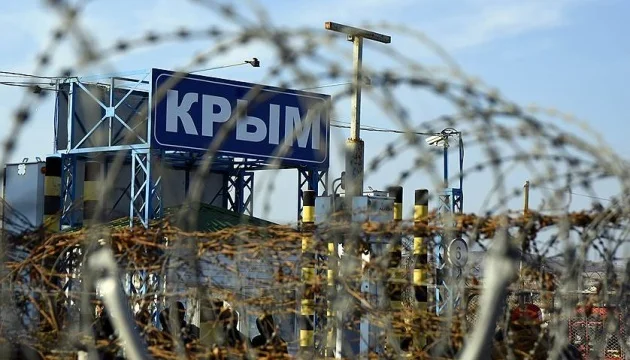
This view was expressed in an interview with Ukrinform by Colonel Markus Reisner of the Austrian Armed Forces, head of the Officer Training Institute at the Theresian Military Academy.
“Ukraine is now trying to use drones to create the very same situation it wanted to achieve in 2023 with a ground offensive: to isolate Crimea. The strategy is to create the same logistical nightmare that was hoped for back then—one that could actually force Russia to the negotiating table. It is precisely this plan that is now being implemented,” Reisner said.
He recalled that during the 2023 counteroffensive, Ukraine planned to advance in the Zaporizhzhia region toward the Sea of Azov, cut off Russia’s land-based supply lines, and combine this with a strike on the Kerch Bridge.
“The operational plan was to cut off Crimea from supplies and create a real logistical nightmare for Russia,” the military expert noted.
According to him, Ukraine has only recently launched a larger-scale campaign against vessels of Russia’s shadow fleet in the Sea of Azov.
“In my opinion, it’s surprising that this campaign has only just begun, so late. Experts have also long wondered why Ukraine has been targeting primarily land corridors and supply routes, but not the ships of the shadow fleet in the Sea of Azov,” said Reisner.
He noted that, according to various reports, up to 150 vessels may have been struck, but there is no reliable data on the number of ships that were seriously damaged or sunk, and some of them may have been attacked multiple times.
“But the main point is that the Sea of Azov is increasingly becoming an area where Russia can no longer move freely. Even if some vessels were attacked repeatedly, the Ukrainian figures and videos that are regularly published indicate a significant impact and a growing problem for Russia,” he emphasized.
Read also:
Austrian expert: Trump may keep up pressure on Ukraine over Patriot missile shortage
At the same time, Reisner noted that Russia is also attempting to disrupt Ukrainian logistics by attacking critical infrastructure, gas stations in frontline regions, railways, locomotives, and grain ships in the Black Sea.
“In this regard, I would like to mention General Zaluzhnyi (former Commander-in-Chief of the Armed Forces of Ukraine), who is currently the ambassador to the United Kingdom. He rightly pointed out that Russia must not be underestimated and that the war is not yet over. Russia remains capable of springing new surprises,” Reisner noted.
As previously reported, Commander of the Unmanned Systems Forces Robert Brovdi (Madyar) reported that on the night of July 20, USSF units struck seven vessels of Russia’s shadow fleet in the Azov and Black Seas. In total, since July 1, as part of Operation “MoLoChKa,” the Unmanned Systems Forces have struck 119 vessels of the Russian Federation’s shadow fleet in the Sea of Azov and 64 in the Black Sea.
Photo: Main Intelligence Directorate