Sign in. It’s quick, free and it’s up to you.
An account is an optional way to support the work we do. Find out more.
Media outlets across Europe – including The Journal – have worked together to produce a series of articles on Ukraine, Moldova and the EU, covering areas such as security, disinformation, and this one, on population changes in those two countries.
IN THE SECOND season of Servant of the People, the TV series in which Volodymyr Zelensky plays a history teacher who becomes president of Ukraine, it is announced that the European Union has approved visa-free travel for Ukrainian citizens, marking a first step towards EU membership.
The next day, the President finds himself all alone in Ukraine, because all his fellow citizens have left. Back in October 2017, this story may have felt gently ironic; now, Kyiv is still eager to join the European Union, and Ukraine is genuinely emptying out.
The country faces a dual crisis: its population has been declining for over 30 years, and the Russian invasion has only accelerated this trend.
The global population is projected to decline in the coming decades, but according to Oleksander Gladun of the Ptoukha Institute for Demography and Social Studies of the National Academy of Sciences of Ukraine, “What is unique is the situation in which Ukraine finds itself.”
As early as 2023, the Kyiv Independent ran the headline “Demographic disaster: Ukraine’s biggest post-war threat”.
As Gladun points out, “mortality [during wartime] also rises due to worsening chronic illnesses, stress and, in some cases, the inability to receive timely medical care”. At the same time, birth rates fall, “people postpone the decision to have children. It’s a natural reaction”.
According to data published by the Ukrainian Ministry of Justice and cited by the Kyiv Independent, in 2024 Ukraine recorded 495,090 deaths. This figure is nearly three times higher than the number of births.
“The population of Ukraine has been declining since 1993,” Gladun explains. “The war has greatly accelerated this process. According to our forecasts, the population will continue to decline. However, the pace of this decline depends on the year and conditions under which the war ends.”
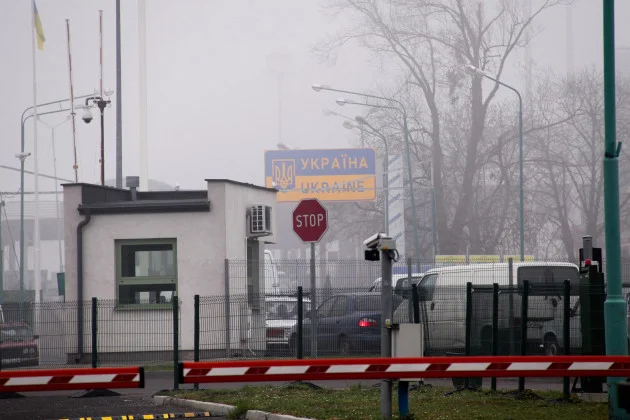
According to the Kyiv-based Centre for Economic Strategy (CES), at the start of this year, 5.6 million Ukrainians were refugees living abroad. Of these, four million left Ukraine via the western borders.
“We also have over 4 million internally displaced persons,” adds Gladun. “Therefore, more than 10 million people have left their homes, which is around 20% of the pre-war population.”
In late August 2025, the Ukrainian government liberalised cross-border movement for men aged between 18 and 22, and allowed men aged 23 and over living abroad to return temporarily to Ukraine. Up to that point, martial law in force since the start of the Russian invasion in 2022 had prohibited all men aged between 18 and 60 from leaving the country, with rare exceptions.
The aim was to ensure the army had a sufficient number of recruits. “We want Ukrainians to maintain as many ties with Ukraine as possible,” Prime Minister Yulia Svyrydenko said.
Yet according to data from the CES, approximately 96,000 men emigrated between August and November 2025.
The CES estimates that between 1.3 and 2.2 million people could return to Ukraine once the war ends, depending on the scenario.
“The decision to return will be influenced by a whole range of factors: the availability of housing in Ukraine, employment opportunities, social infrastructure for children, etc,” Gladun says.
A key factor is how and under what conditions the war will end. “Two years ago a survey showed that 25% more people would return if the war ended within the 1991 borders than if it ended along the current front line,” says Gladun.
It is a widely held view “that if the war ends at the front line, the Russian Federation will resume it in a few years.”
According to Iryna Ippolitova of the CES, “Currently we see that young people under 35 are much less likely to return to Ukraine than older people, especially those over 50.”
Factors include better integration in host countries, economic factors such as jobs and salaries, and most importantly, security risks.
Currently, Ukrainians benefit from “temporary protection” in EU countries. This special status allows Ukrainians to study, work, and access the national healthcare system. Introduced in March 2022, it is set to expire in March 2027.
For the moment, it is not known what EU countries will do after this date. German Chancellor Friedrich Merz has already reiterated that he wants to limit the number of Ukrainian men seeking asylum. The plan is to facilitate the return of refugees to their homeland, so that “they can help their own country”, he says.
Ukraine wants to join the EU, but according to Ippolitova, it is difficult to clearly predict the effects of that move, if and when it occurs.
“The experience of Central European countries suggests that some people may leave, as they will gain the opportunity to work legally in the EU,” she says.
However, freedom of movement may also “encourage some migrants to return and support circular migration among Ukrainians who currently do not consider returning because they are afraid of losing their right to work and live in the EU”. At the same time, Ippolitova adds, “Ukraine could attract professionals from the EU during the reconstruction phase”.
In terms of security, which is a central question for Ukraine, “EU membership would strengthen Ukraine’s economic and institutional resilience and deepen its integration into European security frameworks”.
At the same time, Ukraine “contributes significantly to European security through its defence capacity, strategic position, and experience in countering external threats”.
Antonina (27) has been in Italy with her mother since 2022. “I’d say I’d go back if I were lucky enough to find a good, well-paid job in Ukraine,” she says. “But at the moment, Ukraine’s economy has deteriorated.
“One of the main reasons is that we don’t know when the war will end. We don’t know if we’re at the beginning or right in the middle of it. I don’t want to put my life on hold. I believe the right thing to do is to start my career, and perhaps I’ll be successful, perhaps I’ll meet my partner and start a family.”
“When someone dies, according to local tradition, eight men should dig the grave,” says Moldovan sociologist and journalist Vitalie Sprînceană. “But in some villages, you can hardly find eight adult men.”
There is a lack of gravediggers, a lack of doctors; the Moldovan population is ageing, and in the future there might not be enough taxpayers to sustain low pensions and underfunded public services.
Moldova, which was hit by a severe and long-lasting economic crisis shortly after gaining independence from the Soviet Union, is among the poorest countries in Europe. It is also among the fastest-depopulating countries in the world, with one-in-four Moldovans living abroad. Now the state is trying to entice its citizens back.
The European Union opened accession negotiations with Moldova in December 2023, with the Moldovan government hastily adopting EU-required reforms and hoping to conclude an accession treaty by 2030.
The continuation of European integration was narrowly but ultimately confirmed in 2024 by a referendum on enshrining the promise of EU integration into the Moldovan constitution, and presidential elections.
However, those elections would have turned out differently were it not for the votes of the Moldovan diaspora, which today numbers approximately one million people.
Mass emigration for work began in the 1990s and has continued since. Another wave of emigration hit Moldova in 2014, fuelled by the introduction of visa-free travel to the EU and a widespread loss of faith following a huge corruption scandal.
“One of the dominant narratives is the claim that ‘the best have left’,” Sprînceană says. “There is a grain of truth in that: since the nineties, doctors, engineers, teachers and scientists left to perform jobs in the West far below their qualifications.”
In 1991 the population of Moldova was nearly 4.5 million. Today fewer than three million people inhabit the country. Every fifth child in the country grows up with only one parent, or even without parents at all.
According to sociologist and migration expert Alexandr Makuhin, a reversal of the emigration trend is not happening. Between 2020 and 2025, the country lost more than 200,000 people.
“Those who do return do so primarily for personal reasons,” he says. “Many of those who left, conversely, already feel more strongly attached to their adopted country—by work, a house, a family.”
“Government programs aimed at the diaspora often focus on culture, trying to play on nostalgic feelings: you are Moldovan, come back to your country, we will welcome you here! It may sound cynical, but the most effective way to get the diaspora to return is economic support.”
One person who has returned is Vlad Vedrașco, a 38-year-old who previously lived and worked in the US.
“Coming back to Moldova is like returning to the Wild West, like going to California during the Gold Rush,” he says.
“It is not easy at all. But now is the best time to come back. You have to work like a horse for a year or two, to prove yourself—and you’ll start making enough money for a life more comfortable than you would have in the United States or Europe.”
Alina, a French teacher who has previously lived with her husband in Rome, remembers exactly how much time she spent abroad: five years, eight months, and two days. “It was an opportunity to learn so many things; it opened my horizons,” she says. “We integrated well… but in your native land, you breathe differently.”
Reporters: Francesca Barca (Vox Europ) and Petra Dvořáková (Deník Referendum)
This piece contains elements from this article in Vox Europ and this article published by Deník Referendum.
To embed this post, copy the code below on your site