POSCO Group unveiled a long-term strategy to accelerate sustainable growth by expanding beyond steel into critical resources.
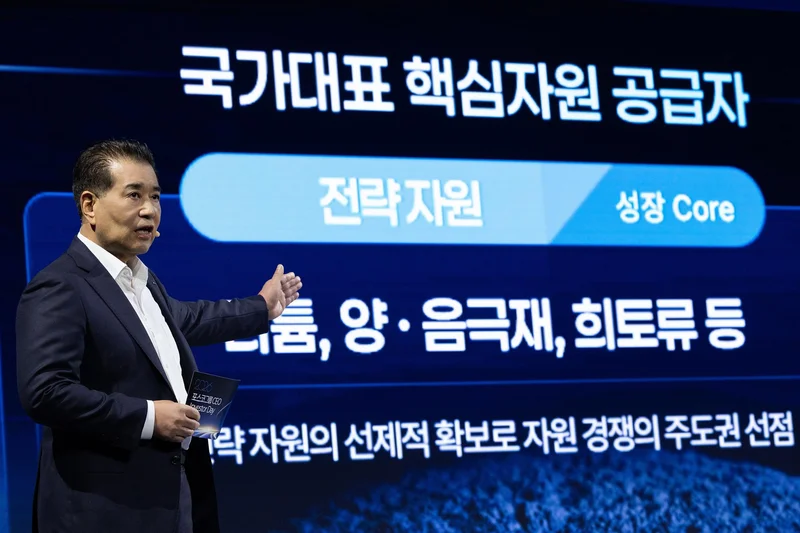
Speaking at the company's CEO Investor Day event in central Seoul on July 2, Chairman Chang In-hwa outlined a three-pronged strategy centered on steel, strategic resources and energy resources. He said the company aims to position itself as Korea's leading supplier of critical resources.
"Now is the time to create new growth opportunities through bold innovation of our business portfolio as supply chain instability and the acceleration of the low-carbon transition intensify external uncertainties," Chang said.
"We will expand the scope of our business from steel and materials to resources and lead efforts to strengthen the nation's industrial security and supply chains."
He said the group seeks to achieve 187 trillion won ($127.8 billion) in revenue and 13.1 trillion won in operating profit by 2035.
The group aims to increase its annual lithium production capacity to 173,000 metric tons by 2033, positioning itself among the world's top five lithium producers, while targeting more than 1.8 trillion won in operating profit from the business by 2035.
Its brine lithium operation in Argentina turned profitable in March, and recently secured approval under the country’s Large Investment Incentive Regime (RIGI), strengthening its earnings outlook.
The company also plans to accelerate phase 3 and phase 4 expansion of its brine lithium operations to reach an annual production capacity of 100,000 metric tons by 2033.
In steel, POSCO plans to expand production capacity by 10 million tons by 2031 in high-growth markets including India, the United States and Indonesia. Profits generated overseas will be reinvested in domestic low-carbon transition projects.
The group also plans to expand liquefied natural gas trading, develop renewable energy projects including domestic offshore wind and overseas solar power and commercialize physical artificial intelligence (AI) technologies for manufacturing and industrial processes based on its expertise in automation and industrial data.
To support the strategy, it plans to invest 16.7 trillion won in future growth projects between 2026 and 2028.
The company said it also aims to optimize its stakes in listed subsidiaries to around 50 percent, and using the proceeds to fund strategic resource investments, while allocating about 10 percent of disposal proceeds for share buybacks and cancellations.