- Do you have a story? Email eliana.silvergokun@dailymail.co.uk
- See more Daily Mail on Google - save us as a Preferred Source
A Spanish lawyer has warned British buyers to 'trust no one' after his clients were duped into paying for a villa in Spain they later discovered was part of an illegal development facing demolition.
After paying €150,000 (£128,000) towards what they believed would be their forever home in Gea y Truyols, Murcia, the couple began moving furniture and personal belongings into the newly built villa.
But before the sale could be completed, an independent lawyer uncovered a series of planning issues that had never been disclosed to the couple, revealing the property was subject to an active demolition order and, legally, amounted to little more than a plot of land.
The couple, who are in their seventies and eighties and spent much of their life savings on their dream retirement home, are now fighting to recover the money they invested after pulling out of the purchase.
Their case comes after the Daily Mail revealed last week how dozens of British buyers were duped into purchasing illegal homes in the same Murcia development, La Montana, with many later facing eviction, court battles and years of uncertainty.
Now, the Spanish lawyer representing another British couple caught up in the saga says their experience should serve as a warning to the thousands of Britons considering buying property overseas.
Alberto Nuñez Lopez, a property and planning lawyer from the firm Senent Blanco and Asociados based in Alicante, believes the problem is not simply illegal developments, but the way foreign buyers are persuaded that everything is above board before it's too late.
'People assume that because someone speaks their language and presents themselves as their adviser, that person is acting on their behalf,' he said. 'But that's not necessarily true.'
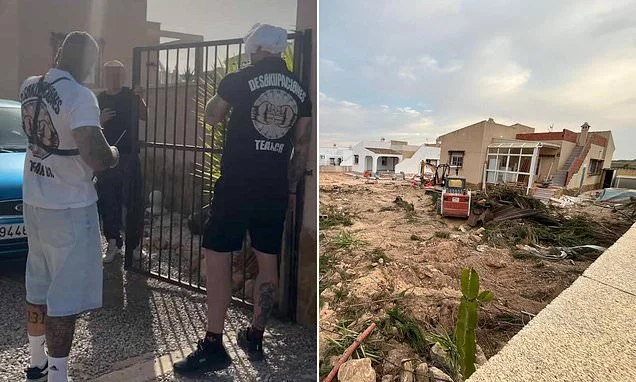
Debris left around the villas in Gea y Truyols, Murcia, during renovations carried out by the builder
Rubble left by one of the villas in the development during Tovar's renovations at La Montana
His clients' ordeal began in 2024, more than two decades after the first wave of British buyers purchased homes in La Montana in 2003.
Those original homeowners say they were later intimidated by squatter removal agencies and driven from their properties by builder Antonio Tovar, whose company, Concept Orihuela, renovated the villas before allegedly reselling them to unsuspecting buyers, including Nuñez's clients.
Like many Britons searching for a holiday home in Spain, the couple found the property through Channel 4's A Place in the Sun website.
They were soon introduced to one of Tovar's associates, a fluent English speaker who put them at ease, guiding them through the buying process and reassuring them that all the paperwork was in order.
'Naturally, foreign buyers feel much more comfortable dealing with someone who speaks their own language,' Nuñez says, 'That trust is then used to reassure them that everything is perfectly legal and in order, while important information is withheld.'
In his clients' case, the information they say was withheld was that the €300,000 villa they had agreed to buy was part of an illegal development subject to a demolition order.
Nuñez added: 'The villa itself, along with all the additional structures needed for a functioning home, such as facilities providing electricity and water, as well as the swimming pool, fencing and other features, was completely illegal.
'The reason was that the development did not comply with Spanish planning regulations and was already subject to an enforcement order.
'The Murcia City Council, which is the competent authority, had ordered the demolition of all those structures.'
Instead of purchasing the fully legal villa they believed they were buying, the couple had essentially acquired little more than a plot of land.
According to Nuñez, Tovar's company had been aware of the planning issues for years but continued targeting elderly British buyers unfamiliar with Spain's planning system.
'If you were buying a property for, say, €200,000, and someone told you: "By the way, there's a demolition order hanging over it, but don't worry, nothing will happen," well, naturally, you'd think twice before buying it. But they completely omit the true seriousness of these planning problems.'
According to Nuñez, Concept Orihuela also directs buyers to its own legal advisers.
In Spain, these professionals are known as 'solicitors' and specialise in handling property transactions rather than litigation.
He says that buyers are introduced to solicitors with links to the company, rather than independent professionals acting solely in their interests.
'The professionals supposedly representing the buyers either don't want to disclose the issues, don't understand them themselves, or simply take the easiest route,' Nuñez says.
'After all, many estate agents are primarily interested in earning their commission.'
After paying a €150,000 deposit, the couple began to suspect something was wrong when they discovered the property would have to rely entirely on solar power because there was no municipal infrastructure connecting it to essential services.
Concerned, they sought a second opinion from an independent lawyer, who quickly identified that the transaction was missing a Licence of First Occupation, also known as a Certificate of Habitability.
This is a crucial legal document confirming that a property complies with planning regulations and is legally fit to be occupied.
In addition, they then found out that the property, which sits within Gea y Truyols, is an area officially classified as a military strategic zone.
'That means that non-EU nationals who want to buy land there must first obtain military authorisation, issued by the relevant ministry, before they can legally purchase the property.
'Yet something as important as this was never mentioned to the buyers,' Nuñez said.
Nuñez, alongside lawyers Francisco J. Senent Blanco and Jorge Senent Girona, are now representing the couple in an attempt to recover their €150,000 deposit.
An aerial view of the La Montana development in Murcia
Alberto Nuñez Lopez, a property and planning lawyer from the firm Senent Blanco and Asociados based in Alicante, believes the problem is not simply illegal developments
Murcia is a hotspot for British expats looking to purchase abroad
The original homeowners say they were later intimidated by squatter removal agencies and driven from their properties by builder Antonio Tovar
Drawing on what he says are the mistakes that trapped his clients, he has issued a series of warnings for Britons hoping to buy property in Spain, urging them to carry out independent legal checks before committing to a purchase.
'The first thing is not to trust anyone,' he said. 'That would be the first rule: don't trust anyone.'
He clarifies that he is not suggesting buyers become cynical, but that they independently verify every claim before handing over what is often their life's savings.
Nuñez added: 'The second thing is to make sure you're represented by your own independent lawyer.
'Never use a lawyer recommended by the seller, the estate agent or the developer. You should always have someone whose only obligation is to protect your interests.'
He also warns buyers never to rely on verbal assurances. Instead, they should insist on seeing planning documents, permits and the Licence of First Occupation, while ensuring the property's legal status is independently checked.
'If someone avoids answering your questions or gives vague answers, that should immediately make you suspicious,' he adds.
Another major red flag, he says, is pressure. 'The first indication that there may be something wrong with the transaction is if they put a lot of pressure on you and insist that everything has to be completed as quickly as possible.'
He says buyers are frequently told that other purchasers are waiting and that they must pay immediately to secure the property.
'That doesn't necessarily mean there's always something wrong,' he said. 'But it should make you stop and think.'
The lawyer also advises buyers to visit the property themselves before completing any purchase, inspect it thoroughly and never sign a power of attorney without fully understanding exactly what authority they are handing over.
For Nuñez, older foreign buyers can be particularly vulnerable. His clients spent decades working before deciding to retire in Spain, making the purchase of a villa their largest ever investment.
'They're investing money in Spain. They're contributing to our economy. And then someone takes advantage of their lack of knowledge to deceive them and exploit them.'
His clients, aged between 75 and 85, had hoped to spend their retirement enjoying Spain's climate. Instead, they remain in Britain while legal proceedings continue.
'What should have been one of the happiest chapters of their lives has instead become a very negative ordeal,' he said.
Despite the case, Nuñez insists prospective buyers should not abandon plans to move to Spain.
'Moving to Spain is safe,' he said. 'This is an exceptional situation. The important thing is simply to take the necessary precautions, obtain independent legal advice and make sure everything has been checked before signing anything.'
'If buyers do that, they shouldn't be afraid of buying property in Spain.'
Antonio Tovar and Concept Orihuela have been contacted for comment.